Surging Domestic and International Orders Including Europe
Hwaseong 2 Plant Parallel Production Under Review
Mass Production Starting Late This Year to Early Next Year
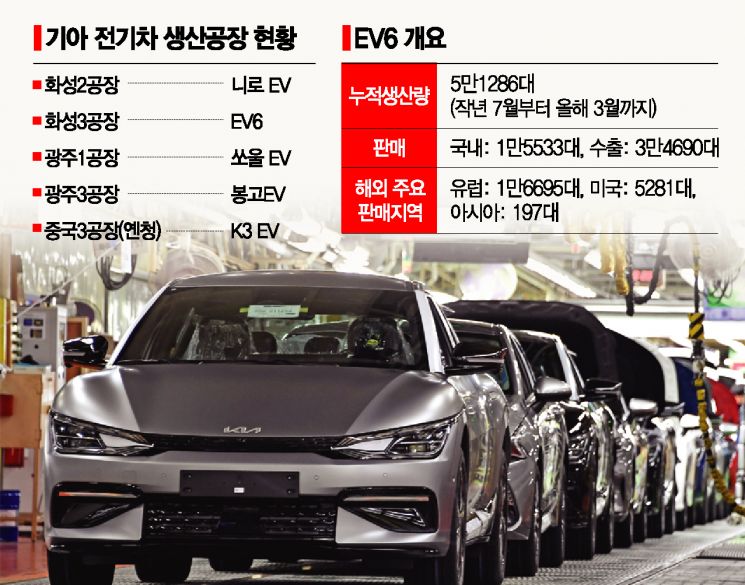
[Asia Economy Reporter Choi Dae-yeol] Kia has decided to expand the production plant for its dedicated electric vehicle EV6. This decision comes as orders have surged not only domestically but also across various European countries, making it difficult to meet demand with the current production capacity. It is interpreted as a strategic move to quickly respond to market demand if conditions improve to increase production when the supply of automotive semiconductors normalizes around the end of this year or early next year.
According to industry sources on the 22nd, Kia recently proposed to the Hwaseong plant labor union a plan to produce the EV6, currently manufactured at Plant 3, concurrently at Plant 2. To this end, construction for concurrent production must be completed by October, and mass production should begin from the end of this year or early next year. The deployment of production line personnel and allocation of volume will require negotiations between labor and management.
Concurrent production refers to producing the same model simultaneously at different plants or lines, even if the volume is not originally assigned to that specific plant or line. Typically, finished vehicle assembly lines are dedicated to individual models for final assembly. While having one model per line is efficient in terms of cost reduction and unit productivity, it has the drawback of being inflexible in responding to market changes. Concurrent production, which divides volume across plants, or mixed-model production on a single line, allows flexible responses to market demand as needed.
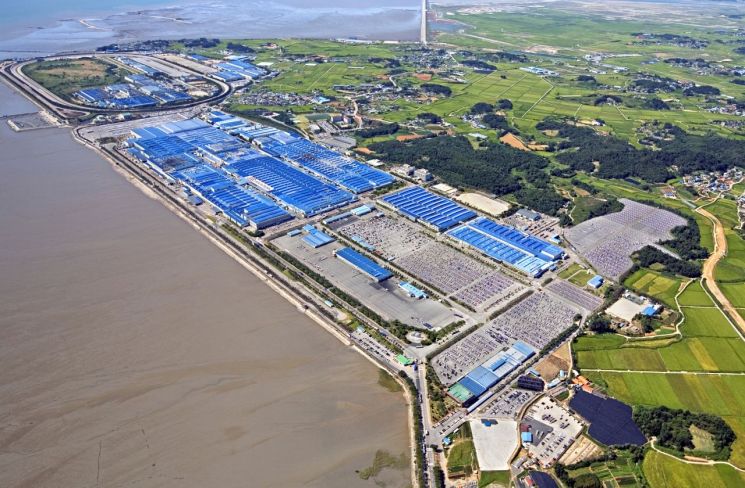
According to the company, the EV6 is currently produced at Hwaseong Plant 3, which also manufactures sedans such as the K5 and K8. Plant 1 produces the compact sedan K3 and SUVs Sorento and Mohave, while Plant 2 manufactures the K3 and compact SUV Niro. The annual production capacity of the Hwaseong plant is approximately 180,000 to 190,000 units per plant, totaling around 560,000 units. Last year, about 500,000 units were produced. However, actual production fell short due to disruptions in parts supply.
The EV6 is Kia’s first dedicated electric vehicle, built on Hyundai Motor Group’s dedicated electric vehicle platform (E-GMP). Although it differs slightly in specifications from the earlier released Hyundai Ioniq 5, they share the same platform as sibling models. Domestically, the Ioniq 5 sells slightly more, but the EV6 leads in export volume. From the beginning of this year through last month, 16,341 EV6 units were exported, surpassing the Ioniq 5’s 12,423 units. It holds the highest export record among domestically produced electric vehicles. Especially in Europe, where demand for electric vehicles is high, the EV6 has been recognized for its quality, winning the European Car of the Year award after its launch in the second half of last year, and its sales performance has been solid.
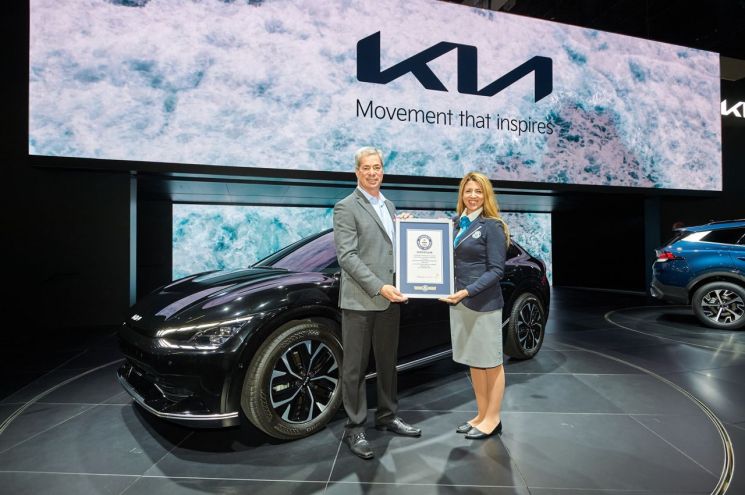 'The electric vehicle that crossed the United States with the shortest charging time' entered the Guinness Book of Records, Kia EV6
 However, as with the domestic market, prolonged production disruptions have prevented timely fulfillment of the backlog of orders. Mass production began in earnest in July last year, with production reaching 30,000 units by the end of the year and about 20,000 units produced in the first quarter of this year, averaging 6,000 to 7,000 units per month. Given that the semiconductor shortage, which has hampered the global automotive industry, is expected to ease by the end of this year or early next year, preparing for concurrent production now is intended to establish a foundation to immediately increase production once parts supply stabilizes. The labor union has stated that "further discussion is needed regarding concurrent production at Plant 2 while overtime work is not possible at Plant 3."
© The Asia Business Daily(www.asiae.co.kr). All rights reserved.
![Clutching a Stolen Dior Bag, Saying "I Hate Being Poor but Real"... The Grotesque Con of a "Human Knockoff" [Slate]](https://cwcontent.asiae.co.kr/asiaresize/183/2026021902243444107_1771435474.jpg)


















