[Seoul District News] Yangcheon-gu Mokdong's Representative Park 'Pari Park' Renovation Completed, Full Opening on April 23... Presenting a New Urban Park Vision Combining Tradition and Smart Technology, Reborn as a Complete Green Oasis in the City Center, New Resident Complex Cultural Community Space 'Salon de Paris' Constructed, Diverse Cultural Programs Operated... Works of 'Genius Sculptor' Kwon Jin-gyu Revealed at 'Seongbuk Village Archive'

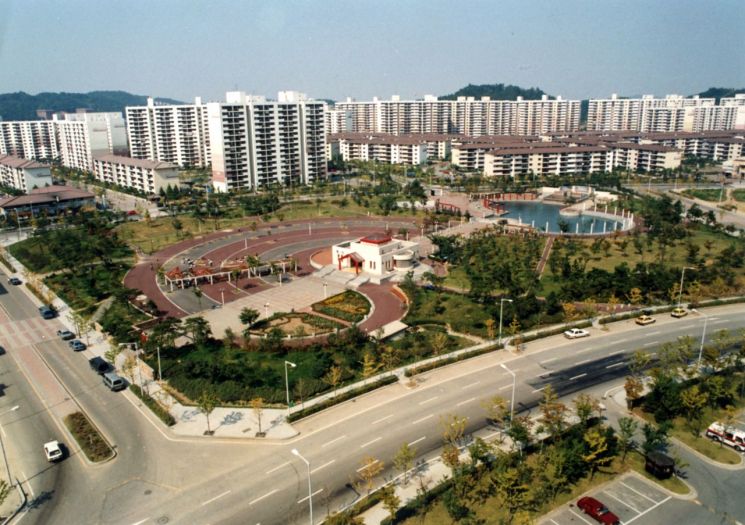
[Asia Economy Reporter Park Jong-il] The renovation of Paris Park in Mok-dong, Yangcheon-gu (Mayor Kim Soo-young) has been completed and will be fully opened on the 23rd.
Paris Park is one of the five central axis parks in Mok-dong, created during the development of the new town in Mok-dong, Yangcheon-gu, and was established to commemorate the 100th anniversary of Korea-France diplomatic relations.
Since 2018, Yangcheon-gu has planned a customized refurbishment of Paris Park, conducted basic and detailed design services in 2020, and began construction last August to carry out the renovation.
In particular, from the design conception stage, the district sought advice from various experts and collected residents' opinions to reflect the symbolism and historical significance of Paris Park.
The park, created to commemorate 100 years of history, has served as a place of rest, comfort, memories, and recollections for many people over more than 30 years. As history is described as a "continuous dialogue between the past and present," Paris Park, which was conceived in 1886, established in 1987, and continued until 2022, has itself become history.
Looking into the history of Paris Park, in 1986, the heads of state of Korea and France, as allied countries, agreed to build Seoul Plaza in Paris and Paris Plaza in Seoul. The park, which opened in July 1987 by remodeling a neighborhood park in the Mok-dong new town, is Paris Park. Designed to symbolize exchange and friendship between France and Korea, Paris Park emphasized sculptural form and design, becoming a symbolic space of great significance in the history of Korean parks and landscaping.
At that time, Paris Park created Seoul Plaza, Paris Plaza, and Hanbul Madang (Korea-France Yard), harmonizing Korea and France. The park featured a Taegeuk pattern on the ground and a French embroidery flower bed, embodying the spirit of diplomatic relations between the two countries.
The newly renovated Paris Park in 2022 first inherited its symbolism with an Eiffel Tower sculpture representing France and a French-style embroidery flower bed. The existing symbolic spaces such as Seoul Plaza, Paris Plaza, and Hanbul Madang maintained their overall framework, while the Korean Geon-Gon-Gam-Ri pattern was newly introduced into the Hanbul Madang paving, and the circular walking path was reorganized. Additionally, a mirror pond and ground fountain were created to enhance the water-friendly space.
Future-oriented elements were also introduced to the park. Using IoT sensors, fine dust is blocked and air purified, and a smart pergola with cooling and heating functions according to external temperature was installed to allow visitors to enjoy the park more comfortably. A smart bench capable of charging smartphones via solar power was also built.
Furthermore, 'Salon de Paris,' reflecting the unique cultural and artistic characteristics of Paris Park, was newly created. This space will be operated as a community area for residents, offering cultural programs, education, and exhibitions in collaboration with the French Cultural Center. The lawn yard established in 1987 was restored, preserving its location and shape, and outdoor exercise facilities were arranged while maintaining the existing forest of trees.
Thus, the renovation of Paris Park harmonizes historic significance, everyday life, tradition, and the future. While maintaining the symbolic sculptural beauty passed down from the past, it coexists with the daily lives of future users and the cultures of Korea and France, applying future-oriented smart technology to a traditional space. It has been reborn as a complete green resting place in the city where past, present, and future connect.
Additionally, on the opening day of Paris Park, the 23rd, a commemorative event celebrating the new beginning of the park will be held at 1:30 PM. Besides pre-ceremony performances featuring traditional music from France and Korea, the park will be filled with various attractions and activities such as French embroidery exhibitions, wine exhibitions and tastings, Korean traditional jang (fermented sauces) sales, and face painting.
An archiving exhibition titled "The Vision, Records, and Newness of Paris Park" (Re-novation, 1987~2022) will also be held for about two months at Salon de Paris. This exhibition offers a comprehensive view of the original design plan from 35 years ago, the changes over time, and the newly presented park design, allowing visitors to reflect on the meaning and value of Paris Park.
Going forward, the district plans to promote various cultural events within Paris Park to facilitate communication among residents across generations. This reflects the urban residents' desire to enjoy nature and unique culture even in nearby locations. Similarly, Yangcheon Park, which completed its renovation in 2020, has received great responses from residents by operating diverse park cultural programs that span generations, including ecological exploration, forest walks, concerts, and seasonal park festivals.
Yangcheon-gu's parks represent a concept that goes beyond simply using cultivated spaces. The district operates a volunteer platform called "Friends of the Park," consisting of about 100 residents who maintain and manage the parks themselves, enhancing their value. In the case of Paris Park, volunteer "Paris Park Happiness Keepers" participate in activities such as operating the park's "Book Rest Area," voluntarily creating park culture.
A district official stated, "Yangcheon-gu is realizing a 'Garden City' by connecting mountains, parks, and paths to make the entire city a forest, park, and trail. Paris Park, which has stood in the apartment forest of Mok-dong for nearly 35 years, will proudly serve as a landmark of Yangcheon, beyond being a space for rest and communication, with its historical and symbolic significance."
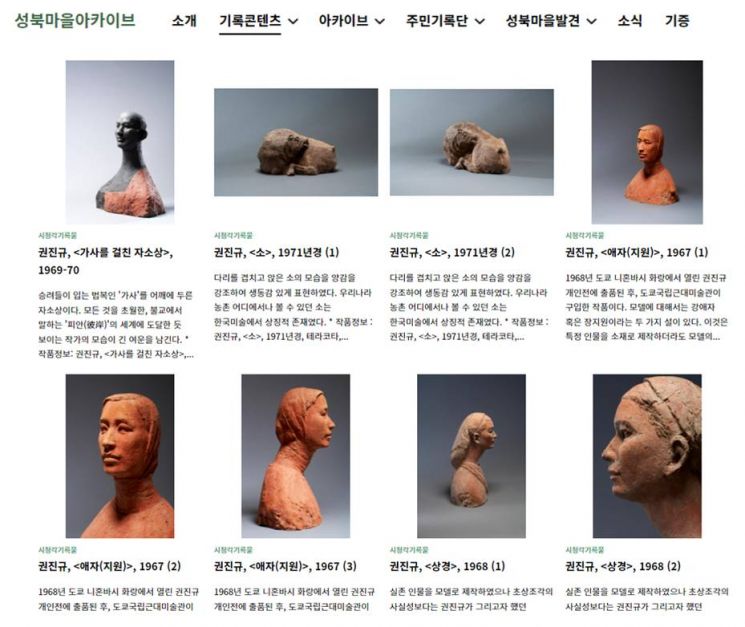
Seongbuk-gu and Seongbuk Cultural Center have released numerous high-resolution images of sculptor Kwon Jin-gyu’s works on the local archive website Seongbuk Village Archive to commemorate the 100th anniversary of his birth.
Kwon Jin-gyu (1922?1973) was a sculptor who explored terracotta and dry lacquer (ganchil) techniques, leaving a distinct mark on modern and contemporary Korean sculpture history, and had a deep connection with Seongbuk-gu. He began his art education in 1947 at the Seongbuk Painting Research Institute (currently Dongso-mun-dong 3-ga), and after returning from studying in Japan, he personally built a combined studio and residence atelier at 250-1 Dongseon-dong 3-ga in 1959.
Accordingly, Seongbuk-gu and Seongbuk Cultural Center collected materials focusing on images of works created during Kwon Jin-gyu’s Dongseon-dong period (1959?1973), when he established Korean realism sculpture. In 2009, they received high-resolution photos from photographer Lee Jung-hoon, who had taken pictures of Kwon Jin-gyu’s works held in various locations domestically and internationally, including Seoul, Daegu, Busan, and Tokyo, Japan, with cooperation from the Kwon Jin-gyu Memorial Association. Since sculptures constitute a large portion, photos taken from multiple angles?front, side, and back?were secured to allow a three-dimensional examination of the works.
In addition to sculptures, images of various genres such as reliefs, oil paintings, ink paintings, and drawings were made public, providing a broad view of Kwon Jin-gyu’s artistic world. Photos capturing various parts of the Dongseon-dong Kwon Jin-gyu Atelier, where traces of his intense life and artistic activities remain, as well as related newspaper articles, are also available.
Jo Tae-kwon, director of Seongbuk Cultural Center, said, "Please look forward to the diverse content of Seongbuk Village Archive, which has undergone academic review, research, and curation of the materials."
A Seongbuk-gu official stated, "Seongbuk-gu is a region where many great artists, including Kwon Jin-gyu, have carried out creative activities. Based on this, we plan to discover various archive contents."
Records and images related to Kwon Jin-gyu can be found through the "Seongbuk by Theme" section on the Seongbuk Village Archive website.
© The Asia Business Daily(www.asiae.co.kr). All rights reserved.
![Clutching a Stolen Dior Bag, Saying "I Hate Being Poor but Real"... The Grotesque Con of a "Human Knockoff" [Slate]](https://cwcontent.asiae.co.kr/asiaresize/183/2026021902243444107_1771435474.jpg)













