US Washington DC Press Conference
"Mentioned 2nd Supplementary Budget While Explaining Our Economic Situation"... Fiscal Soundness Discussion Expected After New Government Inauguration
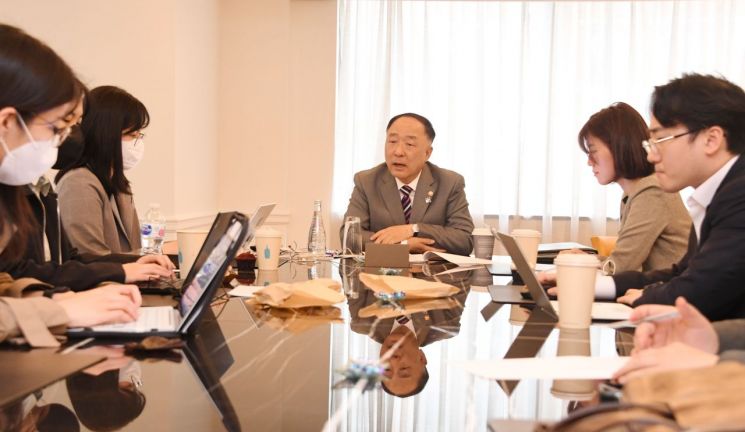
[Asia Economy Washington (USA) = Reporter Kwon Haeyoung] The international credit rating agency Standard & Poor's (S&P) is expected to discuss fiscal soundness issues through policy consultations after the inauguration of the next government, in relation to the second supplementary budget (supplementary budget) promoted by the new administration.
Hong Nam-ki, Deputy Prime Minister and Minister of Economy and Finance, announced this during a press briefing held in Washington DC, USA, on the 20th (local time), revealing the meeting with S&P.
Deputy Prime Minister Hong said, "While explaining our economic situation, I conveyed the fact that there may be a supplementary budget in the new government," adding, "S&P expressed their intention to hold policy consultations with the new government in June."
Currently, the Presidential Transition Committee plans to implement a supplementary budget worth tens of trillions of won immediately after the government takes office. Initially, President-elect Yoon Seok-yeol pledged to support small business owners affected by COVID-19 with 50 trillion won. Considering the first supplementary budget implemented in February, there is speculation that the scale of the new government's supplementary budget could reach the 30 trillion won range.
The Transition Committee's stance is to secure funds primarily through expenditure restructuring, but realistically, it is inevitable to raise funds through additional issuance of deficit bonds. This directly leads to an increase in national debt. Based on the first supplementary budget, the national debt stands at 1,075.7 trillion won, and the ratio to Gross Domestic Product (GDP) is 50.1%, which has increased by a staggering 14.1 percentage points from 36% in 2017, the first year of the Moon Jae-in administration.
As national debt rapidly increases and fiscal soundness deteriorates, concerns are growing both inside and outside the government that the national credit rating may be downgraded.
© The Asia Business Daily(www.asiae.co.kr). All rights reserved.
![Clutching a Stolen Dior Bag, Saying "I Hate Being Poor but Real"... The Grotesque Con of a "Human Knockoff" [Slate]](https://cwcontent.asiae.co.kr/asiaresize/183/2026021902243444107_1771435474.jpg)
















