Land prices rose by 0.91% but decreased by 0.05 percentage points compared to the previous year
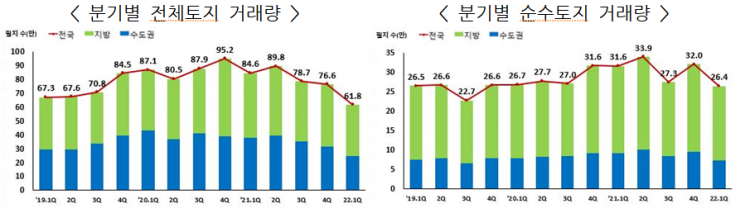
The volume of land transactions in the first quarter of this year sharply declined by about 27% compared to last year. This is analyzed to be due to a decrease in land purchasing demand as the real estate market's winter prolonged, along with reduced investment incentives caused by rising land prices.
According to the Ministry of Land, Infrastructure and Transport on the 22nd, the total land transactions (including land attached to buildings) in the first quarter of 2022 amounted to approximately 618,000 parcels (476.6㎢), a 19.3% (about 148,000 parcels) decrease compared to the previous quarter (about 766,000 parcels). Compared to the first quarter of 2021 (about 846,000 parcels), it sharply dropped by 26.9% (about 228,000 parcels).
The volume of pure land transactions, excluding land attached to buildings, was about 264,000 parcels (444.3㎢), decreasing by 17.6% compared to the previous quarter and by 16.4% compared to the first quarter of 2021.
Compared to the previous quarter, total land transaction volumes decreased in 16 cities and provinces, including Gangwon (32.7%), Gwangju (32.2%), and Daejeon (31.6%).
Pure land transaction volumes significantly declined in 16 cities and provinces, including Gwangju (47.0%), Gangwon (26.1%), and Incheon (24.3%).
It is interpreted that in recent years, land prices nationwide rapidly increased due to the real estate market boom and various development issues, but around events such as the presidential election, transaction volumes and prices entered an adjustment phase.
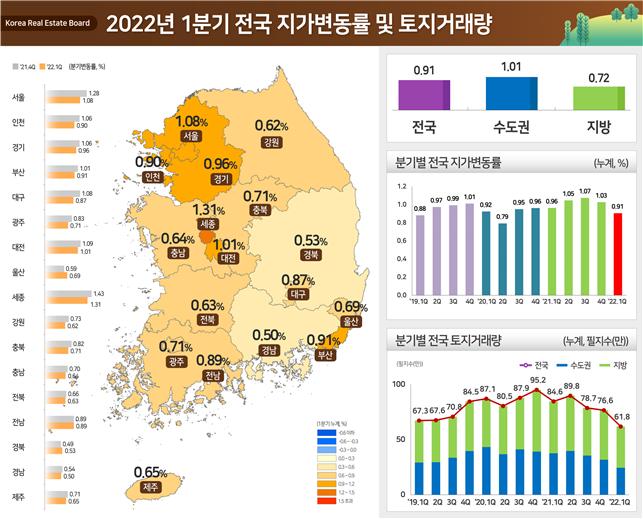
The rate of land price changes is also intensifying its downward trend. In the first quarter of 2022, nationwide land prices rose by 0.91%, which is 0.12 percentage points (p) lower than the 1.03% increase in the fourth quarter of last year, and 0.05 p lower than the 0.96% increase in the first quarter of 2021.
Compared to the previous quarter, the rate of change slightly contracted in both the metropolitan area (from 1.17% to 1.01%) and provincial areas (from 0.78% to 0.72%).
The land price change rates in Seoul, Gyeonggi, and Incheon recorded 1.08%, 0.96%, and 0.90%, respectively, showing levels higher than the national average (0.91%).
The rate of change in provincial areas was 0.72%. The rates in three cities?Sejong (1.31%), Daejeon (1.01%), and Busan (0.91%)?were higher than the national average (0.91%).
© The Asia Business Daily(www.asiae.co.kr). All rights reserved.


















