"Prosecution Normalization Through Separation of Investigation and Indictment Powers to Be Addressed in April National Assembly"
[Asia Economy Reporters Oh Ju-yeon and Park Jun-i] On the 21st, Park Hong-geun, floor leader of the Democratic Party of Korea, requested Speaker Park Byeong-seok to convene a plenary session of the National Assembly on the 22nd. This is interpreted as a step to push forward the prosecution reform bill, which centers on the separation of the prosecution's investigative and prosecutorial powers, known as 'Geomsu Wanbak' (complete removal of the prosecution's investigative powers).
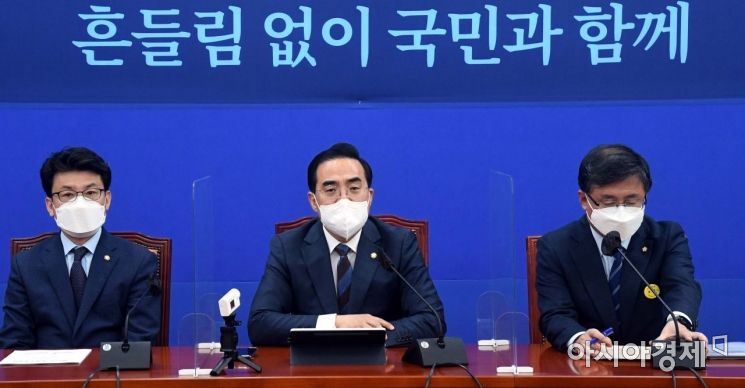 Park Hong-geun, floor leader of the Democratic Party of Korea, is attending the policy coordination meeting held at the National Assembly on the 21st and delivering opening remarks. Photo by Yoon Dong-joo doso7@
At the policy coordination meeting held at the National Assembly that morning, Floor Leader Park said, "The Democratic Party has reluctantly submitted a request to form an agenda adjustment committee to the Legislation and Judiciary Committee," explaining, "because we can no longer waste the National Assembly's time due to the People's Power Party's obstinacy." He emphasized, "We will definitely pass the normalization of the prosecution through the separation of investigative and prosecutorial powers in the April National Assembly."
He pointed out, "For several days, we have held subcommittee meetings of the Legislation and Judiciary Committee day and night to gather various opinions and conduct reviews, but the People's Power Party has been fully engaged in obstructing parliamentary proceedings by nitpicking and delaying."
Regarding the agenda adjustment committee of the Legislation and Judiciary Committee meeting that morning, he urged, "Since there is not much physical time left in the April National Assembly, I ask the agenda adjustment committee to conduct a thorough review even if it means staying up all night today." He also requested, "I ask the Speaker to convene the plenary session tomorrow, the 22nd."
Addressing the People's Power Party, he said, "The slander to block the reform bill of power institutions must stop. The separation of the prosecution's investigative and prosecutorial powers has been a long-standing public promise deliberated since the Participatory Government." He added, "After the inauguration of the Moon Jae-in administration, the first phase of reform was carried out, including the introduction of the Corruption Investigation Office for High-ranking Officials (CIO) and adjustment of investigative powers, and now the second phase of power institution reform is being pursued."
Meanwhile, that morning, the Legislation and Judiciary Committee referred the prosecution investigative and prosecutorial powers separation bill to the agenda adjustment committee and began reviewing the bill.
The agenda adjustment committee is a body for discussing agendas that require reconciliation of differences, composed of three Democratic Party members, two People's Power Party members, and one independent member from the Legislation and Judiciary Committee. If two-thirds or more of the members approve the bill, the agenda can be passed.
In the Democratic Party, Min Hyung-bae, a hardliner for Geomsu Wanbak, resigned from the party the day before and attended the agenda adjustment committee as an independent member that day, creating conditions for the swift passage of the Democratic Party's Geomsu Wanbak bill.
© The Asia Business Daily(www.asiae.co.kr). All rights reserved.
![Clutching a Stolen Dior Bag, Saying "I Hate Being Poor but Real"... The Grotesque Con of a "Human Knockoff" [Slate]](https://cwcontent.asiae.co.kr/asiaresize/183/2026021902243444107_1771435474.jpg)
















