Strong Performance in Core Small-to-Medium OLED Sector
Exclusive Panel Supply for Some iPhone14 Series Lines
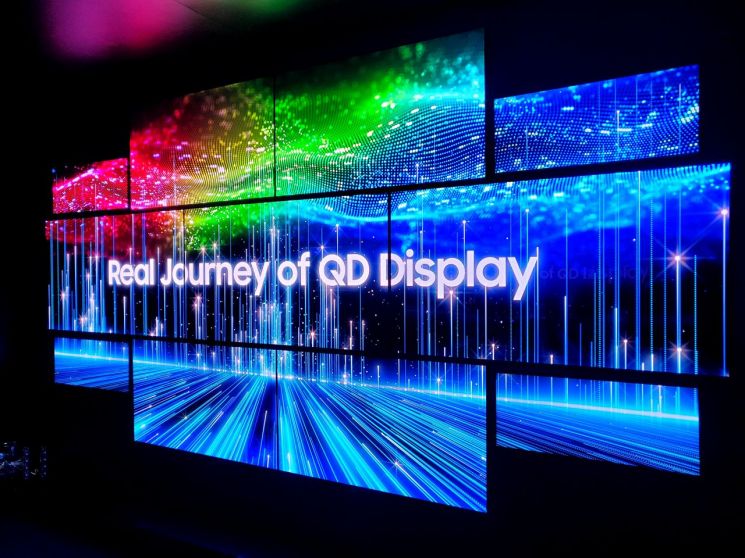
[Asia Economy Reporter Park Sun-mi] Samsung Display, a latecomer in the large-sized organic light-emitting diode (OLED) panel market, is rapidly securing production competitiveness by overcoming its limitations. This is attributed to the rapid improvement in the yield of Quantum Dot (QD)-OLED, leading to expectations that manufacturing costs could decrease.
According to the IT and electronics industry on the 20th, Samsung Display raised the QD-OLED panel yield (the ratio of qualified products) from only about 50% last November to around 75% this month. This was achieved just five months after starting QD OLED panel production. Although the yield was low at about 50% in the early mass production stage, drawing criticism regarding competitiveness, if this pace continues, it is expected to surpass 80% in the first half of the year and reach around 90% within the year.
Industry insiders evaluate that Samsung Display, which had focused only on the small and medium-sized OLED market, has entered the large OLED market as a latecomer but is securing production competitiveness faster than expected. The QD technology uses a front-lighting method that efficiently utilizes light, designed with a simpler and more efficient structure compared to LCDs that require backlighting, providing thin and lightweight displays.
As Samsung Display improves the yield of QD OLED panels, the number of panels available for shipment has increased. Samsung Display's QD OLED production capacity is 30,000 sheets per month based on substrates. One substrate can produce a total of five large TV panels: three 65-inch panels and two 55-inch panels, enabling an annual production of 1.8 million panels.
When the yield was only about 50%, only 900,000 panels out of the annual production of 1.8 million could be utilized, but with the current yield rising to 75%, 1.35 million panels can be used. If the yield reaches around 90% within the year, producing 1.62 million TVs annually will be feasible.
The panels produced by Samsung Display are installed in QD OLED TVs that Samsung Electronics has started selling in the United States. Although Samsung Display is not currently considering facility investments to expand production capacity, it is preparing for the possibility that Samsung Electronics may launch QD OLED TVs in Korea or increase the number of countries where they are released, thereby increasing orders, as a certain level of yield has been secured.
There is also a forecast that the manufacturing cost of QD-OLED panels will significantly decrease next year. Market research firm Display Supply Chain Consultants (DSCC) predicted that the cost of producing Samsung QD-OLED panels next year will decrease by up to 30% compared to this year, due to the rapid improvement in QD-OLED yield.
Meanwhile, Samsung Display is expected to maintain its leading position in the small and medium-sized OLED sector, its core area, by exclusively supplying panels for some lines of the Apple iPhone 14 series to be released in the second half of the year. Some foreign media reported that Apple will exclusively use Samsung Display panels for the iPhone 14 Pro. While Apple, which seeks to diversify panel suppliers, will use LG Display and China's BOE panels for some iPhone 14 lines, it has decided to use only Samsung Display panels for one or two lines.
An industry official said, "Even though China's BOE has newly entered the iPhone market, Samsung Display is recognized for its technology by exclusively supplying panels for several iPhone series models and maintaining its industry-leading position, so catching up will not be easy."
© The Asia Business Daily(www.asiae.co.kr). All rights reserved.

















