Full Return to School from Next Month 1st, Normal Operation of Curricular and Extracurricular Activities
If Isolation for Confirmed Cases Changes from Mandatory to Recommended, Support for Final Exam Participation
Voluntary Preemptive Testing, Only Symptomatic and High-Risk Groups Tested Once When Confirmed Cases Occur
Attendance of Confirmed Students to Be Discussed and Announced After Changes in Quarantine Guidelines
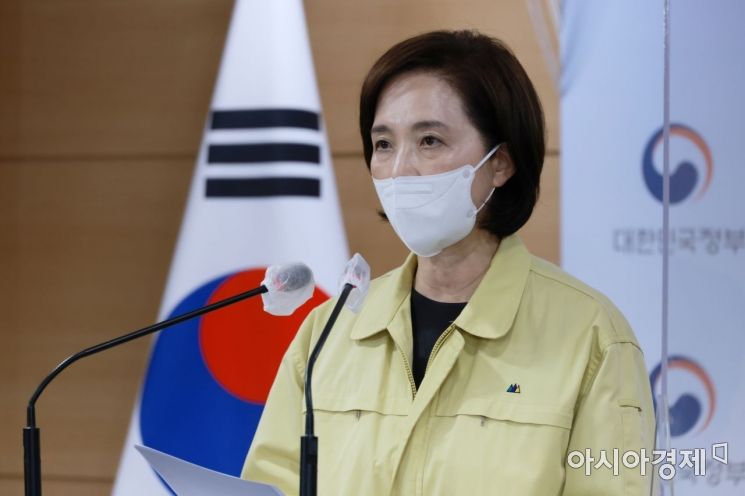 Deputy Prime Minister and Minister of Education Yoo Eun-hye is announcing the plan to promote the recovery of daily school life in the post-Omicron era at the Government Seoul Office Building on the 20th.
From May, all kindergartens, elementary, middle, and high schools nationwide will resume normal in-person attendance. Group and discussion classes will be reinstated as they were before COVID-19. Overnight programs such as school trips, experiential learning, and university students' MT (Membership Training) will also be allowed. After late May, when the isolation of confirmed cases changes from mandatory to 'recommended,' support will be provided to allow infected students to take their final exams.
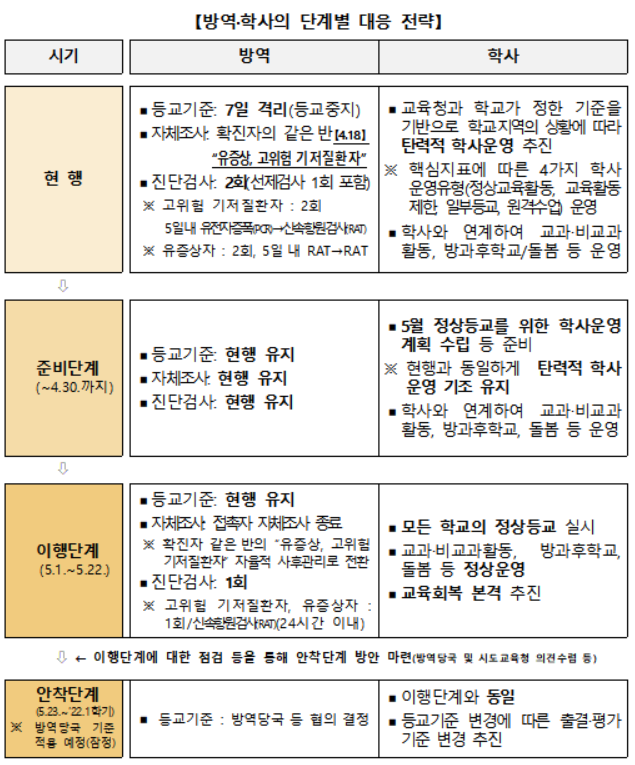
On the 20th, the Ministry of Education announced the "Post-Omicron School Daily Life Recovery Plan" containing these details. According to the plan, flexible academic operations will be maintained until the end of this month, but from May, normal attendance, curricular and extracurricular activities, after-school programs, and childcare will operate normally. In kindergartens, outdoor play and physical activities will be possible, and in schools, various classes such as group activities, discussions, and mobile classes will be available.
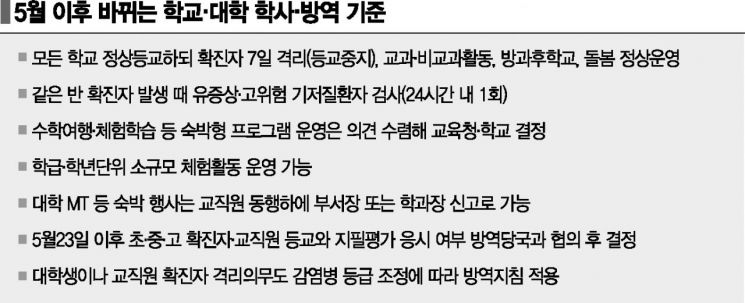
Students confirmed with COVID-19 must refrain from attending school for seven days until May 22. School-led investigations will also be suspended, but if a confirmed case occurs in the same class, high-risk individuals with underlying conditions and symptomatic persons must take a rapid antigen test within 24 hours. The indoor mask-wearing mandate will remain, and in addition to medical masks (KF80 or higher), droplet-blocking masks will also be permitted. The Ministry of Education intends to maintain the current home study allowance, which has been permitted for about 57 days, through the first semester.
Deputy Prime Minister and Minister of Education Yoo Eun-hye stated, "From May, all educational activities at schools will expand to pre-COVID-19 levels. Proactive testing using existing rapid antigen test kits will be decided autonomously by education offices and schools to ease the burden of quarantine measures on the field," adding, "The most important aspect after May 23 during the stabilization phase is to prepare for the case when mandatory isolation for confirmed cases changes to a recommendation, and the Ministry of Education will work with education offices to concretely prepare educational opportunities for infected students."
School trips, which were suspended for three years, will also resume. Decisions will be made by education offices and schools after review by school operation committees and parental consent. Additionally, small-scale experiential activities at the class or grade level and internal and external events will be allowed. However, if infectious diseases resurge, metropolitan and provincial education offices may set standards to allow flexible academic operations at the class or grade level.
Ham Young-gi, Director of Curriculum Policy at the Ministry of Education, said, "Educational activities or training activities conducted after regular class hours must be reviewed by the school operation committee, and overnight programs must also undergo review," adding, "Since the situation is not completely safe, we will guide compliance with quarantine rules when going on training trips or school trips."
Support for confirmed students to take final exams will be arranged with detailed plans after late May. This is premised on the quarantine authorities lowering the infectious disease level to stage 2 after May 23 and changing the isolation of confirmed cases from mandatory to recommended. Deputy Prime Minister Yoo said, "If the policy changes so that isolation of confirmed cases is a recommendation rather than mandatory, students will be able to attend school and take final exams," and added, "The guidelines and standards for academic operations such as attendance will be prepared and announced by the Ministry of Education, not decided autonomously by schools."
Detailed coordination is needed regarding the attendance policy for confirmed students after late May. Schools have high density and frequent contact among students, raising concerns about infection spread. Lee Sang-soo, Director of School Innovation Support at the Ministry of Education, said, "Final exams can be taken in isolated locations for a short period, and some guidelines will be prepared for taking exams," adding, "If isolation changes to a recommendation, whether confirmed students can attend school daily, and whether seating arrangements and class activities will be conducted as usual, are being discussed with metropolitan and provincial education offices and quarantine authorities. Related guidelines will be created and announced before May 23."
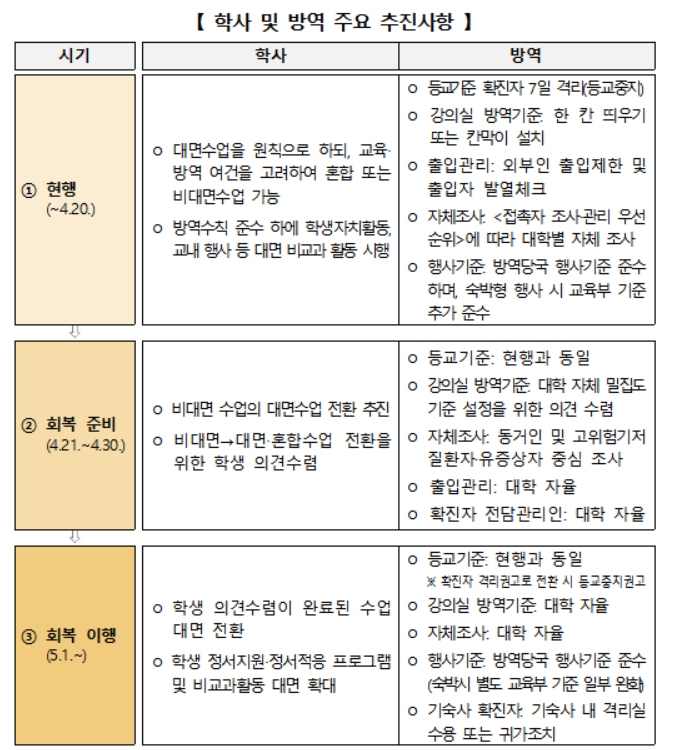
The Ministry of Education has recommended that universities actively consider face-to-face classes from May. However, if a significant number of students require remote learning, hybrid classes (remote + face-to-face) are also possible. When changing the class format, students' opinions must be gathered, considering hardships such as long-distance commuting and health issues.
From May, standards related to university festivals and MT will also be significantly relaxed. Previously, approval was required for overnight events, but from May, they can be held after reporting to the head of the unit or department, provided that faculty members accompany the event. Campus events can be held as long as mask-wearing guidelines are followed, and student council activities are allowed without prior reporting. If university students or faculty members test positive, the quarantine obligation will change to a 'recommendation' after May 23, and the updated quarantine guidelines will apply.
A Ministry of Education official explained, "Overnight programs are allowed but must go through opinion-gathering procedures. University festivals and MTs will maintain existing standards until the end of April but will be allowed after reporting from May, with restrictions eased and strict compliance with quarantine rules enforced."
The Ministry plans to continue supplementary classes and university student tutoring to support educational recovery and will conduct performance analysis of policies related to educational deficits and gaps in the second half of this year. Guidelines for attendance, evaluation, and records related to the transition to recommended isolation for confirmed cases will also be provided in May.
© The Asia Business Daily(www.asiae.co.kr). All rights reserved.
![User Who Sold Erroneously Deposited Bitcoins to Repay Debt and Fund Entertainment... What Did the Supreme Court Decide in 2021? [Legal Issue Check]](https://cwcontent.asiae.co.kr/asiaresize/183/2026020910431234020_1770601391.png)


















