Ulsan National Institute of Science and Technology Research Team Minimizes Toxicity Without Intermediate Substances
Laser Induces Reactive Oxygen Species to Eliminate Cancer Cells and Bacteria
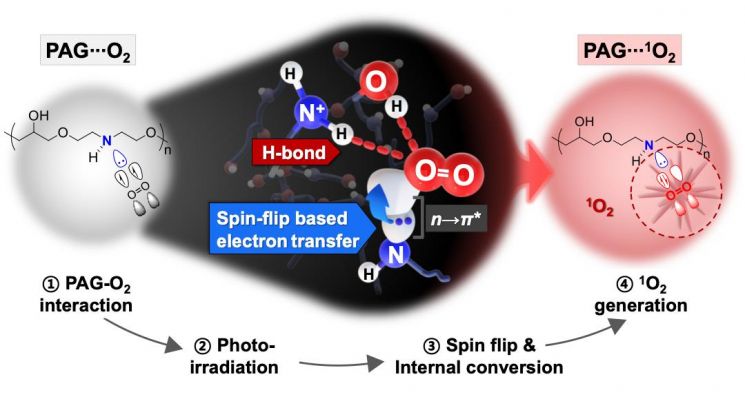 Schematic diagram of the action of a substance that attacks cancer cells when exposed to laser. Photo by Ulsan National Institute of Science and Technology.
[Asia Economy Reporter Kim Bong-su] A substance that attacks cancer cells and bacteria when exposed to laser light has been developed. It is expected to be widely used in new cancer treatments, as well as in fields such as water and air sterilization.
Ulsan National Institute of Science and Technology (UNIST) announced on the 20th that a research team led by Professors Kwon Tae-hyuk and Min Seung-gyu from the Department of Chemistry developed a photosensitizer based on poly(glycerol), a hydrophilic biodegradable polymer.
A photosensitizer is a substance that converts surrounding oxygen into reactive oxygen species using the laser light it absorbs. The strong oxidative power of reactive oxygen species can attack and kill cancer cells and bacteria. In actual experiments, when the photosensitizer was applied and laser light was irradiated, the growth rate of cancer cells and bacteria was reduced to less than half.
The research team developed a photosensitizer that produces singlet oxygen, which has very strong oxidative power among reactive oxygen species. Photosensitizers that produce singlet oxygen typically contain heavy metals or aromatic compounds that do not mix well with water, making them harmful to the body and poorly soluble in water-based bodily fluids. By incorporating nitrogen into the molecular structure of the photosensitizer, they created a photosensitizer (hyperbranched polyaminoglycerol, hPAG) using biocompatible poly(glycerol) as the main material. Nitrogen induces a strong interaction force that narrows the distance between oxygen and the photosensitizer, allowing electrons from the photosensitizer to transfer to oxygen. Simulation results confirmed that the distance was narrowed to within about 3 atoms, approximately 3 ?ngstr?ms (3 × 10^-10 m).
A representative of the research team explained, “Unlike the previously known fact that singlet oxygen is synthesized only through an energy transfer pathway, the developed photosensitizer can convert oxygen into singlet oxygen via an electron transfer pathway, eliminating the need to include heavy metals or aromatic compounds that assist energy transfer reactions.”
The results of this study were published online on the 29th of last month in the international academic journal JACS Au, published by the American Chemical Society.
© The Asia Business Daily(www.asiae.co.kr). All rights reserved.

















