KAIST
[Asia Economy Reporter Kim Bong-su] KAIST announced on the 19th that a research team led by Professor Kim Kyung-min of the Department of Materials Science and Engineering has succeeded in developing hardware and related algorithms for artificial intelligence that implement neuromodulation activities occurring in the brain.
With the advent of the 4th Industrial Revolution era, research on Artificial Intelligence (AI) technology is becoming active, and accordingly, the development and product launch of AI-based electronic devices are accelerating. To implement AI in electronic devices, the development of customized hardware must also be supported. Currently, most AI electronic devices use high power consumption and highly integrated memory arrays to perform large amounts of computation. Solving the issues of power consumption and integration limits to enhance AI capabilities is a major challenge in the AI technology field, and efforts have continued to find clues to problem-solving from human brain activities.
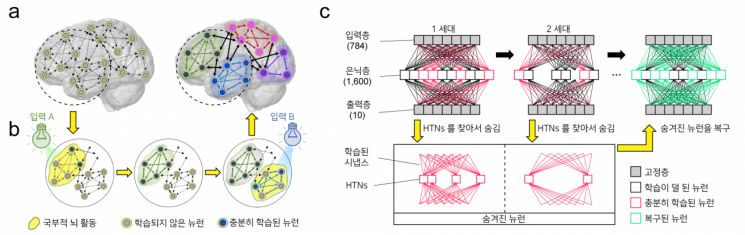
The research team developed a technology that mimics the human brain neural network’s neuromodulation function, which continuously changes the connection structure according to the situation, enabling efficient processing of mathematical operations for AI. In the brain, the connectivity of neural networks is changed in real-time during learning to store or retrieve memories as needed. This study proposed a new AI learning method that directly implements such neuromodulation functions in hardware.
To prove the efficiency of the developed technology, the research team fabricated artificial neural network hardware equipped with proprietary electronic synapse devices, applied the developed algorithm, and conducted actual AI learning. As a result, they were able to save 37% of the energy required for AI learning.
A team representative stated, "The human brain has evolved to minimize energy consumption for survival. In this study, we were able to reduce energy consumption by nearly 40% by implementing the human brain’s learning method with a simple circuit configuration," adding, "It has advantages that can be used universally in all SNN (Spiking Neural Network) artificial neural networks."
This brain-inspired learning algorithm can be applied and compatible with existing electronic devices and commercial semiconductor hardware, and it is expected to be used in the design of next-generation AI semiconductor chips.
This research was published on the 31st of last month in the international academic journal Advanced Functional Materials.
© The Asia Business Daily(www.asiae.co.kr). All rights reserved.
![Clutching a Stolen Dior Bag, Saying "I Hate Being Poor but Real"... The Grotesque Con of a "Human Knockoff" [Slate]](https://cwcontent.asiae.co.kr/asiaresize/183/2026021902243444107_1771435474.jpg)
















