Korea Research Institute of Bioscience and Biotechnology Opens Path to Develop Varieties for Mass Production Even at High Temperatures
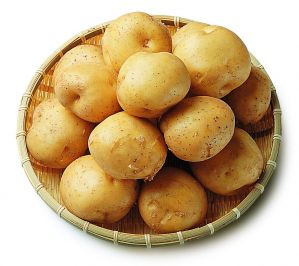
[Asia Economy Reporter Kim Bong-su] Domestic researchers have uncovered the cause of potato crop failures during prolonged heatwaves in late spring or early summer.
The Korea Research Institute of Bioscience and Biotechnology announced on the 19th that Dr. Hyojun Lee and Dr. Hyunsun Kim's team at the Plant Systems Engineering Research Center conducted gene analysis of potatoes at different growth stages and discovered the mechanism that suppresses tuber (potato fruit, underground stems shaped like tubers) formation when potatoes are cultivated under high temperatures. This finding is expected to contribute to the development of potato varieties that maintain yield even in high temperatures.
It has long been known that potato yields decrease at high temperatures. Accordingly, in Korea, potatoes are mainly cultivated in high-altitude regions where temperatures are relatively low. Several studies have pointed to the reduced function of a specific gene (StSP6A), which induces tuber formation at high temperatures, as a major cause of yield reduction. During the potato growing period, the gene that induces tuber formation gradually increases to promote tuber development; however, when temperatures rise, the amount of this gene does not increase, thereby suppressing tuber formation. Nevertheless, aside from fragmented studies on the tuber-inducing gene and yield, there has been no research on tuber formation and development throughout the entire growth period, and thus no reports on the relationship between growth temperature and yield.
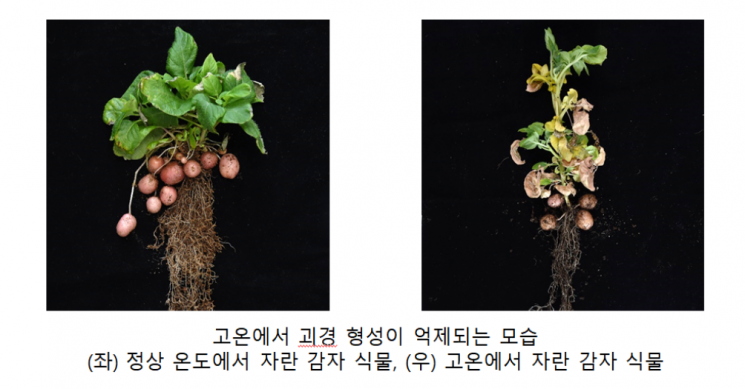
The research team cultivated potatoes at various temperatures and analyzed the genes and yields of potatoes at different growth stages. They found that while potatoes suppress tuber formation as an environmental adaptation under high temperatures, the mechanisms differ between early and late growth stages. Specifically, potatoes reduce yield by suppressing the tuber-inducing gene throughout growth when temperatures rise. However, in the early growth stage, tuber formation is suppressed by regulating the RNA of the tuber-inducing gene, whereas in the late stage, the gene's DNA is regulated. Increasing the expression of the tuber-inducing gene in the early growth stage can restore yield, but increasing gene expression in the late stage has no effect on yield.
Based on these findings, the research team additionally identified genes expected to be involved in suppressing tuber formation during early and late growth stages. Dr. Hyojun Lee of the research team stated, "The reduction in potato yield under high-temperature conditions is not a side effect such as growth retardation but rather a result of the plant itself suppressing tuber formation as an environmental adaptation," adding, "By utilizing the mechanism behind potato yield reduction, it may be possible to develop potato varieties with high yields even in hot environments."
This study was published as the cover article of the online edition of the international biology journal Cell Reports on the 29th of last month.
© The Asia Business Daily(www.asiae.co.kr). All rights reserved.
!["The Woman Who Threw Herself into the Water Clutching a Stolen Dior Bag"...A Grotesque Success Story That Shakes the Korean Psyche [Slate]](https://cwcontent.asiae.co.kr/asiaresize/183/2026021902243444107_1771435474.jpg)
















