COVID-19 Death Toll Includes Elderly and Patients with Underlying Conditions
The number of deaths in South Korea is rapidly increasing due to the surge in COVID-19 cases caused by the Omicron variant and the change of seasons. The daily average number of cremations is also reaching record highs. Notably, the number of general deaths, which the government does not officially classify as COVID-19 deaths, has significantly increased, drawing attention.
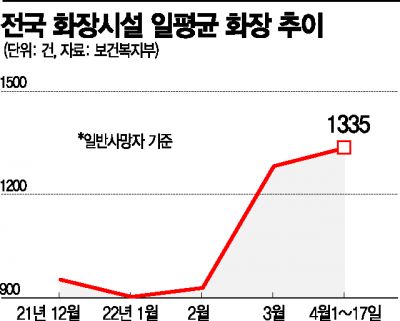
According to the Ministry of Health and Welfare on the 19th, from the beginning of this month until the 17th, a total of 22,687 cremations were conducted at 60 cremation facilities nationwide. Excluding exhumed remains for reburial, this amounts to an average of 1,335 cremations per day.
In March alone, there were 39,748 cremations, averaging 1,282 per day. The daily average number of cremations at domestic facilities exceeded 1,000 only in March and April of this year since statistics began to be collected. In the same period in previous years, the daily average cremations were around 700, and last year it was about 770 to 780, but this year it has nearly doubled.
The proportion of cremations for COVID-19 deaths among the total cremations has exceeded 20%. On the 13th, out of 1,345 cremations conducted nationwide, 23.6% (318 cases) were for COVID-19 deaths.
While the daily average number of COVID-19 death cremations surged from 37 in January to 50 in February, and then to 272 in March and April, the number of cremations for non-COVID deaths also steadily increased to 867, 881, 1,008, and 1,061 respectively. Even considering that elderly deaths typically rise during seasonal changes, this is an unusual increase.
Among these, there may be cases classified as deaths due to old age or underlying conditions after COVID-19 infection. Professor Lee Jong-woo of the Department of Funeral Studies at Eulji University said, "Cremation facilities can only confirm cases officially classified by the government as COVID-19 deaths if the person died in isolation," adding, "If the cause of death on the death certificate is listed as pneumonia or lung disease, it is only presumed to be related to COVID-19 infection."
The increasing trend in deaths is also confirmed by other statistics. According to the Statistics Korea population trend survey, the number of deaths in South Korea was about 28,400 in November last year and 31,600 in December, representing increases of 10.8% and 17.7% respectively compared to the same months the previous year. In January and February last year, the number of deaths decreased compared to the previous year, but overall, the annual total increased by 4.2%, indicating that deaths were concentrated in November and December. In January this year, deaths numbered 29,686, a 9.0% increase compared to the same period last year.
The number of deaths removed from the resident registration by the Ministry of the Interior and Safety also rose sharply to 39,532 in March this year, a 38.1% increase compared to 28,626 in March last year. Death removals in February also increased by 22.3% to 29,407 compared to 24,044 in February last year.
The Korea Disease Control and Prevention Agency reported 8,172 COVID-19 deaths in March alone, and 4,994 deaths from the beginning of this month until the 18th. Of the total cumulative deaths of 21,224, 62.0% occurred in March and April this year. While the daily death toll peaked at 469 in late March, the number of deaths has somewhat decreased to between 100 and 200 per day since mid-April. However, on a monthly basis, the number of COVID-19 deaths in March and April is expected to be similar.
Professor Eom Jung-sik of the Department of Infectious Diseases at Gachon University Gil Medical Center said, "The number of confirmed cases during the Omicron wave was much higher than initially predicted, and deaths have also increased significantly. Since there are still 100,000 new cases daily, even after lifting social distancing and returning to normal life, deaths may not decrease, so we need to observe the situation for another two to three weeks."
© The Asia Business Daily(www.asiae.co.kr). All rights reserved.


















