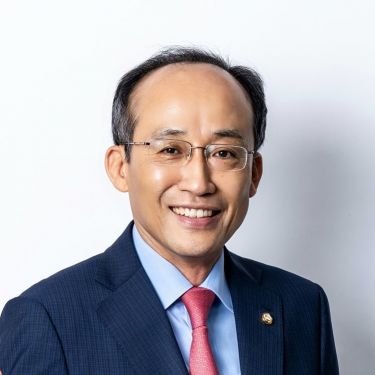
[Asia Economy Sejong=Reporter Kim Hyewon] "In summary, at that time, the urgent issue to stabilize the financial market was the non-performing problem of Korea Exchange Bank, and there was no alternative other than Lone Star's capital participation. It was not decided or carried out secretly behind closed doors. Even now, I do not regret participating in that decision at all."
This is what Chu Kyung-ho, the 20th Presidential Transition Committee’s Planning and Coordination Subcommittee Secretary and the first Deputy Prime Minister and Minister of Economy and Finance candidate under the Yoon Suk-yeol administration, said ahead of his confirmation hearing. This is not recent. It was through a lengthy article posted on March 22, 2006, on the Ministry of Finance and Economy’s website under ‘Policy Explanation.’ At that time, he was serving as the head of the Financial Policy Division at the Ministry of Finance. Various suspicions arose regarding the 2003 sale of Korea Exchange Bank, and three years later, the Board of Audit and Inspection and prosecutors were conducting investigations. Candidate Chu argued in about 30 manuscript pages that "the claim that Korea Exchange Bank was sold to Lone Star at a bargain price is unfounded, and it was a correct policy decision at the time."
Candidate Chu recalled, "Government officials handling Korea Exchange Bank affairs were well aware that allowing Lone Star, which was neither domestic capital nor a financial institution, to acquire shares of Korea Exchange Bank, even if legally permitted, could later lead to criticism and responsibility." Nevertheless, he said that waiting for Korea Exchange Bank’s deterioration without a proper alternative was judged to be irresponsible at the time. He explained the background of the decision: "Considering the economic situation and the progress of Korea Exchange Bank’s non-performing assets at the time, we could not irresponsibly respond in a passive manner by fearing responsibility for policy decisions, refusing Lone Star’s investment in Korea Exchange Bank, and waiting until a major bank became completely insolvent and the worst-case scenario occurred, then dealing with the aftermath."
Regarding the situation at the time, Candidate Chu stated, "It was a period when the dismantling of Daewoo Group in 1999 and Hyundai Group in 2000 posed serious potential non-performing risks to banks’ financial soundness, and concerns about the recurrence of a financial crisis were rising due to the SK Global accounting fraud scandal and the 2003 credit card crisis." He added, "Korea Exchange Bank was the main creditor bank for major conglomerates such as Hynix and Hyundai Construction, making it the Achilles’ heel of our financial industry." He also noted that Korea Exchange Bank’s subsidiary, Korea Exchange Card, posted a deficit of about 1.4 trillion won in 2003, and Olympus, the second-largest shareholder of Korea Exchange Card, refused a capital increase in September of that year, increasing the risk of Korea Exchange Bank’s default.
Candidate Chu said, "In a situation where public capital increases targeting the general public and overseas securities issuance were all canceled, the only entities expressing interest in Korea Exchange Bank were the U.S.-based funds Lone Star and Newbridge." From Korea Exchange Bank’s perspective, there was no alternative other than Lone Star. He stated, "The issue of granting Lone Star the status of a major shareholder in Korea Exchange Bank was thoroughly discussed and decided at the full meeting of the Financial Supervisory Commission, which included private members, and it was not decided secretly behind closed doors."
Regarding the controversy over the bargain sale, he added, "Compared to the price-to-book ratio (PBR) of Chohung Bank, which was sold around the same time, Lone Star’s purchase price for Korea Exchange Bank shares was slightly higher," explaining, "That was the market evaluation at the time." He concluded his article by saying, "If there had not been a large-scale capital inflow exceeding 1 trillion won into Korea Exchange Bank, imagining the financial market situation in the second half of 2003 is not only dizzying but also makes me think about how shameful and irresponsible such behavior would have been." Candidate Chu said he would clarify his current position on this matter during the confirmation hearing.
© The Asia Business Daily(www.asiae.co.kr). All rights reserved.

















