[Seoul District News] Creation of Public Art Space 'Danghyeon Bitgil' in 210m Covered Section of Danghyeoncheon at Sanggye Station Underground
Installation of 7 Unique Works Using LED Lighting and Fluorescent Paints with Themes of Nature and Nowon... Korea's First Western Painter Go Heedong's Work 'Goesukdo' Returns to His Home... Dobong-style Elementary After-school Support Center [Moduit] Opens at Sungmi Elementary... Gangbuk-gu Hosts 62nd Anniversary 4·19 Revolution History Golden Bell Quiz
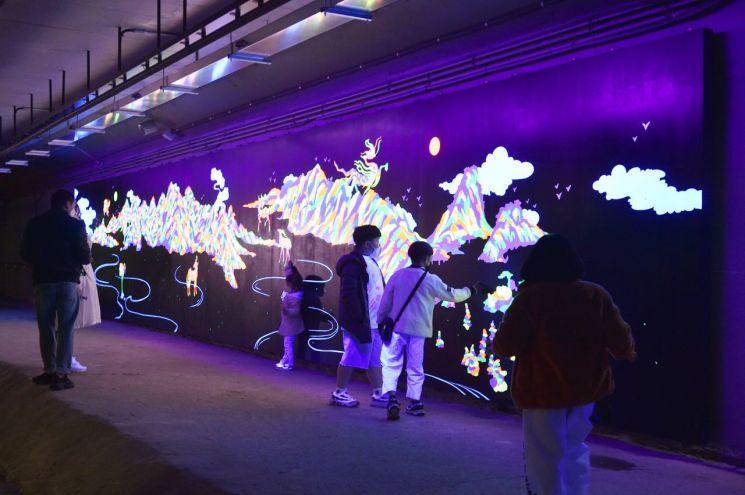
[Asia Economy Reporter Park Jong-il] Nowon-gu (Mayor Oh Seung-rok) announced that it has created 'Danghyeon Bitgil,' a permanent exhibition of public art installations in the underground covered section of Danghyeoncheon at Sanggye Station, allowing people to enjoy culture and arts while taking a walk.
'Danghyeon Bitgil' is located beneath Sanggye Station on Subway Line 4, at the entrance to the Danghyeoncheon walking trail. This area was previously neglected and dark, causing walkers to detour above the covered section, with only some cyclists passing through.
Since May last year, the district has been promoting a landscape improvement project for the covered structure. Taking advantage of the environmental characteristics of the stream, where light does not penetrate and shallow water flows, public art works using light and video were installed, transforming the area into an outdoor art gallery.
A total of seven works were installed. 'Gate of Light' features LED lights installed on the entrance bridge pillars, creating the image of moonlight pouring into the entrance. 'Dalhanopigomdodasha' depicts the shape of the moon in the sky using a large 5-meter diameter LED. It broadcasts various planned videos lasting 2 to 3 minutes, serving as a pause in busy daily life.
'A Thousand Lights,' created by installing LED bars over a 150-meter section, adds depth to the space with lights changing moment by moment in red, green, purple, blue, and other colors. 'Hyeongwolrim' is a work symbolizing the light of fireflies, recalling the Danghyeoncheon where many fireflies once lived, expressing hopes for natural environment and ecological restoration.
'The Moon's Gate Opens,' utilizing the wall surface, is a three-dimensional representation of various light fragments permeating Danghyeoncheon. It is an audience-participation piece that continuously changes as visitors shine their phone flashlights on it, allowing viewers to see new shapes of light at every moment. 'Imagery of the Moonlit Night' visualizes Wolgye, Gongneung, Hagye, Junggye, and Sanggye neighborhoods of Nowon-gu as polyhedral shapes. 'Gureumi Green Moonlight' expresses residents' wishes for happiness through traditional painting methods, adding special effects by using fluorescent paint and blacklight inspired by traditional five cardinal colors and saekdong (colorful stripes).
The artworks are on permanent display, with lighting from 10 a.m. to 10 p.m. The district plans to utilize the space beneath Sanggye Station as an art platform to promote media art exhibitions and various cultural and artistic performances through the Danghyeon Bitgil project.
Meanwhile, Danghyeoncheon, which runs through Nowon-gu, is emerging as a healing space for residents through the 'Stream Rebirth' project, which includes maintenance of walking trails, bicycle paths, public restrooms, and the installation of music and ground fountains as resting areas.
Recently, to welcome spring, the specialized flower beds were redecorated with spring flowers, four upcycling sculptures and one heart-shaped sculpture were installed, and a photo zone was created to enhance the enjoyment of walks.
Oh Seung-rok, Mayor of Nowon-gu, said, "The previously unused covered section of Danghyeoncheon has been reborn as a cultural and artistic space for residents," adding, "We will continue to strive to expand spaces where people can enjoy various cultural and artistic experiences in daily life."
In Wonseo-dong, Bukchon, there is a house where Chun-gok (春谷) Go Hee-dong (1886?1965), Korea's first Western-style painter who also mastered Oriental painting, lived for 41 years.
This is the 'Jongno-gu Go Hee-dong Art Museum' (40 Changdeokgung 5-gil).
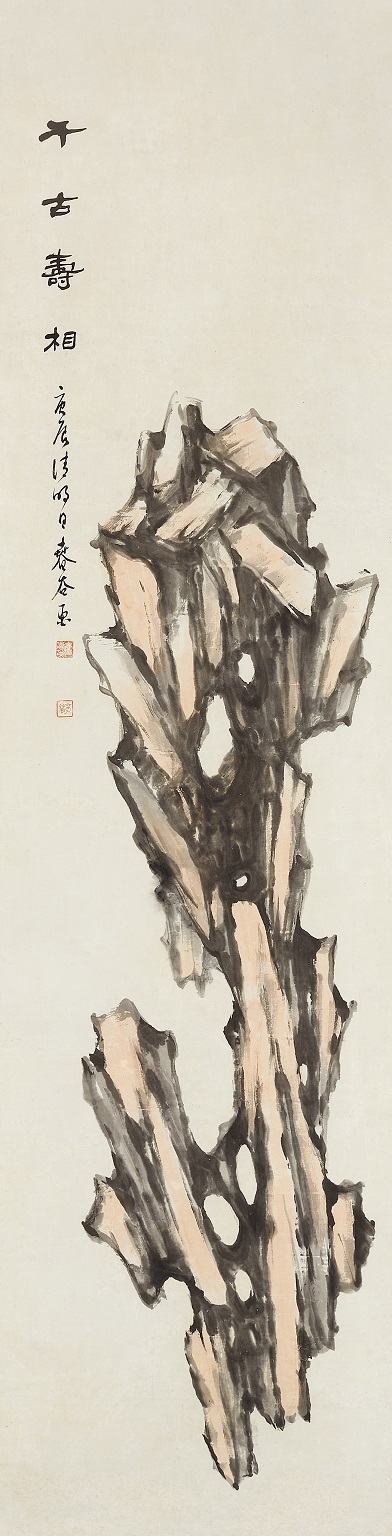
Last month, Jongno-gu received a valuable Oriental painting by Chun-gok Go Hee-dong as a donation and plans to open it to the public at the Go Hee-dong Art Museum from the end of this year.
The donor, Kim Soon-young, had long kept Chun-gok's 1940 work 'Gwaeseokdo' collected by her parents. Upon learning about the Go Hee-dong Art Museum in Jongno-gu, she decided to donate the artwork hoping it would be placed in a meaningful location. In appreciation, the Jongno Cultural Foundation presented her with a plaque of gratitude last month.
The museum is currently holding a reopening commemorative exhibition titled 'Spring of Chun-gok (春谷)' where visitors can see both Chun-gok's Oriental and Western paintings. Besides the donated piece, the museum holds 330 works including calligraphy, prints, and folk artifacts. Visitors can also participate in various exhibition-linked programs such as calligraphy classes or creating their own art notebooks.
Go Hee-dong, known as Korea's first Western-style painter, returned from studying art in Japan in 1918 and continued his artistic activities and mentoring of juniors in the house he designed himself. Considering the many disciples and prominent artists of the time who frequented the house, it is no exaggeration to call Chun-gok's home the 'cradle of modern Korean art.'
His house, blending traditional Korean hanok and Japanese architectural styles, is recognized as a significant example of early modern Korean housing. It was registered as National Registered Cultural Property No. 84 in 2004, underwent restoration, and opened as 'Go Hee-dong House' in 2012.
Since the Jongno Cultural Foundation began managing it in 2019, it has been operated under the name 'Jongno-gu Go Hee-dong Art Museum.'
A district official said, "Chun-gok Go Hee-dong attempted a new Korean painting style combining traditional ink wash techniques with Western color and methods. We are very grateful for this donation, which provides an opportunity to study his artistic world more deeply and prepare new exhibition content. We will continue to present diverse planned exhibitions and related programs so that the museum becomes a beloved public art museum representing Jongno."
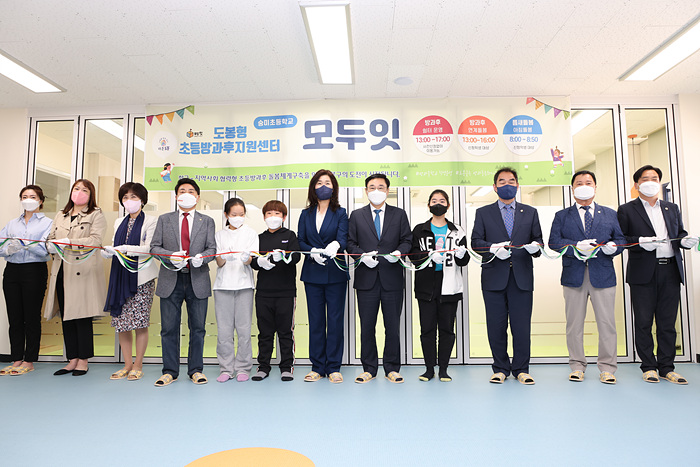 Dobong-type Elementary After-school Support Center 'Moduit' Sungmi Elementary School Opening Ceremony Tape Cutting
Dobong-gu (Mayor Lee Dong-jin) held an opening ceremony on April 15 for the Dobong-style Elementary After-School Support Center 'Moduit' at Sungmi Elementary School, which supports after-school program operations and cooperates with the community to provide gap-time care.
'Moduit' is an elementary after-school support center where the school provides the space, and Dobong-gu is responsible for staffing and overall operation. It serves as a community-centered school-village cooperative after-school care system space.
'Moduit' consists of a support office handling after-school administrative tasks and an after-school rest area where children can relax after school. Notably, the third branch at Sungmi Elementary differs from the first and second branches by having two classrooms equipped with play activity spaces and audiovisual facilities.
Meanwhile, the after-school rest area operates during times when care classrooms do not provide support: from 7:30 to 9 a.m., 5 to 8 p.m., and from 12:30 p.m. to 5 p.m. after regular classes end, offering a place for children to rest anytime.
Since the start of the school year in March 2022, the three 'Moduit' after-school rest areas have been used by about 300 students weekly on average. It is expected that more students will use the facilities once regionally linked specialized after-school programs are introduced.
The Dobong-style Elementary After-School Support Center 'Moduit' aims to provide safe and broad learning opportunities for students by organizing after-school programs in cooperation with the local community. For inquiries, contact Sungmi Elementary School Moduit.
Lee Dong-jin, Mayor of Dobong-gu, said, "Through Moduit, we aim to fulfill gap-time care in unused school spaces and operate care programs linked with community resources, establishing a public-private-academic care governance. We will do our best to open more after-school activity opportunities for Dobong-gu children."
Gangbuk-gu (Mayor Park Kyum-soo) held the 'Gangbuk-gu History Golden Bell' quiz contest for middle school students in the district on the 15th.
To commemorate the 62nd anniversary of the April 19 Revolution, the district organized this event to widely promote the modern and contemporary cultural heritage preserved in Gangbuk-gu among youth, fostering a correct historical perspective and patriotism.
Last year, due to COVID-19 prevention measures, the event was held online, but this year, 62 students selected from 12 local middle schools participated in person at the Gangbuk Well-being Sports Center at 2 p.m. on the 15th.
The event proceeded in the order of opening remarks, congratulatory performances, the Golden Bell quiz competition, and an awards ceremony. It was also broadcast live on the Gangbuk-gu YouTube channel.
The quiz questions, aligned with the 'April 19 Revolution Memorial Day,' covered modern and contemporary history sections from middle school textbooks and historical and cultural content related to Gangbuk-gu's heritage sites such as Bonghwanggak, the National April 19 Democratic Cemetery, and the burial sites of 16 patriotic martyrs.
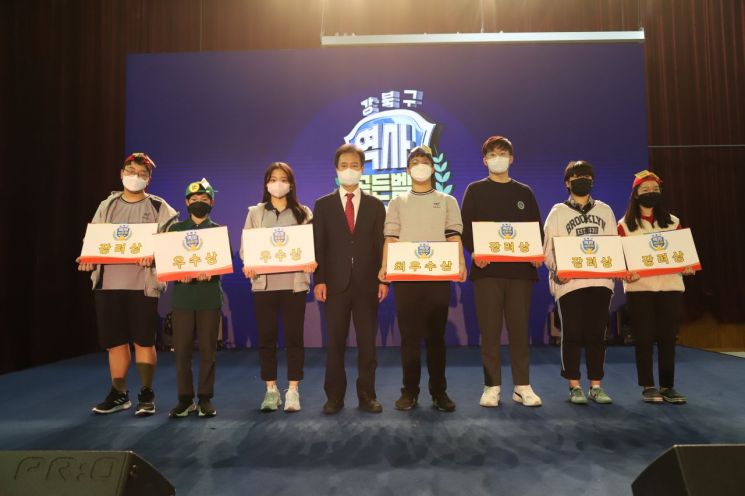
The winners were: Grand Prize - Min Seo-chan from Miyang Middle School; Excellence Awards - Kim Yul-ha from Miyang Middle School and Go Min-seo from Seorabeol Middle School; Encouragement Awards - Park Yong-seon from Miyang Middle School, Jeon Seo-young from Changmun Girls' Middle School, Seo Ah-in from Susong Middle School, and Na Seung-won from Seorabeol Middle School, totaling seven awardees.
All participants received commemorative gifts sponsored by Shinhan Bank.
Park Kyum-soo, Mayor of Gangbuk-gu, said, "This event provided a valuable opportunity for participants to learn about the significance of the April 19 Revolution and the historical culture of Gangbuk-gu. We will continue to strive to widely promote the district's historical and cultural heritage."
© The Asia Business Daily(www.asiae.co.kr). All rights reserved.
![Clutching a Stolen Dior Bag, Saying "I Hate Being Poor but Real"... The Grotesque Con of a "Human Knockoff" [Slate]](https://cwcontent.asiae.co.kr/asiaresize/183/2026021902243444107_1771435474.jpg)













