BOK "Eased Quarantine Measures Also Increase Demand-Side Inflation Pressure"
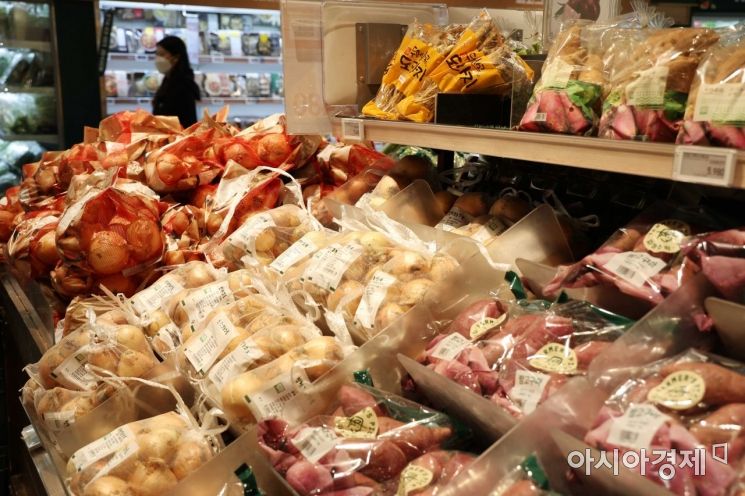
[Asia Economy Reporter Seo So-jeong] In a situation where inflationary pressures are rapidly spreading across the board and expected inflation (the anticipated consumer price increase) continues to rise, an analysis has emerged suggesting that central banks should proactively implement monetary policy aimed at stabilizing prices to alleviate economic agents' inflation anxiety.
On the 17th, the Monetary and Credit Research Team of the Monetary Policy Department at the Bank of Korea stated in their report titled "Monetary Policy Operation in Response to High Inflation" that "amid a sharp rise in international raw material prices due to the Ukraine crisis, there are concerns that supply bottlenecks may be prolonged further due to recent lockdown measures in China."
They also anticipated that domestic consumption pressures on prices would increase if consumption recovers following the easing of quarantine measures.
As of last month, consumer price inflation rates in the United States, Euro area, and the United Kingdom were 8.5%, 7.5%, and 7.0%, respectively, continuing their upward trend, while South Korea's consumer price inflation rate rose to 4.1%.
With increased inflation anxiety, expected inflation continues to rise, and the number of economic agents anticipating high inflation in the future is growing. According to the report, the proportion of respondents expecting South Korea's inflation rate to exceed 4% one year from now increased significantly from 13% in January last year to 27% in March this year.
Based on economic modeling research, it was analyzed that as expected inflation becomes unstable and price persistence increases, high inflationary pressures persist for a considerable period (more than six quarters) when demand and supply shocks occur.
The report emphasized, "Instability in expected inflation leads to prolonged inflationary trends, which, by reducing purchasing power, causes economic downturns," and added, "Stabilizing expected inflation is a key factor for macroeconomic stability."
Furthermore, analyzing the macroeconomic ripple effects of monetary policy responses under the compounded occurrence of demand and supply shocks, it was found that the more actively the central bank responds to inflation, the faster prices converge to equilibrium levels. Although there is some increase in downward pressure on the economy in the short term, in the medium to long term, early price stabilization mitigates the weakening of real purchasing power among economic agents and reduces the need for further policy rate hikes, thereby quickly alleviating economic slowdown pressures compared to other scenarios.
The report concluded, "In a situation where inflationary pressures are rapidly spreading across the board and expected inflation is rising, it is desirable for the central bank to proactively operate monetary policy in a way that alleviates inflation anxiety, from the perspective of promoting macroeconomic stabilization."
© The Asia Business Daily(www.asiae.co.kr). All rights reserved.
![Clutching a Stolen Dior Bag, Saying "I Hate Being Poor but Real"... The Grotesque Con of a "Human Knockoff" [Slate]](https://cwcontent.asiae.co.kr/asiaresize/183/2026021902243444107_1771435474.jpg)
















