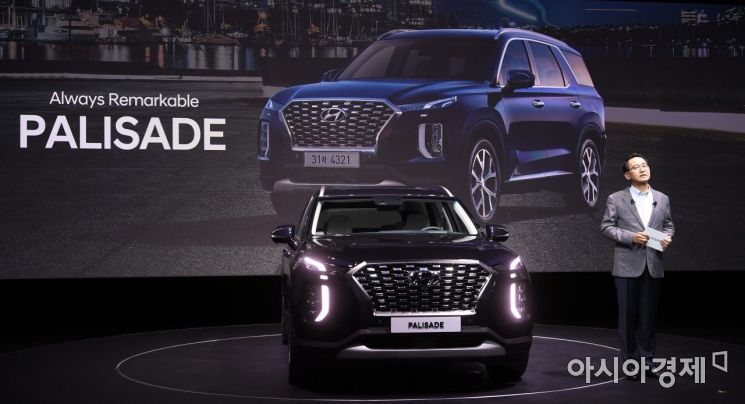
 Hyundai Motor Company held the official launch event for the 8-seater flagship SUV 'Palisade' at a studio in Yongin, Gyeonggi Province on the 11th and began full-scale sales. The Palisade is available in two lineups: a 2.2 diesel engine and a 3.8 gasoline engine, with prices ranging from 36.22 million to 41.77 million KRW. Photo by Hyunmin Kim kimhyun81@
[Asia Economy Reporter Yoo Hyun-seok] As the popularity of sports utility vehicles (SUVs) and recreational vehicles (RVs) rises, the sales proportion of domestic finished car manufacturers exceeded half for the first time in the first quarter of this year.
According to the monthly automobile statistics report by the Korea Automobile Manufacturers Association (KAMA) and the sales performance of five domestic finished car companies, Hyundai Motor, Kia, Renault Korea Motors, GM Korea, and Ssangyong Motor, the total sales volume in the first quarter of this year was 308,298 units. Among them, RVs accounted for 159,379 units, making up 51.7%. This is an increase of 5.3 percentage points compared to the same period last year.
On an annual basis, the proportion was 47.5% last year. In 2010, the annual sales volume of domestic RV models was only 275,433 units, but it continuously increased to 542,032 units in 2016, 603,069 units in 2018, and 718,295 units in 2020.
Last year, due to the global shortage of automotive semiconductors, the domestic automobile market shrank, causing RV sales to decrease to 681,521 units. However, compared to 2010, it has grown approximately 2.5 times. The RV market grew at an average annual rate of 8.6% from 2010 to 2021 over 11 years.
On the other hand, passenger car models sold only 100,602 units in the first quarter of this year, accounting for 32.6% of total sales. Compared to the first quarter of last year (36.9%), it dropped by 4.3 percentage points.
This is the lowest level ever recorded. Among every 10 cars on the road, only 3 are passenger car models.
In 2016, passenger car models accounted for 50.4% (801,347 units) of the total annual sales volume (1,588,572 units). That year, the RV proportion was 34.1%.
The point at which the proportions of the two models reversed was 2020. At that time, passenger car models accounted for only 40.8% (656,420 units), while RVs recorded 44.7%. Since then, the market structure has been centered on RVs.
The RV trend in the domestic automobile market has accelerated further after the COVID-19 pandemic. As leisure activities changed, family-oriented leisure activities such as car camping and camping gained popularity. Additionally, the industry analyzes that the 'revenge consumption' phenomenon for more expensive but larger and more comfortable cars has rapidly expanded the sales proportion of RVs.
© The Asia Business Daily(www.asiae.co.kr). All rights reserved.

![A Woman with 50 Million Won Debt Clutches a Stolen Dior Bag and Jumps... A Monster Is Born [Slate]](https://cwcontent.asiae.co.kr/asiaresize/183/2026021902243444107_1771435474.jpg)















