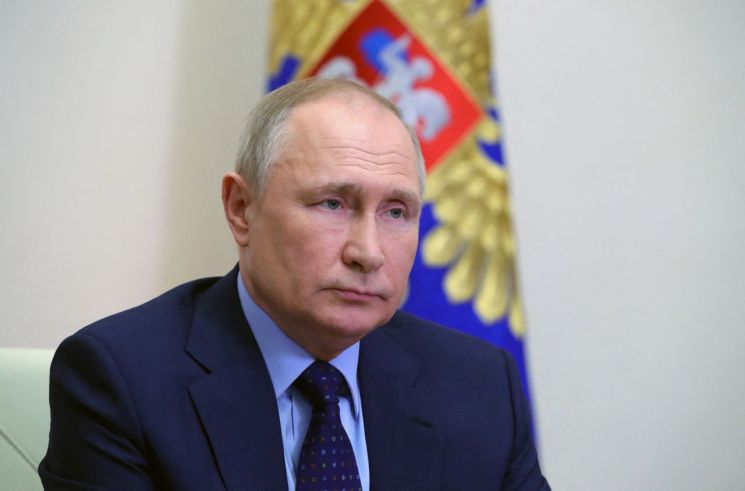
[Asia Economy Reporter Park Byung-hee] Russian President Vladimir Putin has acknowledged that Russia's energy industry is facing difficulties due to Western sanctions, the Wall Street Journal (WSJ) reported on the 14th (local time). Putin emphasized the need to shift the market for oil and gas sales from Europe to Asia.
At a government meeting that day, Putin said that although Russia's energy industry is struggling due to Western sanctions, the West will inevitably suffer economic damage as it reduces its reliance on Russian crude oil. As of last year, 45% of the federal budget came from the oil and gas industry.
Putin stated that Russia must gradually change its crude oil and gas export destinations to rapidly growing markets in the east and south, and to achieve this in the short term, key infrastructure facilities must be secured and construction started.
He said the most serious problem caused by Western sanctions is the disruption in the oil and gas export network. Three-quarters of Russia's natural gas exports go to Europe. Therefore, European sanctions will cause serious damage to the Russian economy.
The EU has not blocked supplies of Russian crude oil and gas. Some countries, including Germany, oppose cutting off Russian crude oil and gas supplies, arguing that it would cause serious economic damage. Instead, the EU has banned the provision of technology, funds, and equipment to Russia's oil and gas sector. Even these measures are expected to significantly impact Russia's energy industry, as many of Russia's oil fields are aging and require investment and equipment to continue production. Market insiders have analyzed that more than 150,000 Russian oil fields have infrastructure problems.
The International Energy Agency (IEA) estimated that Russia's daily crude oil production would decrease by about 3 million barrels starting in May. Some predict that the production cut could reach as much as 9 million barrels per day.
Although the EU has not yet imposed direct sanctions on Russian crude oil and gas imports, major raw material brokers are already reducing transactions involving Russian crude oil. Currently, Russia's representative crude oil grade, Urals, is trading at more than $30 per barrel cheaper than Brent crude. It is being sold at a low price due to difficulties in finding buyers.
© The Asia Business Daily(www.asiae.co.kr). All rights reserved.
![Clutching a Stolen Dior Bag, Saying "I Hate Being Poor but Real"... The Grotesque Con of a "Human Knockoff" [Slate]](https://cwcontent.asiae.co.kr/asiaresize/183/2026021902243444107_1771435474.jpg)
















