Infectious Disease Classification Downgraded from the 25th
4-Week Transition Period Leading to Stabilization Around May 23
Patient-Borne Treatment Costs and Private Sector-Led Testing
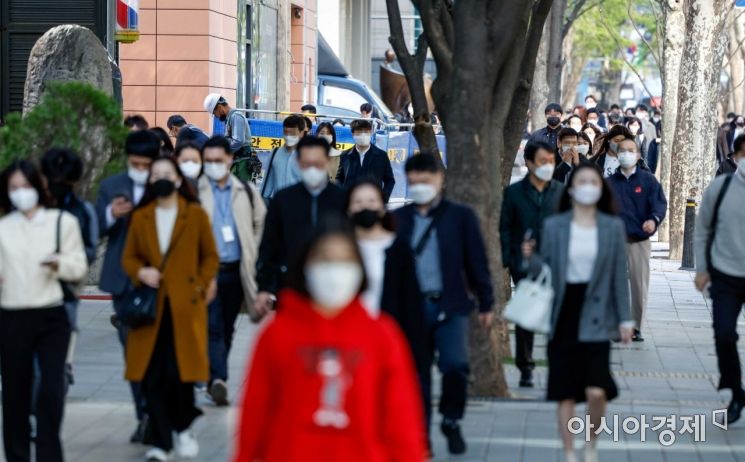 On the 15th, when the government decided to fully lift social distancing measures after 2 years and 1 month, office workers wearing masks were heading to work on Teheran-ro, Gangnam-gu, Seoul. Photo by Jinhyung Kang aymsdream@
[Asia Economy Reporter Kim Young-won] Starting from the 25th of this month, COVID-19 will be downgraded to a Category 2 infectious disease. Measures such as the lifting of quarantine obligations will be implemented after a transition period, expected to begin in mid to late May.
On the 15th, the government announced the "Post-Omicron Response Plan" containing these details. Authorities explained that as the Omicron variant wave has passed its peak and is declining, a plan to prepare for the post-Omicron phase has become necessary. On the same day, the government completed the administrative notice for revising the infectious disease classification and plans to lower COVID-19 to a Category 2 infectious disease around the 25th.
After a four-week transition period starting on the 25th, from mid-May (stabilization phase), there will be significant changes in COVID-19 testing, quarantine, and treatment methods. First, COVID-19 testing, which was primarily conducted through public testing systems such as public health centers, will shift to being centered on private medical institutions. This is because the purpose of testing has changed from "epidemic containment" to "rapid linkage to diagnosis and treatment." Accordingly, public health centers will focus on priority testing for high-risk groups such as the elderly. After the stabilization phase, efficient testing will be conducted mainly for symptomatic individuals requiring treatment, and there may be out-of-pocket costs for rapid antigen tests. Park Hyang, head of the Central Disaster and Safety Countermeasure Headquarters' quarantine team, stated, "We will further discuss what portion of the test fee (17,000 KRW) will be set as the patient's burden."
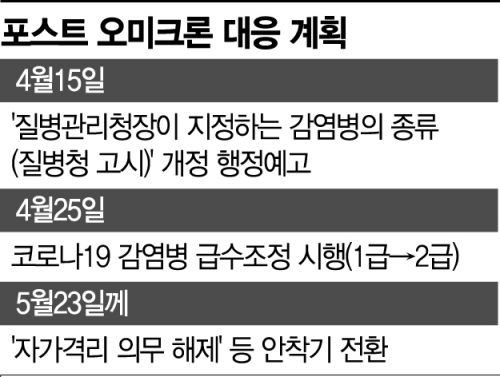
The seven-day self-quarantine will be maintained during the transition period even after the infectious disease classification is downgraded. However, in accordance with the characteristics of a Category 2 infectious disease, the obligation to "report immediately upon confirmation of infection" will change to "report within 24 hours." From the stabilization phase, confirmed cases will no longer be required to self-quarantine. The government has termed this not as "home quarantine" but as "home management." This means that COVID-19 patients can rest at home and manage their health on their own according to their will. Since temporary non-face-to-face medical consultations, which have been allowed since February 2020, will continue, confirmed patients can receive either remote or in-person medical care.
Furthermore, from the stabilization phase when the infectious disease classification is fully adjusted, patients will bear the cost of treatment and support fees that were previously fully covered by the government. Health insurance will apply to all treatment costs. However, the government plans to continue supporting hospitalization costs and oral antiviral medication costs related to COVID-19 for some time. A Korea Disease Control and Prevention Agency official explained, "We are tentatively reviewing that it would be better to maintain the current national subsidy method because the supply and utilization of therapeutics are considered very important in the transition to the general medical system."
While the government distinguished the transition and stabilization phases based on the 25th of this month and a four-week period for most matters, it did not set a clear timeline for vulnerable facilities such as nursing hospitals. The post-Omicron response plan for vulnerable facilities includes allowing visits and outings or overnight stays. Park said, "Since deaths and severe cases are still occurring in nursing hospitals and facilities, their vulnerability to infection must be considered," adding, "For infection-vulnerable facilities, rather than setting a fixed date for implementation, the overall situation and facility conditions should be comprehensively considered." Additionally, the government plans to investigate ventilation systems in vulnerable facilities by August and support their installation to improve the environment in the medium to long term. Next year, it will prepare pilot projects and residential environment improvements aimed at downsizing living units.
© The Asia Business Daily(www.asiae.co.kr). All rights reserved.
!["The Woman Who Threw Herself into the Water Clutching a Stolen Dior Bag"...A Grotesque Success Story That Shakes the Korean Psyche [Slate]](https://cwcontent.asiae.co.kr/asiaresize/183/2026021902243444107_1771435474.jpg)

















