J-20 to Counter US F-35, Protect China's Airspace and Maritime Interests
Performance Still Unverified... Stealth Capability Likely Reduced Due to Canard Installation
[Asia Economy Beijing=Special Correspondent Jo Young-shin] China's next-generation stealth fighter jet, the J-20, has reportedly begun patrol flights over the East China Sea and the South China Sea, according to state media.
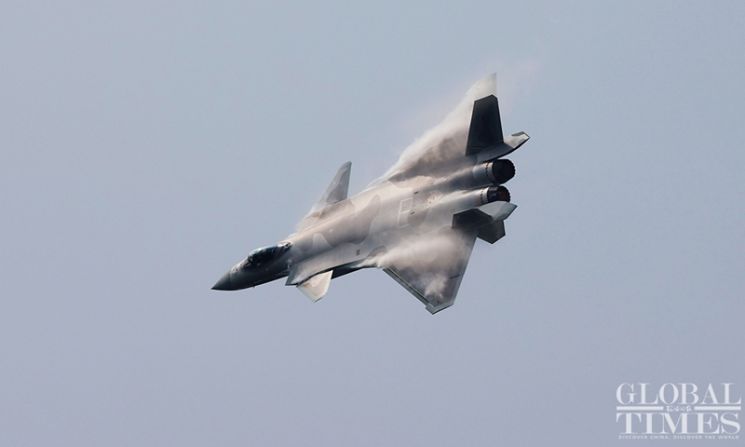
The state-run Global Times announced on the 14th that China's 5th-generation J-20 stealth fighter jet has commenced routine flight operations to protect Chinese airspace and maritime interests. The J-20 is a stealth fighter developed by China to counter the U.S. F-35 stealth fighter and is known to have entered mass production in July 2020.
The most notable feature of the J-20 deployed in actual combat is said to be the installation of a thrust vector control (TVC) system. TVC is a key technology necessary for controlling the fighter jet's attitude and flight trajectory. It is also reported to be equipped with an engine developed domestically by China.
Chinese military expert Song Zhongping stated, "If U.S. F-35 or F-22 fighters fly near China, the J-20 will intercept them in the future," adding, "The J-20 will confront U.S. fighters such as the F-35 head-on."
The Global Times report on this day implies that the J-20 has been deployed in actual combat in China's Eastern and Southern Theater Commands.
While Chinese media express strong pride in the performance of the J-20, skepticism about its capabilities is also a reality.
The J-20, developed by Chengdu Aircraft Corporation (CAC), is classified as a 5th-generation fighter, but its stealth capabilities are reported to be inferior. The J-20 measures 20.3 meters in length, 12.9 meters in wingspan, and 4.5 meters in height, making it larger than the U.S. main stealth fighter, the F-35.
It is designed as a wing-body blended type with forward horizontal canards instead of horizontal tail wings. The larger radar cross-section is generally evaluated as reducing stealth performance.
Its lower thrust is also cited as a drawback. The J-20's maximum speed is estimated to be around Mach 1.7 to 2.4, with analyses suggesting that sustained supersonic flight is difficult due to low engine output.
There are also doubts about the performance of the installed radar. The prevailing view is that the active electronically scanned array (AESA) radar performance will be inferior to that of the F-35.
© The Asia Business Daily(www.asiae.co.kr). All rights reserved.

















