Referred to Seoul St. Mary's Hospital as Treatment Difficult in Hawaii
Health Recovery through Collaboration with Neonatal Specialists
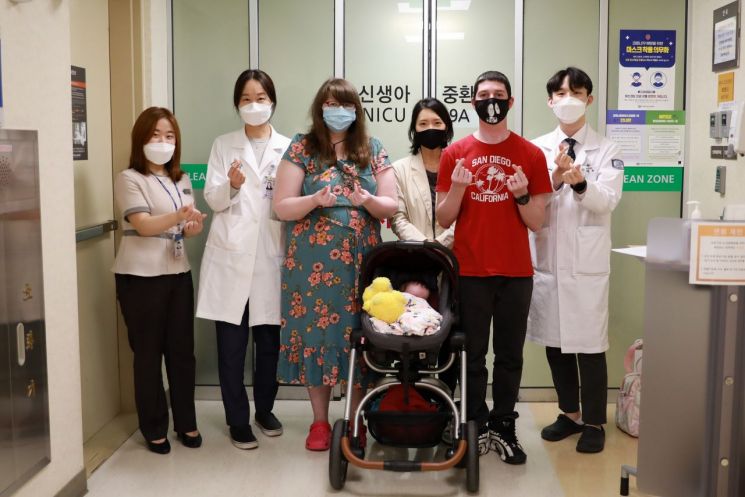
[Asia Economy Reporter Lee Gwan-joo] A fetus suffering from congenital anencephaly accompanied by complex malformations was safely born and returned to the family 44 days after birth.
According to the Catholic University Seoul St. Mary's Hospital on the 14th, Marceline Aqua Renaud, the child of Mr. and Mrs. Taylor Renaud of the U.S. 8th Army, born in February, was discharged earlier this month.
The mother, Star Hood, had been informed at her previous hospital that the baby had anencephaly along with abnormalities in several organs. Anencephaly, a condition where cerebrospinal fluid accumulates in the brain, is a rare disease with a poor prognosis, as survival is usually determined before birth, and even if born normally, neurological symptoms appear within weeks. Therefore, if symptoms are confirmed during pregnancy, termination of pregnancy is sometimes recommended.
The Renaud couple wanted to show their child the light of the world. While searching for a hospital in Hawaii, USA, where delivery was possible, they contacted Seoul St. Mary's Hospital, a major partner hospital of the U.S. 8th Army. Despite the uncertain survival of the baby, Professor Ko Hyun-sun of the Department of Obstetrics and Gynecology at the Congenital Disease Center at Seoul St. Mary's Hospital readily agreed to the delivery request, and the Renaud couple came to Korea.
The obstetrics department carefully assessed the baby's health and malformations through ultrasound examinations. Subsequently, a multidisciplinary consultation at the Congenital Disease Center was held, where the current condition and postnatal treatment were discussed with the guardians in one place. Especially before and after birth, the neonatal team managed the neonatal intensive care unit while close cooperation began with various departments including neurosurgery, pediatric cardiology, pediatric radiology, surgery, plastic surgery, ophthalmology, and otolaryngology.
As the size of the baby's ventricles rapidly increased due to anencephaly, neurosurgery performed a ventriculoperitoneal shunt. Pediatric cardiology and thoracic surgery performed pulmonary artery banding surgery to alleviate symptoms of atrioventricular septal defect. Additionally, the baby underwent surgeries on the head and ears and gradually recovered health in the neonatal intensive care unit before being discharged.
Professor Yoon Young-ah of pediatrics, the attending physician, said, “The multidisciplinary collaboration before birth at the Congenital Disease Center increased the guardians' understanding and cooperation, and after birth, complex malformations of the brain, heart, kidneys, eyes, hearing, and skin were smoothly resolved one by one thanks to the collaboration. Continuous treatment and observation will likely be necessary through outpatient care in neonatology, pediatric cardiology, and neurosurgery.”
The baby's father, Taylor Renaud, expressed gratitude, saying, “While the baby was hospitalized in the neonatal intensive care unit recovering, we prepared the room and arranged a car seat and stroller to welcome the baby. Now that the baby is finally discharged, I feel both excited and worried, but I hope the baby eats well and stays healthy.”
© The Asia Business Daily(www.asiae.co.kr). All rights reserved.

















