[Asia Economy Reporter Donghyun Choi] "I am eagerly waiting for the chairman of the Legislation and Judiciary Committee to change when the National Assembly’s second half organization is formed this June."
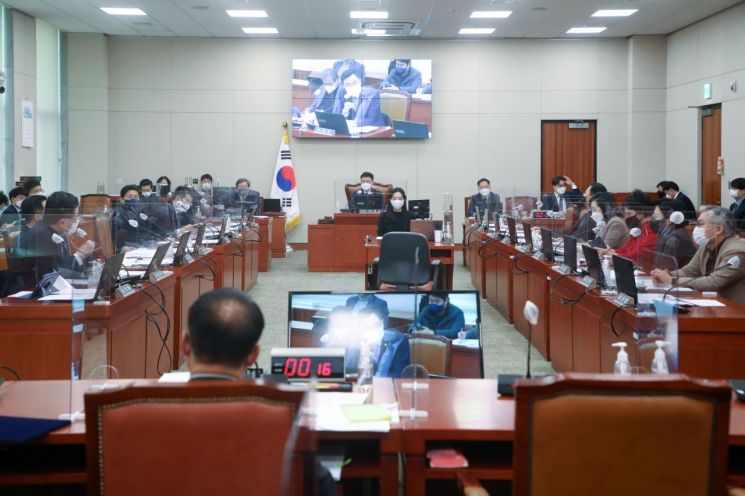
This is a complaint conveyed by a venture industry insider when asked if there is any political movement regarding the introduction of the ‘Multiple Voting Rights System’ (Differential Voting Rights System). Currently, the related bill has been stuck in the National Assembly’s Legislation and Judiciary Committee for months due to opposition from some members of the Democratic Party of Korea, leaving the venture and startup sectors helplessly waiting for the replacement of the committee chairman. According to prior agreement between the ruling and opposition parties, the chairman of the Legislation and Judiciary Committee in the second half of the 21st National Assembly is to be held by the People Power Party. The People Power Party does not oppose the introduction of multiple voting rights, and since it was also a pledge of President-elect Yoon Suk-yeol, there is hope that the bill will be processed within the second half of this year through the chairman’s prerogative to bring it to the agenda.
The Multiple Voting Rights System allows exercising two or more voting rights per share until the company goes public. The purpose is to guarantee that founders can operate their companies stably without feeling threatened in their management rights during the investment attraction process. Alphabet, Google’s holding company, succeeded in listing on NASDAQ in August 2004 through the multiple voting rights system, making it a long-standing wish of the venture and startup sectors in Korea, where discussions on its introduction have continued for over 15 years.
The introduction of the multiple voting rights system gained momentum under the Moon Jae-in administration. The Democratic Party of Korea promised the introduction of the system as their second pledge in the February 2020 general election. In June 2020, the bill for the multiple voting rights system was introduced by Representative Yang Kyung-sook of the Democratic Party. In the second half of 2020, then Minister of SMEs and Startups Park Young-sun announced plans to introduce the system through amendments to the Special Measures Act on the Promotion of Venture Businesses. After the government proposal was submitted in December last year, it passed the Industry, Trade, Energy, SMEs and Startups Committee, the relevant standing committee of the National Assembly, about a year later, and the ball was passed to the Legislation and Judiciary Committee.
The government’s multiple voting rights bill currently pending in the Legislation and Judiciary Committee requires the founder to obtain consent from shareholders holding three-quarters of the total shares to issue multiple voting rights shares. If the major shareholder is the founder, to prevent abuse of control, the voting rights per share are limited to a maximum of 10. The duration of the multiple voting rights is limited to a maximum of 10 years. Major resolutions such as appointment and dismissal of auditors and changes to the duration are restricted to one vote per share. Additionally, if the company becomes part of a publicly disclosed business group or if multiple voting rights shares are inherited or transferred, they must be converted into common shares. These measures were designed to minimize various side effects that emerged during discussions on the introduction of the multiple voting rights system.
Nevertheless, some Democratic Party members, including Park Ju-min, Park Yong-jin, and Oh Ki-hyung, who were active in Lee Jae-myung’s camp, oppose the introduction of the multiple voting rights system, and the bill has yet to even be placed on the agenda of the Legislation and Judiciary Committee. They argue that in Korea, where corporate governance and protection of minority shareholders are weak, the problems caused by the introduction of the multiple voting rights system would be greater, so more thorough discussion and social consensus are necessary.
However, with the recent regime change, momentum for the introduction of the multiple voting rights system is growing. The justification for keeping the bill, which most lawmakers from both ruling and opposition parties and the venture and startup sectors agree on, tied up for a long time just because some Democratic Party members oppose it, has weakened. Typically, the agenda of the Legislation and Judiciary Committee is set through agreement between ruling and opposition party secretaries, but it can also be done at the chairman’s discretion. This means that even if Democratic Party members are the majority in the committee during the second half of the National Assembly, the agenda can be set. However, there is a possibility of confrontation between the ruling and opposition parties over the chairman position in the second half, as the Democratic Party has become the opposition and may break previous promises.
It is also encouraging that on the 13th, Lee Young, a People Power Party lawmaker, was appointed as the first Minister of SMEs and Startups under the Yoon Suk-yeol administration. Lee is an IT venture entrepreneur who founded Terten, a venture company providing digital content security solutions, in 2000. He entered the 21st National Assembly in 2020 as a proportional representative of the People Power Party. Lee also introduced a bill for the introduction of the multiple voting rights system in August 2020 as a representative of the opposition. A representative from the Korea Federation of SMEs said, "The candidate is an expert who knows the field well as a former small business owner," adding, "There is a high possibility that he will push the legislation of the multiple voting rights system as a key policy task."
© The Asia Business Daily(www.asiae.co.kr). All rights reserved.

















