Howard Schultz Draws Sword, Cites Federal Law to Deny Expanded Compensation for Union Members
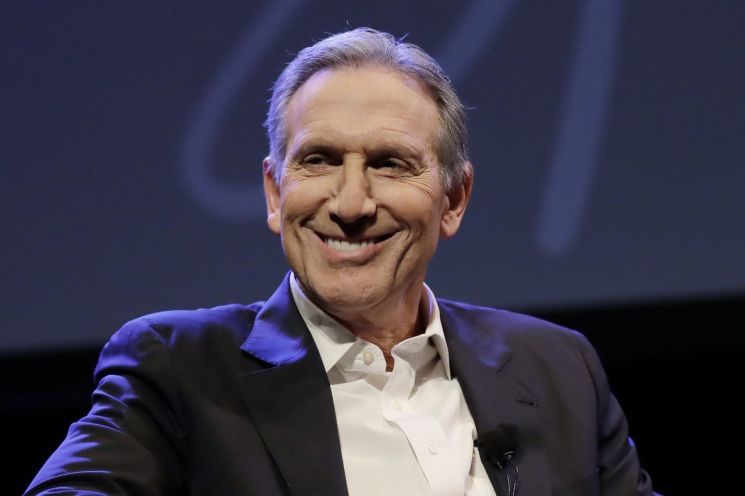
[Asia Economy Reporter Jeong Hyunjin] Howard Schultz, who took the position of interim CEO as Starbucks' "relief pitcher," announced that he plans to expand employee compensation but will exclude those who have joined the union. This is interpreted as a full-scale response to put the brakes on the accelerating unionization movement at Starbucks stores in the United States.
According to the Wall Street Journal (WSJ) on the 13th (local time), CEO Schultz recently stated in an online forum with U.S. store owners that he is considering expanding the compensation package for employees. This plan was announced after he halted the company's stock buyback plan immediately after taking office on the 4th and said he would invest those funds in stores and employees instead.
CEO Schultz said that this compensation expansion would help reduce employees feeling worn out, and that they would hire additional baristas and be able to retain them. He did not disclose specific details of the expanded compensation program nor the timing of its implementation.
What stands out in the news about the compensation expansion program review is that store employees who voted to join the union are not included in the application scope. CEO Schultz cited Starbucks' legal team, stating that under federal law, compensation for unionized employees must be negotiated separately with union representatives, and the company cannot unilaterally change compensation.
Casey Crayton, director of the Cornell University ILR Buffalo CoLab and a former attorney for the National Labor Relations Board (NLRB), said that it is correct that legally the employer cannot unilaterally change compensation if employees form a union, but if union members want to receive the same benefits, they can request it from the employer. She evaluated that citing this as a reason itself is a "union avoidance strategy."
CEO Schultz has expressed an anti-union stance. In his book, he introduced that there was a unionization movement early in his management around 1987, stating, "Under my leadership, I believed I could listen well to employees' concerns and resolve them, and if there is trust in me, I thought a union was unnecessary." Regarding the compensation expansion program this time, CEO Schultz also claimed that compensation could be increased without a union.
Along with Amazon, Starbucks is one of the large companies in the U.S. where unionization movements have been strong since last year. Of the approximately 9,000 Starbucks stores in the U.S., about 200 have been moving toward unionization since last year, and the NLRB has recognized union formation at eight Starbucks stores.
In this atmosphere, as CEO Schultz returned to lead Starbucks after four years, the market anticipated that he, who holds anti-union principles, would take action. In fact, from his first week in office, CEO Schultz personally met with employees pushing for union formation to resolve the union issue, and on the 10th, he sent a letter to employees expressing that he could not agree with their approach and message.
© The Asia Business Daily(www.asiae.co.kr). All rights reserved.

















