Strong Market Conditions Boost Samsung's Foundry Sales to Potentially Surpass 30 Trillion Won This Year
Gap in Market Share with No.1 TSMC Also Narrows
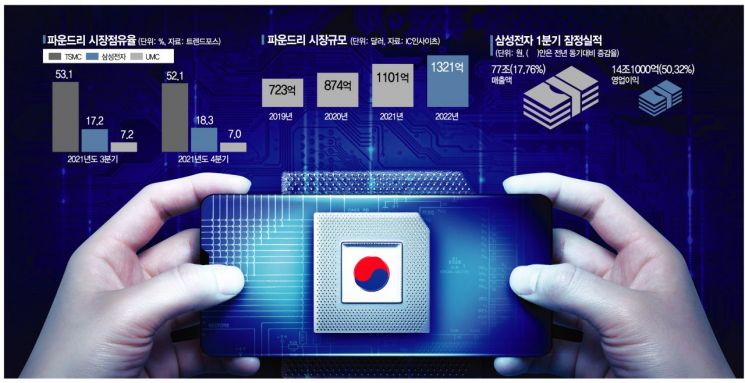
[Asia Economy Reporter Park Sun-mi] Samsung Electronics is expected to record its highest-ever foundry (semiconductor contract manufacturing) sales in the first quarter of this year. The gap with Taiwan's TSMC, the global market leader, is also continuously narrowing, raising expectations that with government support measures to realize the 'semiconductor superpower' pledged by President-elect Yoon Seok-yeol, the goal of becoming the number one system semiconductor company by 2030 could be achievable.
Foundry Super-Gap... First Quarter Sales Expected to Hit Record High
According to the semiconductor and securities industries on the 13th, Samsung Electronics announced preliminary results for the first quarter of this year exceeding 77 trillion won, with foundry division sales estimated at 7 trillion won. This is the largest scale ever. Samsung Electronics will not separately disclose foundry division results within the semiconductor business (DS) during the scheduled first quarter earnings announcement and conference call on the 28th. However, due to the ongoing global foundry supply shortage, foundry service prices have risen, leading to expectations of significant sales growth in the first quarter.
Currently, the foundry industry has been able to increase unit prices and profitability due to fabless (semiconductor design-specialized) companies placing orders even with advance payments. Global major fabless companies are lining up to entrust production to TSMC and Samsung Electronics, which dominate processes below 10nm, while small and medium fabless companies are being phased out due to failure to secure foundry companies.
In the securities sector, despite the first quarter being a seasonal low for the semiconductor industry, Samsung Electronics' foundry sales are expected to exceed 7 trillion won, making it possible to surpass annual sales of 30 trillion won for the first time this year.
The barometer is TSMC, the global market share leader that announced its results earlier. TSMC, specializing solely in the foundry business, posted first-quarter sales of 49.108 billion Taiwan dollars (approximately 20.8 trillion won), a 35.5% increase year-on-year. Particularly, March sales reached about 7.3 trillion won, a 17% increase compared to February. UMC, ranked third in the foundry industry after Samsung Electronics, has also been setting record-high sales for six consecutive months recently.
No Geun-chang, a researcher at Hyundai Motor Securities, stated, "Although recent issues such as yield decline in 4nm foundry processes and potential loss of some strategic clients have emerged, the base effect of last year's Austin plant shutdown suggests that Samsung Electronics' foundry division is expected to experience excess growth this year."
Samsung Electronics Narrowing Gap with TSMC... Strengthened Government Support
According to global market research firm IC Insights, the global foundry market size this year is expected to be around $132.1 billion (approximately 163.3 trillion won). It has grown sharply from $72.3 billion in 2019 to $87.4 billion in 2020, $110.1 billion in 2021, and $132.1 billion in 2022. The industry expects the foundry market to grow at a rate in the 20% range this year and to continue growing purely in the foundry sector for at least the next five years.
Until now, Samsung Electronics' semiconductor growth has been skewed toward the strong memory sector, but the foundry division, which corresponds to non-memory, is expected to determine future growth. By focusing on the much larger non-memory sector, the market share gap between Samsung Electronics and TSMC is gradually narrowing.
According to market research firm TrendForce, Samsung Electronics' global foundry market share based on fourth-quarter sales last year was 18.3%, up 1.1 percentage points from 17.2% in the third quarter. Although TSMC's share remains dominant at 52.1%, it decreased by 1 percentage point from 53.1% in the previous quarter, further narrowing the gap between Samsung Electronics and TSMC. The estimated sales difference also shrank from 3.09 times in the third quarter to 2.8 times in the fourth quarter last year.
The industry expects that since President-elect Yoon has announced plans to foster the semiconductor industry by easing regulations and increasing support, Samsung Electronics' pursuit of TSMC in the foundry sector could accelerate.
The Presidential Transition Committee is currently reviewing support measures to secure a semiconductor super-gap, including talent development, deregulation, and investment incentives, to realize a 'semiconductor superpower.' To address the semiconductor industry's long-standing labor shortage, plans under consideration include expanding student and faculty quotas through designation of semiconductor-specialized universities, establishing semiconductor graduate schools in fields such as artificial intelligence (AI) and power to increase master's and doctoral experts, as well as education programs for non-majors switching to semiconductor majors and expanding contract departments for materials, parts, and equipment (SoBuJang).
In particular, since the transition committee has designated the system semiconductor industry, which Samsung Electronics, SK Hynix, and other Korean semiconductor companies are nurturing as next-generation businesses, as a key support target, budget support to promote new and expanded foundry factories is also expected to follow.
The nomination of Lee Jong-ho, a world-renowned semiconductor expert, as the first Minister of Science and ICT in the Yoon Seok-yeol administration is also a hopeful sign for the semiconductor industry.
Lee, who has served as director of the Seoul National University Semiconductor Joint Research Center, expert committee member of the Korea Research Foundation ICT Convergence Research Group, member of the Ministry of Science and ICT's SoBuJang (materials, parts, and equipment) special committee, and member of the Ministry's AI and software advisory committee, is regarded as an expert suitable for industrial development due to his policy advisory activities aimed at strengthening Korea's semiconductor technological competitiveness.
© The Asia Business Daily(www.asiae.co.kr). All rights reserved.

















