Yoon to Announce 2nd Cabinet and Chief of Staff Today
Presidential Office Reorganization Expected to Accelerate
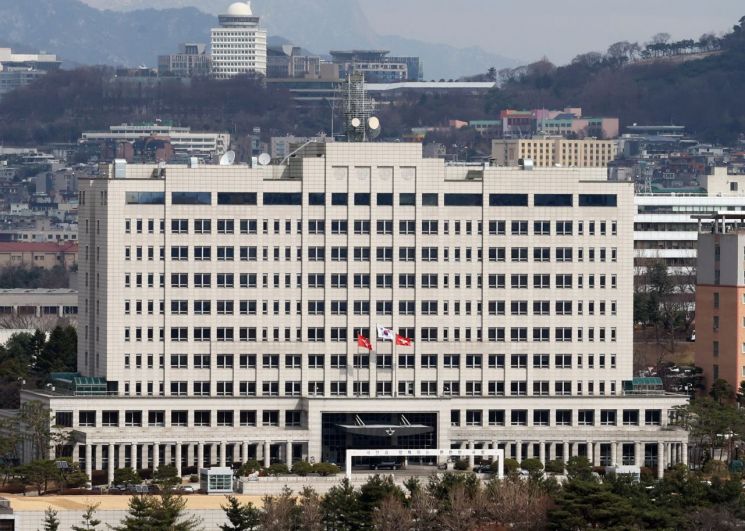 The Ministry of National Defense building in Yongsan-gu, Seoul, where the Blue House office will be relocated [Image source=Yonhap News]
With former Blue House Policy Chief Kim Dae-gi virtually appointed as the first Chief of Staff under the Yoon Suk-yeol administration, there are expectations that the authority of the public-private joint committee directly under the president will be strengthened. This is because the emergence of a 'policy expert' as Chief of Staff is gaining traction as a sign that policy functions, including the economy, will become central to the presidential office. On the 13th, Yoon's transition team announced the second cabinet and the appointment of the presidential chief of staff, and plans to release follow-up personnel changes at the presidential office, which will be renamed from the Blue House, over the weekend.
According to the presidential transition committee, Yoon's strong will to 'revive the economy' is considered the main reason for nominating Kim as Chief of Staff. An official explained, "The intention to prioritize people's livelihood and the economy was reflected in the appointment of the Chief of Staff." Kim, a former administrative examination pass, has served as Budget Director at the Ministry of Planning and Budget, Blue House Senior Secretary for Economic Affairs, and Policy Chief. In his book, Trapped Korean Economy, he emphasized private-sector-led growth, stating, "In the past, countries fell due to war, but now they fall due to national debt."
The presidential office organization is expected to focus on strengthening policy functions, including the public-private joint committee. The committee is considering establishing six subcommittees: national integration, regional balanced development, COVID-19 crisis response, climate and energy, innovative growth, and mid- to long-term tasks. The plan is to involve related public officials and private experts such as businesspeople and professors with expertise in each field to ensure not only policy momentum but also flexibility and efficiency. A transition committee official said, "Since secretaries have limitations in hearing field difficulties, the aim is to place more emphasis on reflecting voices from the field." The intention is to change the framework of state administration by deciding important policies through meetings of the public-private joint committee in the future.
For example, if the public-private joint committee handles job creation strategies, it can better reflect in policies how jobs are actually created on the ground and which industries or companies should be the focus of the strategy. However, the prevailing view is that granting voting rights to the public-private joint committee will not be adopted. This reflects concerns that giving authority to private members who do not go through confirmation hearings could lead to abuse of power or conflicts of interest.
On the same day in the afternoon, Yoon will also announce candidates for ministers of the remaining 10 ministries, including Education, Foreign Affairs, Unification, Justice, Interior and Safety, Employment, SMEs and Startups, Oceans and Fisheries, Agriculture, and Environment. It is expected that at least 7 to 8 ministries will be announced. The presidential office's Senior Secretary for Political Affairs will also be announced. Bae Hyun-jin, Yoon's spokesperson, said at the transition committee briefing, "Yoon will personally introduce each person at the press conference."
© The Asia Business Daily(www.asiae.co.kr). All rights reserved.
![Clutching a Stolen Dior Bag, Saying "I Hate Being Poor but Real"... The Grotesque Con of a "Human Knockoff" [Slate]](https://cwcontent.asiae.co.kr/asiaresize/183/2026021902243444107_1771435474.jpg)
















