Average Domestic Blood Supply Lasts 3.4 Days
Blood Crisis Level Rated as 'Concern'
Blood Shortage Disrupts Normal Medical Activities
COVID-19 and Continuous Donor Shortage Cause Crisis
Imported Blood Share Increasing in Domestic Usage
Blood Donation Agencies: "Active Participation Is the Only Solution"
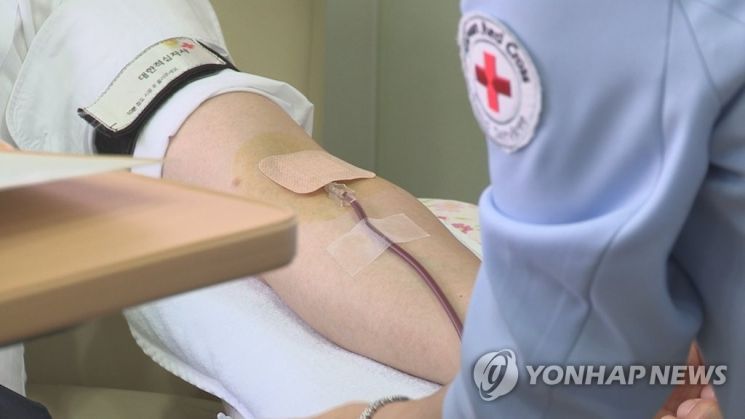 The domestic blood supply situation has reached the first stage of crisis, classified as a 'concern' status. As of the 12th, the average blood stock in the country is 3.4 days' worth. / Photo by Yonhap News
[Asia Economy Reporter Lim Juhyung] #Mr. Yoo, a man in his 30s, recently heard that a relative with blood type B was urgently looking for a designated blood donor. He said, "They need to transfuse platelets during surgery, but the hospital currently has no remaining blood, so a donor is urgently needed. Since family members or relatives cannot be donors, I felt sorry for not being able to help." He added, "I had vaguely heard that hospitals are in chaos due to a lack of blood these days, but I didn't realize the situation was this serious."
It has been revealed that the domestic blood reserve has reached the 'interest' stage of the blood supply crisis. This means that the total blood stock available for all blood types combined is only about three days' worth. Generally, it is known that a stable medical operation requires a blood reserve of at least five days on average.
In South Korea, the blood reserve has been decreasing over the past several years, and especially recently, the COVID-19 pandemic has caused a significant increase in ineligible blood donors, leading to this 'blood shortage' phenomenon. Blood donation organizations have raised their voices, calling for social attention to resolve the blood supply crisis.
◆Domestic Blood Reserves Down to Only '3 Days'
The Blood Management Headquarters under the Korean Red Cross publishes daily blood reserve status on its official website at midnight. According to the latest data on the 12th, the red blood cell supply for all blood types combined averages 3.4 days remaining. Blood type B, which has the highest surplus, has 3.9 days, while type O has the least, with only 3.0 days left.
The Blood Management Headquarters considers a daily average reserve of five days as the 'appropriate blood reserve level.' If the blood supply falls below this level, there is a risk that medical institutions may not receive adequate blood supply. The Blood Management Headquarters classifies the blood reserve status as 'interest' if below five days, 'caution' if below three days, 'alert' if below two days, and 'critical' if below one day, and responds accordingly.
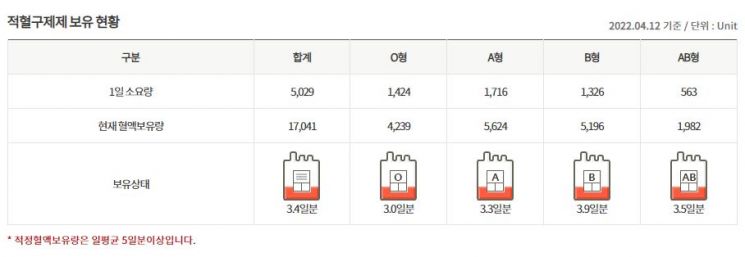 Domestic blood supply status. / Photo by Korean Red Cross Blood Management Headquarters website capture
Currently, the blood reserve is at the earliest warning stage of 'interest,' but medical sites may still face disruptions in blood supply. The information posted by the Blood Management Headquarters represents a national average, and there may be regional variations. Also, blood types with higher demand may run out faster than others.
For example, as of midnight on the 8th, the Korean Red Cross Gwangju-Jeonnam Blood Center reported that the blood reserve in the Gwangju and Jeonnam regions was only 2.2 days, placing it in the 'caution' stage. This means there is a possibility of a crisis where patients' lives could be endangered due to delayed blood supply.
◆COVID-19 Pandemic and Decrease in Donors Trigger 'Blood Shortage'
This is not the first time a 'blood shortage' has occurred in South Korea. During the nationwide social distancing measures strengthened in 2020 due to the COVID-19 pandemic, the number of blood donors sharply declined, causing disruptions in blood supply.
Especially as the COVID-19 situation prolonged, blood donation centers found it increasingly difficult to recruit donors. Consequently, in September last year, the Ministry of Health and Welfare (MOHW) held the National Blood Donation Promotion Council, collaborating with various ministries and local governments to intensify blood donation campaigns.
This year, the surge in confirmed cases due to the Omicron variant is cited as a major cause of the blood supply crisis. COVID-19 confirmed patients are classified as 'ineligible donors' for up to five weeks?one week after confirmation plus four weeks after recovery?during which they cannot donate blood. According to health authorities, the cumulative number of COVID-19 cases has surpassed 15 million, with most infections occurring within the past month. With about 30% of the population unable to donate blood, recruiting donors has inevitably become more difficult.
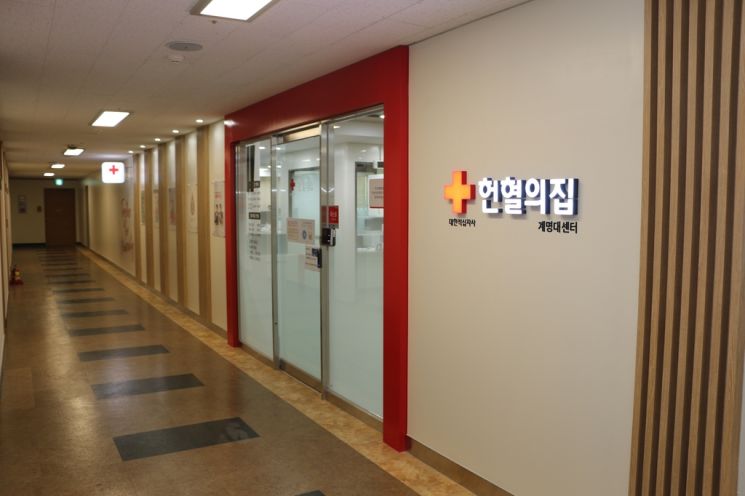 In recent years, the ongoing COVID-19 pandemic has made it difficult to recruit blood donors. The photo shows the Blood Donation Center at Keimyung University and is not related to the specific expressions in the article. / Photo by Daegu Gyeongbuk Blood Center
In addition, blood donations have steadily decreased over recent years. According to blood donation data submitted to independent lawmaker Jeon Bong-min's office by the Blood Management Headquarters last year, the number of blood donors in South Korea was 2.71 million in 2017, 2.68 million in 2018, 2.61 million in 2019, and dropped to 2.43 million in 2020.
Meanwhile, the total domestic plasma usage increased by about 41.4%, from 672,574 liters (ℓ) in 2015 to 950,914 ℓ in 2020.
◆Importing Blood from Abroad Also Difficult... "Participation in Blood Donation is the Only Solution"
If domestic blood supply cannot meet demand, importing blood from overseas becomes inevitable. In fact, the reliance on foreign blood for domestic consumption has been increasing. The self-sufficiency rate for surgical plasma was 95.4% in 2015 but dropped by 40.3 percentage points to 55.1% in 2020.
However, dependence on foreign blood cannot continue indefinitely. The international community currently advocates the principle of 'blood self-sufficiency.' In 1975, the World Health Organization (WHO) and the International Federation of Red Cross and Red Crescent Societies (IFRC) established and recommended to all countries the principles of "blood self-sufficiency by nationals" and "exclusion of commercial use of blood."
Because blood testing methods and operational standards vary by country, securing and managing blood through domestic blood donation is the safest approach. It also helps prevent the formation of a so-called 'black market for blood.'
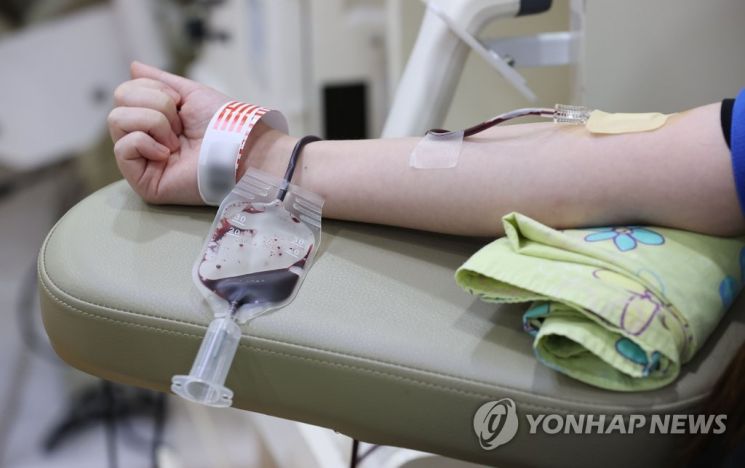 In August 2020, attending physicians from Seoul National University Hospital participated in a blood donation relay campaign at the Blood Donation House Daehakro Center in Jongno-gu, Seoul. / Photo by Yonhap News
Given this situation, the government is also working to introduce systematic blood management laws to reduce waste and accidental disposal of blood.
Since 2018, the Ministry of Health and Welfare has been developing the 'Transfusion Appropriateness Evaluation Index.' This index aims to establish precise guidelines to ensure that only the necessary amount of blood is transfused to patients who truly need it.
Blood donation organizations have urged that overcoming the current blood supply shortage requires social attention, including from the government and the public.
The Blood Management Headquarters stated, "We are requesting active group blood donations from the government, public institutions, and military units, and conducting blood donation events and promotional activities to restore blood reserves." They emphasized, "The current situation is a blood shortage that could paralyze the normal blood supply system."
They added, "The only solution to overcome this crisis is the participation of blood donors. We earnestly ask everyone to actively participate in blood donation to ensure that patients' lives are not threatened."
© The Asia Business Daily(www.asiae.co.kr). All rights reserved.



















