10,000-Person Protest Tomorrow at Gwanghwamun and Other Locations
Repeatedly Escalating Protest Intensity
Corporate Innovation Severely Blocked
Samsung Faces Strike Crisis Over Wages
Kumho Tire, Hyundai Motor Also in Conflict
Experts Warn "Concerns Over Decline in Corporate Productivity"
Police Considering Deploying Around 5,000 Officers
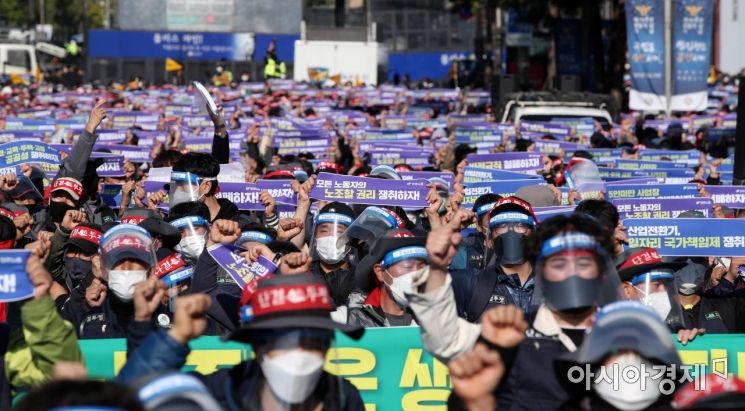 On October 20 last year, members of the Korean Confederation of Trade Unions (KCTU) held the "10·20 KCTU General Strike Rally" at the Seodaemun Station intersection in Seoul, urging the abolition of discrimination against workplaces with fewer than five employees, the elimination of irregular employment, and the securing of union activity rights for all workers. Photo by Hyunmin Kim kimhyun81@
[Asia Economy Reporters Choi Dae-yeol, Yoo Hyun-seok, Jang Se-hee, Kim Jin-ho, Moon Chae-seok] As the labor sector's spring labor struggle (Chuntu) intensifies, the management clocks of major companies such as Samsung Electronics and Hyundai Motor Group are plunging into uncertainty. While fiercely competing for survival in the 'global jungle,' major conglomerates are facing a series of obstacles in discovering future growth engines due to resistance from strong labor unions. Moreover, with the pro-business Yoon Seok-yeol administration about to take office, the labor sector's level of struggle is expected to rise further, increasing the concerns of companies.
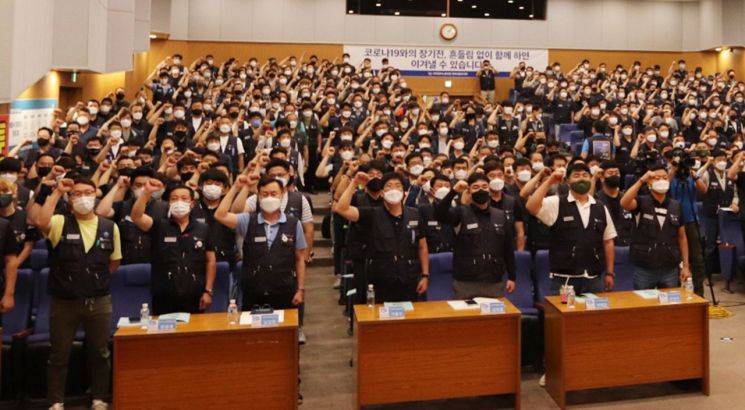
According to the industrial sector and police on the 12th, the Korean Confederation of Trade Unions (KCTU) plans to hold rallies on the 13th near the Presidential Transition Committee office, as well as in various parts of downtown Seoul such as Yeouido and Gwanghwamun. The police estimate that up to 10,000 people will participate in the rallies.
The KCTU held a press conference the day before, stating, "The president-elect and the transition committee are consistently pursuing anti-labor, anti-commoner, and pro-chaebol policies," and demanded, "Stop attempts to worsen the Serious Accident Punishment Act, the Non-regular Workers Act, the minimum wage, and labor hour restrictions."
The labor sector has signaled a tough struggle mode ahead, as President-elect Yoon Seok-yeol has expressed a stance of "strict punishment for strong unions" and hinted at revisions to the Serious Accident Punishment Act and the minimum wage.
The business community voiced concerns. The Korea Employers Federation criticized in a statement that "amid ongoing concerns over the spread of COVID-19, the KCTU's decision to forcibly hold illegal rallies again is a serious challenge to the rule of law."
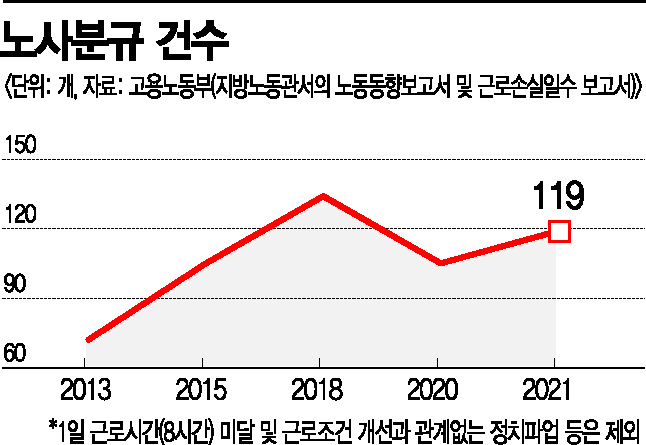
In the midst of fierce competition amid COVID-19 and global hegemony struggles, the business community, facing the risk of falling behind in competitiveness, is repeatedly hampered by strong labor unions. According to the Ministry of Employment and Labor's 'e-Employment Labor Index,' the number of labor disputes last year was 119, an increase of 14 from 105 in the previous year. The resulting lost workdays due to labor disputes also reached 471 days last year. Lost workdays measure social losses directly caused by labor disputes. This indicates that even amid the severe COVID-19 situation, workplaces where work was halted due to union refusals over disagreements on working conditions have increased. A business community official expressed concern, saying, "In the worst corporate management environment, political struggles aligned with the pro-business new government will act as obstacles to efforts to revive the economy."
Meanwhile, the police plan to deploy more than 5,000 officers for the KCTU rally and farmers' assembly scheduled on the 13th, expecting over 10,000 participants. They are considering measures such as blocking rallies within the city or closing access routes like the Gyeongbu Expressway. The court is expected to partially accept the KCTU's injunction request to suspend the rally ban. A police official said, "Regardless of the court's decision, since the rally may proceed in the city, we will deploy forces according to the expected number of participants based on police intelligence."
As this rally is the first large-scale gathering after the presidential election, it is expected to provide insights into the new government's rally response policy. Seoul Police Chief Choi Kwan-ho said at a press briefing the day before, "If the public order is threatened, we will make judgments according to the situation on-site, activate order maintenance lines, or designate police deployment points to minimize inconvenience to citizens."
Samsung Electronics Faces First Strike Threat Since Founding
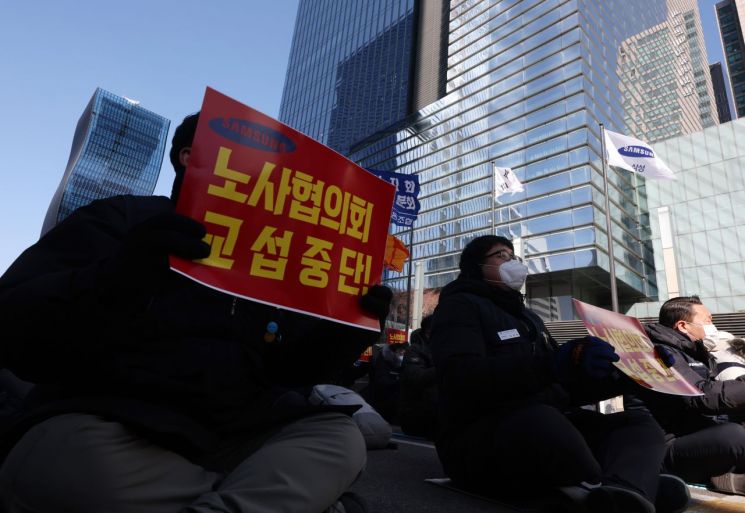 The 'Samsung Group Labor Union Joint Wage and Collective Bargaining Struggle Victory Rally' held in front of the Samsung building in Seocho-dong, Seoul, on the afternoon of February 23. (Image source=Yonhap News)
"Raise wages by 15.7%." (Samsung Electronics Union) "We will initiate legal procedures to enforce domestic factory facility investments." (Kumho Tire Union)
"If the transition to future cars results in employment insecurity, we will strongly resist." (Hyundai Motor Union)
Although corporate management is expected to get back on track with the COVID-19 endemic, major workplaces are struggling with union risks. Amid the global emergency caused by the COVID-19 pandemic and Russia's invasion of Ukraine disrupting global supply chains, the labor sector is already preparing to increase its combat readiness. Strong union leaderships have been elected one after another in key manufacturing sectors, entering a hardline mode. Experts advise that considering global competitors are rapidly preparing future growth strategies and making large-scale investments, domestic companies must unite labor and management to survive.
According to the business community on this day, Samsung Electronics is struggling to find common ground in labor-management conflicts over wage increases. Usually, labor-management councils hold meetings in February or March to finalize the annual wage increase rate, but this year, the gap between labor and management is so wide that no conclusion has been reached. The core issue is the wage increase rate. The workers' representatives demanded a historic high basic increase rate of 15.7%, but the company is reportedly reluctant due to the burden of labor costs. Last year, Samsung Electronics' labor-management council agreed on an average wage increase of 7.5%.
As the situation enters a prolonged phase, some analyses suggest Samsung Electronics is heading toward its first strike threat in 53 years since its founding in 1969. The union is reportedly preparing to use the 'strike card' as a breakthrough in the deadlocked wage negotiations. However, the demand for a 15.7% wage increase is considered excessive by public opinion as well as inside and outside Samsung Electronics. While it is true that Samsung Electronics achieved record-breaking performance last year as the union claims, critics question whether it is appropriate to significantly increase labor costs all at once amid COVID-19 and intensified global semiconductor competition.
Samsung Electronics, with over 110,000 domestic employees, already bears an overwhelming labor cost burden compared to other companies. Last year, Samsung Electronics spent about 15.8 trillion won on labor costs, an 18.4% increase from the previous year, marking the largest scale ever. There are also concerns about representativeness. The union, which accounts for only 4% of the total 110,000 employees, may not adequately reflect the overall stance. A company official said, "The union is mostly composed of certain ranks, so many other employees strongly criticize internally that their grievances and demands are not properly represented."
"Investment and Manpower" Demands But Ignores Workplace Competitiveness
 The Hyundai Motor Labor Union held an extraordinary delegates' meeting on July 5 last year at the Hyundai Motor Culture Hall in Buk-gu, Ulsan, violating the resolution on the occurrence of disputes related to wage and collective bargaining negotiations. (Photo by Yonhap News)
In the automotive industry, signs of labor-management conflicts are emerging at major workplaces. Last year, Hyundai Motor, Kia, Korea GM, and SsangYong Motor concluded wage collective bargaining without strikes, but the atmosphere has changed this year. Strong unions have been established at Hyundai Motor, Kia, and major affiliates, and labor unions have agreed to speak with one voice on employment and manpower issues. This is because significant changes are deemed inevitable both inside and outside the unions as the automotive production paradigm shifts from internal combustion engines to electric vehicles. The unions repeatedly oppose manpower redeployment, overseas transfer of finished car production volumes, and new factory establishment processes, leading to prolonged negotiations with management. Korea GM is also engaged in a tug-of-war over manpower redeployment at the Bupyeong plant. The utilization rate gap between the two production lines (Plant 1 and 2) at Bupyeong has widened, and manpower adjustments are needed for new models scheduled for pilot production at the Changwon plant in the second half of this year, but the union raises issues such as treatment improvements. An industry insider expressed concern, saying, "At the US GM headquarters level, the competitiveness of each country's plants will be evaluated to allocate electric vehicle volumes, and if the union only raises hardline voices, it will not be easy."
The Kumho Tire labor-management parties are clashing over domestic and overseas factory investment projects. At a meeting held last month among labor, management, major shareholders, and the Korea Development Bank, the major shareholder Double Star clearly stated that "among the global top 20, only Kumho Tire is running at a loss," and that there will be no additional facility investment at the Gwangju plant, which is being relocated. The union has decided to take legal steps to ensure the company proceeds with domestic factory facility investments as originally planned.
Experts warn that labor-management conflicts may become more acute after the new government takes office, potentially severely damaging corporate productivity. Professor Yoon Dong-yeol of Konkuk University said, "Unions have strengthened their social and political influence through negotiations with the government so far," adding, "Rather, more focus should be placed on practical coexistence between labor and management, productivity issues directly linked to corporate competitiveness, and developing workplaces."
© The Asia Business Daily(www.asiae.co.kr). All rights reserved.



















