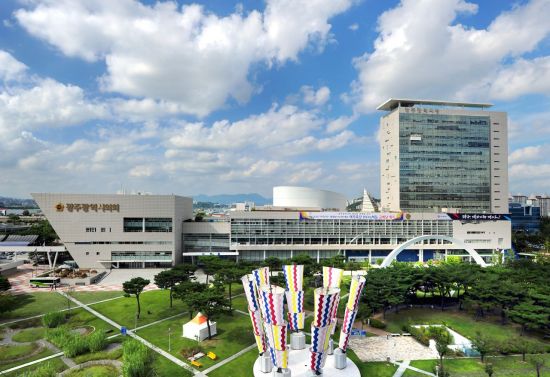
[Asia Economy Honam Reporting Headquarters Reporter Park Jin-hyung] Gwangju Metropolitan City is accelerating the continuous promotion of the medical healthcare industry.
On the 12th, Gwangju City announced that it aims to achieve medical industry sales of 2.3 trillion KRW, employment of 9,000 people, and 2,000 companies by 2030, aspiring to leap forward as a global MedCity.
The biohealth sector is a representative promising industry in the post-COVID-19 era, steadily growing as an industry that fits both the social issue of rapid population aging and the technological trend of the convergence of 4th Industrial Revolution technologies.
The current government has selected the biohealth sector as one of the three future core growth engines (biohealth, future cars, system semiconductors) and allocated a budget of 1.88 trillion KRW this year for the biohealth industry, an increase of 6.8% (120 billion KRW) compared to the previous year.
Through this, the government is steadily accumulating innovation and COVID-19 response achievements across the biohealth industry and is promoting the establishment of an innovation foundation for the biohealth industry through comprehensive investment so that the biohealth industry can establish itself as a key government industry.
Accordingly, since 2019, Gwangju City has designated the medical healthcare industry as a next-generation regional strategic industry and has been dedicated to developing new medical technologies and advancing the industrial base.
In particular, although the emergence of the 4th Industrial Revolution has activated the development of convergence innovative products combining digital and medical technologies, small and medium-sized enterprises continue to give up on commercializing medical devices due to difficulties in securing certified manufacturing facilities, quality managers, and specialized personnel, as well as high regulatory barriers. Therefore, efforts are being intensified to establish a full-cycle support foundation centered on licensing and demonstration for companies.
Currently, as of the end of 2020, there are 501 medical-related companies in the region with sales of 1.084 trillion KRW. The number of companies has increased by an average of 36% annually over 20 years, sales have grown by an average of 61% annually, and the number of employees reached 4,524, showing an average annual increase of 34%.
This growth was possible because a strong network was established centered on Gwangju City and Gwangju Technopark Medical Industry Support Center, with passionate efforts from experts and companies focused on clinical centers such as Chonnam National University Hospital and Chosun University Hospital, the final consumers of the medical industry.
However, compared to regions where the government directly fosters the medical healthcare industry such as Daegu, Osong, and Wonju, Gwangju’s medical healthcare industry is still at a modest scale. It is now essential to establish a medium- to large-scale grand plan for fostering the biohealth industry in the region to attract national and private funding.
Therefore, to leap forward as a global MedCity by 2030, the city is focusing on projects such as the ‘Southwest Nuclear Medical Institute Construction,’ ‘Gwangju Advanced Medical Complex Development,’ and ‘MediHealth Startup Incubation Cluster Development.’
The Southwest Nuclear Medical Institute construction is a representative regional pledge project of the 20th presidential elect of the new government. From 2023 to 2027, 700 billion KRW will be invested over five years to establish ▲a specialized treatment system for intractable cancers ▲prepare for radiation accidents at the Yeonggwang Hanbit Nuclear Power Plant and China’s Dong’an Nuclear Power Plant ▲attract overseas patients and support the industrialization of radiation medical technology. The city is making all-out efforts to have this included in the next government’s top 100 national agenda items.
The Gwangju Advanced Medical Complex is a project investing a total of 1.5 trillion KRW to create an advanced medical complex as a hub in the Honam region for national all-around biohealth industry promotion and balanced national development, following the globalization of K-quarantine and K-medical. The project aims to ▲specialize in high-value-added advanced immune and regenerative bioindustries ▲secure a base for AI-converged digital customized precision medical industries ▲solve national and social health issues such as intractable chronic diseases and infectious diseases. The city has conducted various attraction activities such as forming an attraction committee and joint forums.
Additionally, the MediHealth Startup Incubation Cluster Development project will invest 700 billion KRW over five years from 2023 to 2027 to intensively nurture hospital-centered infrastructure as an innovation hub for industry-academia-research cooperation. It plans to establish detailed plans for the commercialization of innovative medical devices, global leadership in digital biomedical industries, and build a hospital-linked product demonstration and commercialization foundation to foster startup companies.
For these projects to be successfully promoted locally, institutional, economic, and administrative support at the government level is crucial. The city has proposed the necessity of these projects to the 20th Presidential Transition Committee and suggested simplifying preliminary procedures such as exemption from preliminary feasibility studies and significantly shortening review periods for balanced regional development and rapid project promotion.
Son Kyung-jong, Director of the AI Industry Bureau of the city, said, “We are making every effort to achieve the grand plan to nurture the medical healthcare industry as Gwangju’s future growth engine industry,” adding, “We will definitely establish a new-concept biohealth industry hub integrated with AI technology in Gwangju to achieve a global MedCity surpassing Daegu-Gyeongbuk, Osong, and Wonju.”
© The Asia Business Daily(www.asiae.co.kr). All rights reserved.

















