"Target to Reduce Is Total Crime Volume, Not Total Investigations"
"Former Director Yoo Si-min's Sentencing Was Decided Long Before President-elect Yoon's Political Declaration"
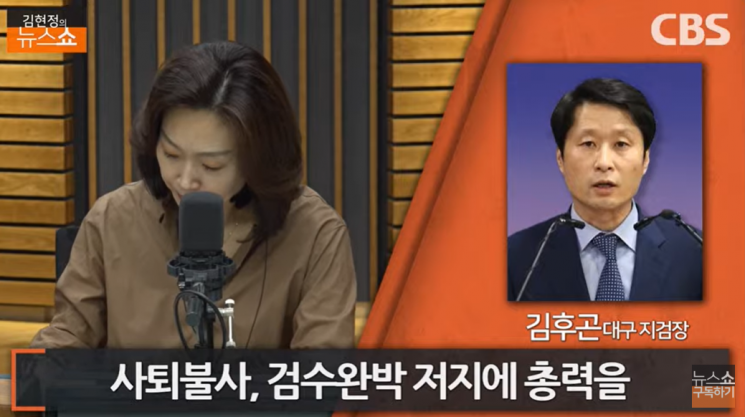 Screenshot of the YouTube LIVE video of CBS Radio's 'Kim Hyun-jung's News Show' broadcast on the 12th.
[Asia Economy Reporter Choi Seok-jin, Legal Affairs Specialist] After the nationwide prosecutors' chiefs meeting held on the 11th, Kim Hu-gon, Daegu District Prosecutor's Office Chief (56, Judicial Research and Training Institute Class 25), who briefed the meeting results, appeared on a radio program on the 12th and emphasized, "'Geomsu Wanbak' is like burning down a thatched cottage to catch a bedbug."
In a phone interview with CBS Radio's 'Kim Hyun-jung's News Show' that morning, Kim made these remarks.
When asked about the atmosphere of the prosecutors' chiefs meeting held the previous day, Kim said, "Everyone was in unanimous agreement that more careful consideration is needed regarding the promotion of this bill."
In response to the question, "Why do you oppose Geomsu Wanbak?" he said, "First, we sincerely apologize to the public for causing concern due to issues like prosecutorial reform," adding, "Ultimately, I think this bill is being pushed because we have not earned the trust of the people. The fundamental cause lies with us. I want to apologize for that first."
Kim explained, "However, Geomsu Wanbak means completely abolishing the prosecution's investigative function and only retaining the right to indict. Then, (the prosecution) must conduct trials or decide on indictments based solely on materials investigated by the police," adding, "It's not that the police cannot investigate. The police do a good job, but it cannot be perfect."
He continued, "If any investigative agency's investigation collects even a little additional evidence beyond the police investigation, allowing for a more complete conviction, but prosecutors cannot request supplementary investigations from the police nor collect evidence themselves, for example, punishments for sexual violence crimes may not be properly enforced," adding, "In fact, lawyer Kim Ye-won, who works hard for the human rights of people with disabilities, has pointed this out with great pain. The suffering of victims increases. Aren't victims also the people?"
When asked whether the supplementary investigation request rights for the six major crimes?corruption, economic crimes, public official crimes, election crimes, etc.?would also be abolished along with the investigative rights, Kim replied, "Yes. That is one of the two characteristics."
He said, "The six major crimes are very serious crimes, as the anchor listed, but if we look at cases the prosecution handled, such as the state manipulation scandal and certain conglomerate cases like Samsung Bio, the public applauded those investigations. But if the prosecution no longer investigates these cases, there is no proper alternative on who, where, and how these cases will be properly handled," adding, "Ultimately, the response to serious crimes will be weakened. Who would benefit from that? Surely, the powerful and wealthy would."
He added, "Even the current system, which was improved by a law passed a year ago, has many problems in practice," noting, "Lawyers point out that about 67% see issues such as delays caused by requests for supplementary investigations."
Kim said, "The Democratic Party is leading efforts to operate this law and is working hard to reduce its drawbacks. If there is a bill that improves these problems, we would definitely support and promote it," but expressed concern, "If a bill that overturns the law before properly resolving its many issues passes, the resulting damage will ultimately be borne by the people."
When asked about Rep. Hwang Un-ha, a former police officer, who pointed out that many unnecessary investigations existed in the six major crimes previously under prosecution's jurisdiction, Kim responded, "There may be such parts," adding, "We must constantly be cautious and self-reflect as long as the prosecution system exists. But I want to ask again: if you specify what exactly constitutes unnecessary investigations, it would be easier for us to reflect."
He continued, "However, the prosecution's investigations into the six major crimes include cases like the state manipulation scandal, major disaster cases, and conglomerate cases. For example, prosecutors in the U.S., Japan, and Germany also directly investigate major economic crimes. The economy's impact on our national society is very significant," adding, "Cases like Samsung Bio, SK accounting fraud, and in the U.S., the Allen case and other economic crimes involve hundreds of witnesses and long trials. Convictions are hard to obtain, and the defense and prosecution fiercely contest in court. Can prosecutors maintain indictments based only on police investigation records? Given the current trial realities, I think it's impossible."
When the host said, "Rep. Hwang also said that stripping the six major crimes' investigative rights does not mean a horizontal transfer to the police but rather evaporation, resulting in a reduction of the nation's total investigative capacity. He argues that the current level of unnecessary investigations justifies this reduction," Kim responded, "I think that statement is very dangerous," adding, "Investigations are activities to punish criminals. Limiting these activities to a certain level is wrong from our perspective. The state should strive to reduce the total amount of crime, not the total amount of investigations. There is a contradiction in that."
When the host mentioned, "I understand that you, Chief Kim, also advocated prosecutorial reform," Kim replied, "Yes, when I promoted prosecutorial reform, I worked as a spokesperson and as part of the promotion support team. Prosecutorial reform is necessary. I also served as the head of the hearing preparation team for Minister Cho Kuk and had many discussions."
He added, "Personally, I think it's time to stop using prosecutorial reform as a political slogan. Reform must be ongoing in daily practice, and the prosecution must continue efforts in this regard."
He said, "However, stripping the prosecution's entire investigative function due to some excessive investigations in the past is like burning down a thatched cottage to catch a bedbug. Although the prosecution faces criticism, it was precisely because of its investigative rights that investigations like the state manipulation scandal, which received public applause, were possible."
When the host referred to Minister of Justice Park Beom-gye's remarks the previous day, saying, "Minister Park emphasized that the essence of Geomsu Wanbak is ensuring investigative fairness and raised a political retaliation frame. For example, the Democratic Party criticized the one-year prison sentence sought against former Chairman Yoo Si-min as catering to the new administration, while investigations into candidate Lee Jae-myung's spouse's corporate card use proceeded quickly, but investigations into President-elect Yoon Seok-youl's spouse's false resume have not. They claim political retaliation and fear a 'prosecutor republic.' What is your view?" Kim responded, "When looking at each of our investigations, the public may criticize why some are fast and others slow."
He added, "But when we step back and look at the investigation teams, they have their own circumstances. I don't know how the public evaluates this, but the structure does not allow directing investigations with specific political objectives."
Regarding the one-year prison sentence sought against Yoo Si-min, Kim said, "Since I was not involved in that case, I asked about it. There are criticisms that it caters to the new administration, but usually, the sentence sought is decided at the time of indictment," adding, "Yoo Si-min was indicted on May 3, 2021, well before the new president was decided and before President-elect Yoon declared his political ambitions."
He continued, "The sentence sought was decided then, but only the investigating and trial prosecutors know it. The public announcement happens at the sentencing stage," adding, "So, because the sentencing was recent, after the new administration was decided, people misunderstand."
When asked about Prosecutor General Kim Oh-soo's statement that he would resign if the Geomsu Wanbak bill passes, and whether resignation is the only option, Kim replied, "I don't think that's the case," adding, "He will do his best to raise awareness of the problems and procedural issues by putting his position on the line. We share the same stance."
When asked if this stance means collective resignation or some collective expression of opinion, Kim said, "We sincerely apologize to the public if it appears like collective action, but this is related to the essence of the prosecution system, so we are raising the issue."
When asked if they would not hesitate to take collective action if necessary, Kim replied, "I don't think it will go as far as collective resignation," adding, "But some unrest is inevitable."
Finally, Kim said, "We will do our best to communicate with the National Assembly and show sincerity to the public to achieve the best possible outcome so that such situations do not arise."
© The Asia Business Daily(www.asiae.co.kr). All rights reserved.

















