Prospects for Outdoor Mask Removal in June-July
Protective Measures for Vulnerable Facilities like Nursing Hospitals
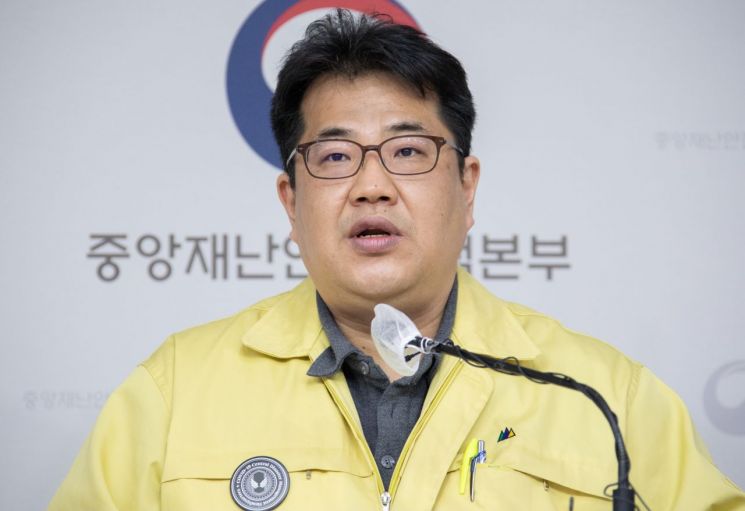 Son Young-rae, Head of the Social Strategy Division at the Central Disaster and Safety Countermeasures Headquarters (CDSCH).
 [Photo by Yonhap News]
[Asia Economy Reporter Lee Gwan-joo] The government is considering lifting restrictions on the number of people allowed in private gatherings and business operating hours.
On the 12th, Son Young-rae, head of the Social Strategy Division at the Central Disaster and Safety Countermeasures Headquarters, responded in an interview on TBS's "Kim Eo-jun's News Factory" to a question about whether restrictions on the number of people or operating hours could be completely removed, saying, "We are also reviewing such measures."
Regarding the forecast that the social distancing measures to be announced by the government this week will be the last adjustment, Son said, "We need to review further whether it will be the last," but added, "However, there was a time when we announced a full-scale adjustment."
The current social distancing allows private gatherings of up to 10 people and restricts the operating hours of multi-use facilities such as restaurants until midnight. Since the Omicron wave, the quarantine authorities have gradually eased both the number of people allowed in private gatherings and the operating hour restrictions. Son said, "The effectiveness of social distancing itself has decreased since the emergence of Omicron," and added, "We judge that the cost compared to the effect of social distancing is high."
Discussions on the post-Omicron response system are also ongoing. The government currently views the Omicron wave as entering a declining phase and is implementing a gradual transition to a routine healthcare system. Son explained, "If this wave stabilizes, the risk of it spreading into a large wave again is expected to be considerably low." He especially emphasized, "To live with Omicron and return to daily life, the healthcare system itself must fully transition to a routine healthcare system," adding, "It is a system where our healthcare adapts and provides treatment as it does for seasonal flu or other common infectious diseases."
Regarding the outlook of returning to normal life with the healthcare system transition and the lifting of outdoor mask mandates around June to July, Son said, "Yes." However, he anticipated that a full-scale easing of regulations for vulnerable facilities such as nursing hospitals and care facilities would be difficult. Son mentioned, "We plan to review parts that can be adjusted reflecting risk levels while maintaining protective measures."
On the future trend of confirmed cases, he said, "Among various predictive models presented by several research institutions, the trend is following a lower-level epidemic curve," and added, "By around May, it appears to drop to within about 100,000 cases." However, he noted, "It seems difficult to predict how low it will go." Son also explained that the number of severe and fatal cases has passed its peak and is on a declining trend.
© The Asia Business Daily(www.asiae.co.kr). All rights reserved.
![User Who Sold Erroneously Deposited Bitcoins to Repay Debt and Fund Entertainment... What Did the Supreme Court Decide in 2021? [Legal Issue Check]](https://cwcontent.asiae.co.kr/asiaresize/183/2026020910431234020_1770601391.png)















