Evaluation of Blocking Chinese Land Grab Including Investment Immigration System Improvement
Jeju Housing Prices Rose 22% Over 7 Years... Nationwide Up 34%
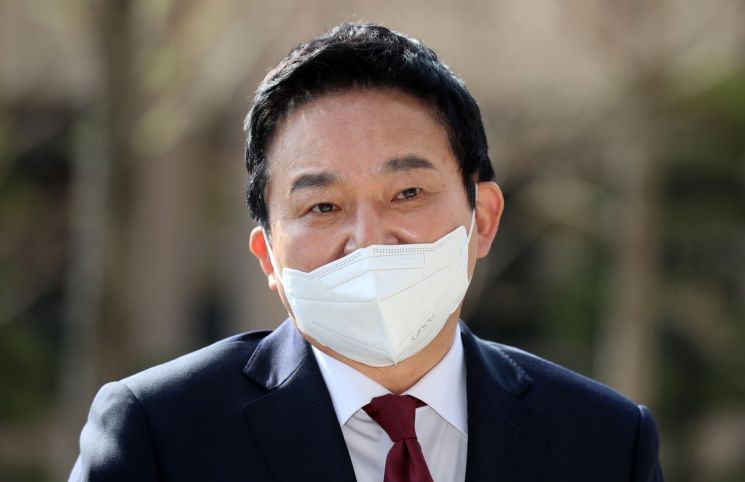 On the morning of the 11th, Won Hee-ryong, the nominee for Minister of Land, Infrastructure and Transport, answered questions from reporters as he arrived at the confirmation hearing preparation office set up at the Seoul Regional Land Management Office in the Government Complex Gwacheon, Gwacheon-si, Gyeonggi-do.
 Won Hee-ryong, nominated as the first Minister of Land, Infrastructure and Transport under the Yoon Seok-yeol administration, is set to oversee the "real estate public sentiment." How were the local real estate policy achievements during his seven years as governor of Jeju Province?
According to KB Real Estate statistics on the 12th, the housing sale prices in Jeju Province (including apartments, villas, and row houses) rose by 22.33% from July 2014, when Won took office as governor, until August 2021, when he stepped down. Narrowing down to apartments only, the increase was even greater at 30.45%. Compared to nationwide housing prices during the same period, the rise in Jeju was relatively smaller. Nationwide housing prices increased by 33.86%, and apartment prices rose by 40.28%. However, due to Jeju’s island characteristics, including limited supply and demand conditions and the influx of migrants, it is considered difficult to evaluate real estate management performance solely based on the rise in Jeju housing prices.
Jeju has traditionally seen significant investment from outsiders and foreigners, making Won’s seven years of real estate policy also a confrontation with these groups. When Won began his administration in 2014, the proportion of Chinese investment in domestic real estate (collective buildings) in Jeju peaked at 23% that year. In response, Won improved the "Real Estate Investment Immigration Program," which granted permanent residency to foreigners who purchased land, in 2015 and significantly strengthened regulations. Since then, the proportion began to decline, dropping to about 1.5% last year.
The proportion of land owned by foreigners, which had been steadily increasing, also turned to a decline in 2020 after three years. Acquisition of farmland in Jeju by outsiders was also a concern, but by strengthening farmland acquisition management, speculative demand was curbed. The number of farmland acquisitions by non-residents in the province decreased by 66.7%, from 596 hectares in 2015 to 198 hectares last year. As a result, this policy achievement is seen as dispelling concerns that "Jeju would become Chinese land," while also receiving criticism for shrinking the local economy due to reduced investment.
Evaluations are mixed regarding Won’s self-proclaimed strength in "political and communication skills." In particular, there are regrets locally about the Jeju Second Airport project, a construction project he strongly promoted. The Jeju Second Airport Emergency Citizens’ Meeting, in a statement the day before, demanded the withdrawal of his nomination, saying, "Despite a clear majority opposing the Second Airport in the residents’ public survey, the project was pushed forward, turning Jeju into an island of discord and division."
Some argue that the controversy over Won’s expertise is inappropriate. Eun Hyung Lee, senior researcher at the Korea Construction Policy Institute, said, "Now is the time for a leader who supports the efficient selection and execution of necessary policies, rather than a hands-on policymaker." He added, "Although real estate is the biggest current issue, the Ministry of Land, Infrastructure and Transport does not deal solely with that." He also said, "As the first minister of the new government, it is not necessarily desirable to focus solely on real estate and housing expertise," suggesting that candidates with broader administrative experience (such as provincial administration) should also be considered.
© The Asia Business Daily(www.asiae.co.kr). All rights reserved.

















