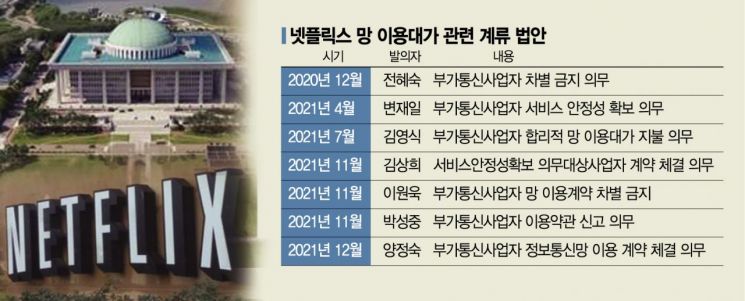
7 Related Network Usage Fee Bills Pending
Expectations for Integrated Bill in Science and ICT Committee Subcommittee 2
[Asia Economy Reporter Lim Hye-seon] On the 20th, as the National Assembly Science, Technology, Information and Broadcasting Communications Committee’s Subcommittee on Information and Communications Broadcasting Act Review convenes, attention is focused on whether the amendment to the Telecommunications Business Act mandating network usage fees (the so-called "Netflix Prevention Act") will be submitted.
Telecom 3 Companies Show Interest in Submission of ‘Netflix Prevention Act’
According to the National Assembly on the 11th, since the opening of the 21st National Assembly, 557 bills have been proposed in the Science, Technology, Information and Broadcasting Communications Committee, but only 149 have been processed, resulting in a processing rate of just 26.8%. In particular, the processing rate of the first subcommittee on bills is 56.6%, while the second subcommittee’s rate is low at 14.8%. At the full committee meeting held on the 30th of last month, Chairman Lee Won-wook urged for vigorous processing of bills pending in the second subcommittee, so it is highly likely that the meeting on the 20th will review the pending bills. Since the Korea Telecommunications Operators Association, representing domestic telecom companies, conveyed to the Presidential Transition Committee the position that the mandatory imposition of internet network usage fees on global content providers (CPs) should be pursued, the key point of interest is whether the ‘Netflix Prevention Act’ can pass the threshold of the bill review subcommittee.
Currently, there are a total of seven bills pending related to network usage fees. These include the amendment proposed by Kim Young-sik of the People Power Party, which prohibits value-added communication service providers above a certain scale from demanding internet access services without paying a fair fee; the amendment by Kim Sang-hee of the Democratic Party of Korea, which imposes an obligation on value-added communication service providers subject to service stability obligations to enter into information and communications network service usage contracts; and the amendment by Lee Won-wook of the Democratic Party of Korea, which requires telecommunications businesses to include network usage fees in contracts related to the use and provision of public telecommunications services.
Many of the bills contain similar content, and with the global attention on the lawsuit between SK Broadband and Netflix, the industry expects that the Science, Technology, Information and Broadcasting Communications Committee will likely propose an integrated bill based on the submitted bills.
National Assembly Takes a Cautious Approach
Within the committee, a cautious view is gaining traction that it would be better to submit the bill after seeing the outcome of the ongoing SK Broadband and Netflix trial. Many offices of lawmakers who have proposed related bills responded that "the consensus is that it would not be too late to submit the related bills after the court’s judgment." The court ruled in favor of SK Broadband in the first trial. Netflix has appealed, and the appeal trial is currently underway. The core of the lawsuit is that telecommunications operators are demanding network usage fees from internet service providers, considering the reality that massive traffic generates huge investments in networks and facilities. Since Netflix began using SK Broadband’s dedicated line in May 2018 at about 50Gbps, the traffic surged approximately 26 times to around 1300Gbps by the end of last year. Subsequently, SK Broadband carried out several additional expansions due to the popularity of hits like ‘Squid Game,’ ‘Hellbound,’ and ‘All of Us Are Dead.’
The telecommunications industry argues that refusal by large global CPs to pay network usage fees limits domestic internet network investment and shifts the cost burden to general users, demanding prompt revision of related laws. In particular, domestic telecom companies claim that while Netflix signs network usage contracts and pays fees with several operators overseas, it deceives consumers by raising service fees by 17% domestically and causes reverse discrimination against domestic CPs that pay network fees. The Korea Telecommunications Operators Association stated, "We need to improve the legal system to prevent domestic and international discrimination and promote virtuous development of the information and communications technology market."
© The Asia Business Daily(www.asiae.co.kr). All rights reserved.

















