Looking into 'Gagyebu Inflation'
12 out of 15 Items Rose in a Year
Grocery Prices Jump 20%
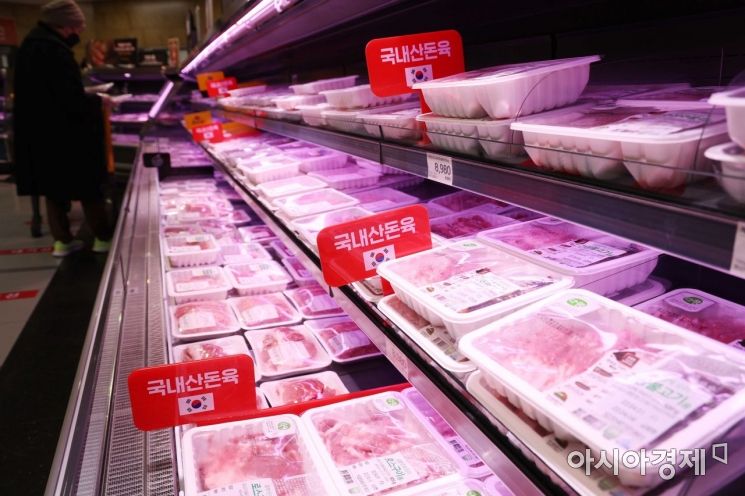 The consumer price inflation rate in March soared to the 4% range for the first time in about 10 years. On the 5th, a citizen shopping at a large supermarket in downtown Seoul is seen doing their grocery shopping. Photo by Mun Ho-nam munonam@
As prices have risen sharply, the 'household budget inflation' felt by ordinary housewives and office workers over the past year has increased by about 20%, according to analysis.
On the 11th, Asia Economy analyzed last month's 'living expenses of Mr. Kim, a single-person household living in Seoul,' and 'allowance card expenses of Mr. Jung, an office worker working in Seongnam-si, Gyeonggi Province,' and found that they spent 76,450 KRW and 60,700 KRW more respectively compared to a year ago.
Mr. Kim, who fills up gasoline twice a month and mainly spends on groceries including beef, pork, instant rice, ramen, tuna, coffee mix, and meal kits, saw price increases in 12 out of 15 items in his household budget. Last year, buying the same items cost 383,730 KRW, but this year it rose to 460,170 KRW, an increase of 19.92%. In Mr. Jung's allowance budget, which mainly covers dining out expenses such as kimchi stew and cold noodles, all items increased. What cost 347,800 KRW in March last year now costs 408,500 KRW for the same meals. The inflation rate in Mr. Jung's budget was 17.45%. ▷Related article on page 5
Most grocery items and dining out expenses, except for some fresh foods that fluctuate depending on the harvest, have increased. According to the Consumer Price Index trends from Statistics Korea, consumer prices in March rose 4.1% compared to a year ago. This is the highest figure in 10 years and 3 months since December 2011 (4.2%). The National Statistical Portal (KOSIS) also reported that dining out prices in March increased by 6.6% compared to a year ago. All 39 dining out items rose, marking the highest increase in 23 years and 11 months since April 1998. The rise in food ingredient costs and delivery fees pushed up the cost, and as Gyeonggi Province recovered from the COVID-19 shock, dining out demand increased.
Experts evaluated that these difficulties are likely to continue for some time due to several internal and external additional inflation factors. Professor Cho Dong-geun of Myongji University’s Department of Economics said, "Price inflation tends to cause a chain reaction, with many causes organically interacting externally such as the Russia-Ukraine war, and internally such as minimum wage increases and instability of the Korean won." He added, "As COVID-19 is calming down, the possibility of 'revenge consumption' strengthening is high, and there are many factors that could negatively affect prices, so this trend is expected to continue for the time being."
© The Asia Business Daily(www.asiae.co.kr). All rights reserved.

















