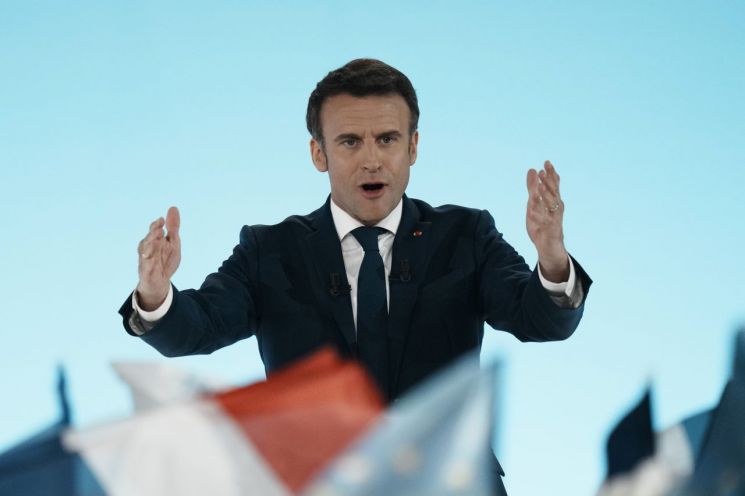
 On the 10th (local time), when the first round of the French presidential election took place, Emmanuel Macron, President of France, who ranked first in the vote share (left photo), responded to the cheers of supporters at his Paris election campaign headquarters.
 [Image source=AP Yonhap News]
[Asia Economy Reporter Jeong Hyunjin] The dream of Emmanuel Macron, the President of France, securing a second term is being threatened by the surge of challenger Marine Le Pen, the candidate from the National Rally (RN). At a time when European unity is more important than ever due to Russia's airstrikes on Ukraine, the possibility of the first far-right president in France is growing, drawing global attention. The top two candidates from the first round of the presidential election held on the 10th (local time) will spend the crucial two weeks leading up to the runoff on the 24th.
According to the French Ministry of the Interior on the 10th, with 97% of votes counted, President Macron received 27.6% of the vote, and candidate Le Pen received 23.4%, securing first and second place respectively, and are expected to advance to the runoff on the 24th of this month. In the French presidential election, if no candidate achieves a majority in the first round, a runoff is held between the top two candidates.
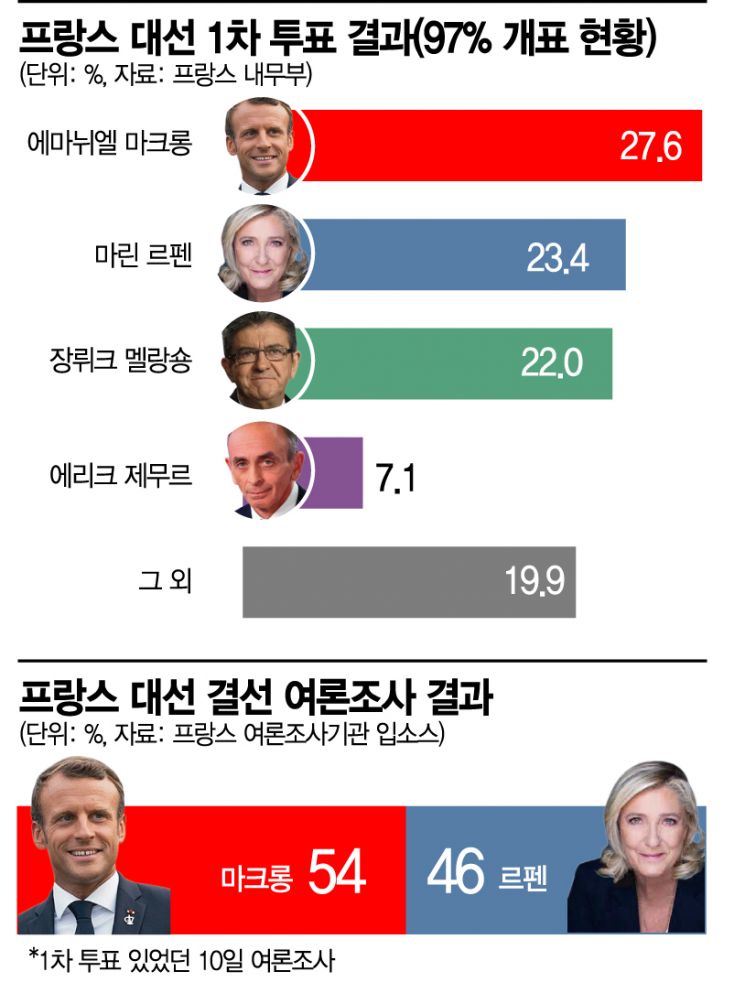
Jean-Luc M?lenchon, the far-left candidate from La France Insoumise (LFI), came in third with 22.0% of the vote, while ?ric Zemmour, the Reconqu?te candidate who was once considered a rival to Le Pen, placed fourth with 7.1%. M?lenchon, who performed unexpectedly well, indirectly supported President Macron by stating that Le Pen should never be elected. Except for Zemmour, who took some votes from the far-right camp, other candidates also supported President Macron. Zemmour declared his support for Le Pen.
The Crucial Two Weeks... A Neck-and-Neck Runoff Expected
The runoff to be held in two weeks is expected to be a very close contest. According to a runoff poll released by Ipsos on the day, President Macron's support rate was 54%, while Le Pen's was 46%. Considering that last week's poll showed the gap between the two candidates narrowing to 2 percentage points, the gap seems to have widened somewhat again. However, since the floating voter segment is estimated to be over 10% of the total electorate, changes in voter sentiment over the next two weeks could still shake up the election landscape. In the 2017 presidential runoff, President Macron won decisively with 66.1% of the vote compared to Le Pen's 33.9%.
Le Pen's late surge is formidable. Five years ago, she pursued core far-right policies such as anti-immigration and made anti-Islamic remarks. However, during this election campaign, she focused on creating a softer image by, for example, smiling and taking photos with teenagers wearing hijabs, removing the far-right color. The Guardian analyzed that she positioned President Macron, who faced the Yellow Vest movement and others, as a divisive figure, while presenting herself as a unifying president.
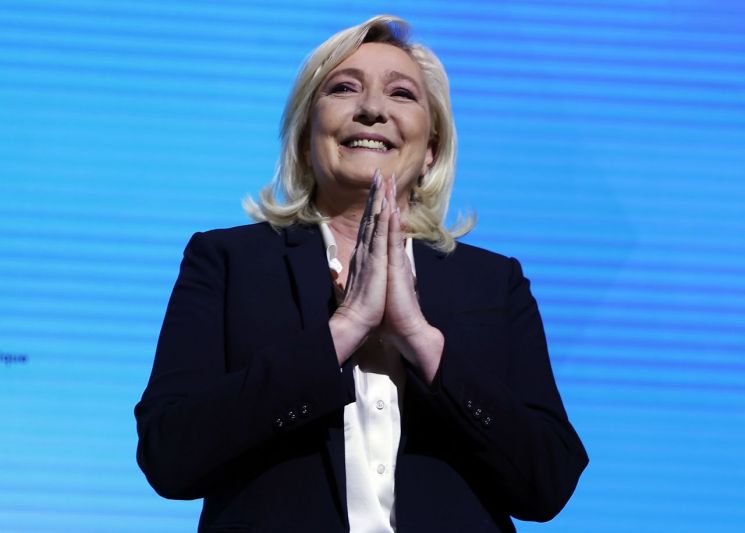 Marine Le Pen, the challenger and candidate of the National Rally (RN), who ranked second in the French presidential election vote share, is seen smiling brightly after speaking at her Paris election campaign on the 10th (local time).
 [Image source=EPA Yonhap News]
President Macron appeared before his supporters on the day and said, "Nothing is decided yet. Do not make mistakes. This contest over the next two weeks will be very important for our country and Europe," urging for support. Candidate Le Pen said, "Everyone who did not choose Macron today, please join this movement," and added, "I ask the French people, whether left, right, or anything else, to join this great national and popular movement."
Will the First Far-Right Female President Emerge?... Market in Turmoil
If President Macron wins the runoff on the 24th, he will become the first president in 20 years since former President Jacques Chirac in 2002 to secure a second term. If Le Pen, who is running for the third time this year, succeeds in her comeback, she will become France's first female president and the first far-right president.
The outcome of the French presidential election will inevitably have a direct impact on the political landscape of Europe. President Macron has made diplomatic efforts for European integration as a major member of the European Union (EU). In contrast, nationalist candidate Le Pen has often voiced opposition to the EU as a Eurosceptic. If Le Pen is elected, France's policies within the EU are likely to move in a regressive direction.
If Le Pen manages a last-minute comeback and wins, the market is expected to be significantly shaken. Investors have so far viewed the possibility of President Macron's re-election, a pro-business and pro-market figure, favorably based on polling results. A different outcome would inevitably increase market volatility.
In fact, last week, as news spread that Le Pen was narrowing the gap with President Macron, the yield on French 10-year government bonds hit a seven-year high. The spread between French and German 10-year government bond yields also widened to 0.53 percentage points on the 6th, the largest gap since the early days of the pandemic in April 2020. This indicates that concerns surrounding the French presidential election have dampened investor sentiment toward French bonds. This indicator also showed a gap of over 0.80 percentage points during Le Pen's strong performance in the 2017 French presidential election runoff.
© The Asia Business Daily(www.asiae.co.kr). All rights reserved.



















