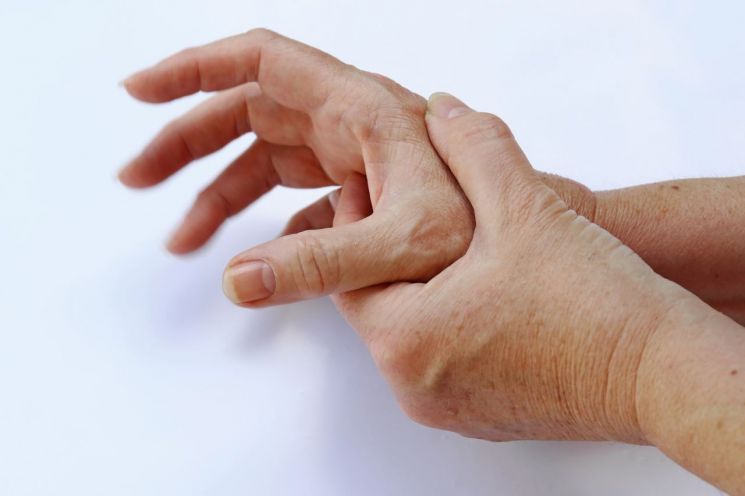
 Patients with Parkinson's disease complain of tremors in certain parts of the body while in a stable posture.
[Asia Economy Reporter Lee Chun-hee] April 11th of every year is designated as "World Parkinson's Disease Day" to raise awareness about Parkinson's disease. It was established on April 11th, the birthday of British physician James Parkinson, who first reported the disease to the academic community in 1817.
Parkinson's disease is one of the three major neurodegenerative diseases in the elderly and the second most common degenerative brain disorder after dementia. As the aging society accelerates, the incidence is steadily increasing. According to the Health Insurance Review and Assessment Service, the number of Parkinson's patients increased by about 16% over five years, from 100,000 in 2017 to 117,000 last year.
Parkinson's disease is a degenerative brain disorder caused by the loss of various nerve cells, including dopaminergic neurons in the brain. It has been simply recognized as a disease causing tremors or difficulty walking, but in reality, it presents a wide range of symptoms. Motor symptoms such as tremors?shaking of a part of the body at rest?bradykinesia, rigidity, gait disturbances characterized by dragging the legs, and postural instability causing stooped posture and easy falls appear in different combinations in each patient.
In addition to motor symptoms, various non-motor symptoms also appear. These include dementia, anxiety, depression, visual hallucinations, sleep disorders (insomnia, talking in sleep), frequent urination, constipation, fatigue, and autonomic nervous system disorders (orthostatic hypotension, sexual dysfunction, abnormal sweating), which may not be clearly visible but often make life more difficult for patients and their families.
Professor Jeong Seon-ju of the Department of Neurology at Seoul Asan Medical Center advised, "If you feel symptoms suspicious of Parkinson's disease or receive such a suggestion, it is wise to promptly consult a neurologist specializing in Parkinson's disease. With appropriate medication and surgery, symptoms can improve enough not to significantly interfere with work or daily life."
There is currently no treatment to prevent Parkinson's disease or slow its progression. After diagnosis, treatment involves various medications that can replace the dopamine deficiency in the brain or surgical methods. However, Parkinson's disease is the only degenerative brain disorder whose symptoms noticeably improve with medication. If patients strictly follow the prescribed dosage and administration by their physician, those who cannot walk may be able to walk, and those who have difficulty walking may be able to run.
If the effectiveness of medication decreases after long-term treatment and late-stage motor complications become severe, deep brain stimulation surgery is performed. Deep brain stimulation involves implanting a device under the skin to deliver electrical stimulation to deep brain areas such as the subthalamic nucleus or globus pallidus to improve motor symptoms. Since it is brain surgery, patients must be in good health to undergo the procedure, and it is generally performed before the age of 75 as it is not suitable for very elderly patients. Deep brain stimulation improves Parkinson's motor symptoms and motor complications by about 75%, so if appropriate patients safely undergo surgery, their quality of life can significantly improve.
For daily management, consistent exercise, a proper diet, and improved sleep environment are necessary. Because muscles become rigid, movements slow down, and posture becomes stooped, doing stretching exercises and aerobic exercise for 1 to 2 hours daily is very helpful. Combining strength training can yield even greater benefits.
Also, since fatigue, weakness, and lack of energy are characteristic symptoms, strict nutritional management is essential. Patients should consume plenty of fruits rich in brain-beneficial vitamins C and E, such as apples, strawberries, tangerines, oranges, and kiwis, as well as cabbage, broccoli, and green vegetables. Nuts should also be eaten in moderation. For protein intake, it is advisable to consume quality lean meats such as skinless chicken breast or beef appropriately.
To improve sleep disorders, a representative symptom troubling Parkinson's patients, improving the sleep environment is also necessary. To resolve insomnia, it is good to get an adequate amount of sunlight during the day and avoid watching TV or using mobile phones and the internet 2 to 3 hours before sleep or after 8 p.m. Taking a lukewarm shower in the evening, drinking a warm cup of tea, reading, or listening to quiet classical music can also help.
REM sleep behavior disorder is a symptom that troubles many Parkinson's patients and their spouses. Patients may mutter or shout while sleeping and make flailing movements that hit their sleeping spouse with arms or legs. In severe cases, patients may get up during sleep, wander outside the house in their underwear, and ring neighbors' doorbells. Since these symptoms result from the loss of various nerve cells in the brain due to Parkinson's disease, if severe, detailed consultation with the attending physician and medication are necessary.
© The Asia Business Daily(www.asiae.co.kr). All rights reserved.

















