Choo Kyung-ho, Nominee for Deputy Prime Minister and Minister of Economy and Finance
Economic Policy Focused on Stabilizing Living Costs for Ordinary People, Private-led Investment, and Job Creation
"Choo Kyung-ho Will Find Ways to Minimize Price Instability and Form Policy Coalitions"
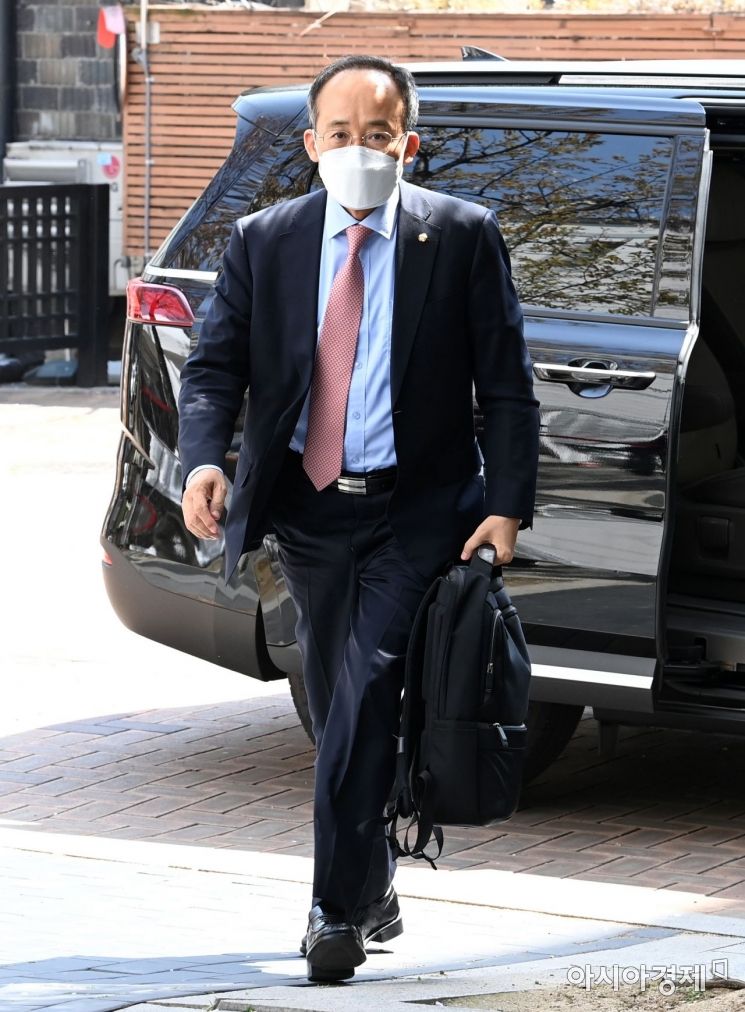 Chu Kyung-ho, a member of the People Power Party who was nominated as the first Minister of Economy and Finance and Deputy Prime Minister for Economic Affairs under the Yoon Suk-yeol administration, is entering the office at the Presidential Transition Committee set up at the Financial Supervisory Service Training Institute in Tongui-dong, Jongno-gu, Seoul on the 10th. Photo by Transition Committee Press Corps
[Asia Economy Sejong=Reporter Kwon Haeyoung] Chu Kyung-ho, the newly appointed Deputy Prime Minister for Economy and Minister of Strategy and Finance, chosen as the first economic chief of the Yoon Seok-yeol administration, announced that he will prioritize "stabilizing living costs for ordinary citizens" and "investment led by private companies and creation of quality jobs" as the top economic policy priorities. A shift in economic policy direction is expected in the new government, moving away from the current administration’s public sector-centered, income-led growth toward market-based, private-led growth.
At a press conference held on the 10th at the Bankers’ Hall in Jung-gu, Seoul, Deputy Prime Minister-designate Chu said, "Currently, government and fiscal-led economic measures have been predominant, but the core of revitalizing our economy and strengthening its structure remains the private sector, companies, and the market."
He added, "Overall economic vitality is currently low," and said, "We need to address structural issues to restore economic vitality, strengthen our economic structure, and increase growth potential."
He also made clear that stabilizing domestic consumer prices, which rose above 4% for the first time in about 10 years last month, and supporting small business owners affected by COVID-19 are top priorities. Chu emphasized, "Stabilizing living costs for ordinary citizens is an urgent task and the first step toward stabilizing people’s livelihoods," adding, "As I mentioned in the supplementary budget (Chugyeong) policy, it is extremely urgent and important to alleviate the difficulties of small business owners and self-employed people who have been hardest hit by COVID-19 and to provide full compensation for their losses."
Regarding concerns that the supplementary budget of 30 to 50 trillion won to be implemented after the new government’s launch might stimulate inflation, he said, "Within the scope that does not undermine macroeconomic stability efforts, we will try to find ways to minimize the inflationary impact of loss compensation for small business owners and self-employed people or livelihood stabilization measures and create a policy mix." He added, "The specific scale and content will be introduced when the government is launched and the supplementary budget bill will be submitted to the National Assembly." On the scale of expenditure restructuring to secure supplementary budget funds, he said the Presidential Transition Committee and the Ministry of Strategy and Finance have started reviewing it, and the outline is expected to be revealed by the end of this month or early next month.
As a measure against high inflation, he hinted at pursuing tax measures, supply-demand stabilization, and distribution structure improvements, along with cost reduction and suppression of price increases through public sector efficiency. He said, "It is no longer an era where the government can directly manage and control prices, and policy tools are very limited," adding, "The government should focus on tax measures, various supply-demand stabilization efforts, and improving distribution structures."
He also emphasized the need for public sector efficiency. Deputy Prime Minister-designate Chu said, "It is natural that the public sector should also operate based on supply and demand through prices," but added, "Since the government can directly decide and exert influence on public sector fees and prices, we will review the fee structure and contribute to stabilizing living costs for ordinary citizens when necessary." He continued, "When determining public sector prices, the cost structure is supposed to be based on actual costs, but have they truly made efforts to stabilize public fees? They should not operate wastefully or irresponsibly approach price increases by accumulating other factors and then deciding to raise prices when the time comes." This can be interpreted as his intention to push for maximum public sector efficiency to reduce costs and only raise fees when no other appropriate measures are available.
As the head leading economic policy, he also expressed his intention to strengthen communication with the Governor of the Bank of Korea, who oversees monetary policy. Chu said, "There are intertwined macroeconomic challenges such as household debt, national debt, and rising U.S. Treasury yields, so dialogue between the central bank and the Ministry of Strategy and Finance must be frequent."
He also listed strengthening fiscal soundness and legislating 'fiscal rules,' which he has repeatedly emphasized in the National Assembly, as major tasks. National debt rapidly increased during the Moon Jae-in administration and surpassed 2,000 trillion won for the first time last year.
Chu said, "Fundamentally, establishing fiscal soundness is the foundation of national economic management," and diagnosed, "The speed at which national debt is increasing recently is very fast and raises many concerns about fiscal soundness, so we must restore fiscal soundness." He added, "In the past, the executive branch operated fiscal management using very strict internal fiscal rules, but now the policy environment is continuously changing with politics overwhelming the economy," and argued, "The National Assembly and the government should jointly regulate fiscal management, which is possible by legislating fiscal rules."
He continued, "However, we cannot ignore economic cycle responses and realistic fiscal spending needs, so economic revitalization should operate as much as possible centered on the private sector and companies, while fiscal spending should focus intensively on protecting the safety of the people, strengthening our security posture, and supporting vulnerable groups such as the socially disadvantaged," emphasizing, "I believe fiscal management that concentrates spending to drive growth through jobs and investment indicators in the government sector should be avoided."
© The Asia Business Daily(www.asiae.co.kr). All rights reserved.

















