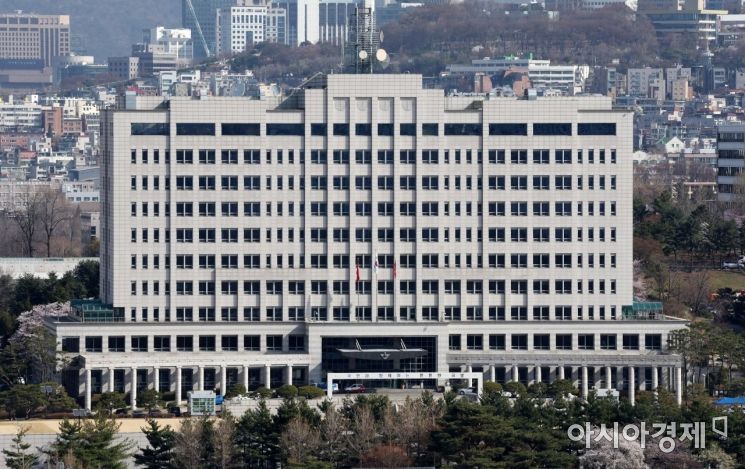
 The Ministry of National Defense building in Yongsan-gu, Seoul, where the presidential office will be located. / Photo by Hyunmin Kim kimhyun81@
[Asia Economy Reporter Seongpil Cho] On the 10th, it was reported that the police have decided to control assemblies by designating the 100-meter area around the presidential office as a 'prohibited assembly zone.'
The police, centered on a task force (TF) led by the Deputy Commissioner of the National Police Agency, have virtually finalized the policy to ban assemblies and demonstrations within 100 meters of the presidential office, just as with the presidential residence, during recent discussions related to the relocation of the Yongsan office. They judged that it is appropriate under the Assembly and Demonstration Act to consider the presidential residence to include the presidential office as well.
Article 11 of the current Assembly and Demonstration Act prohibits assemblies and demonstrations within a 100-meter radius of the presidential residence, the Speaker of the National Assembly, the Chief Justice of the Supreme Court, the President of the Constitutional Court, and the Prime Minister's official residence. The presidential office is not explicitly mentioned. Since the existing Blue House had both the presidential office and residence within its grounds, there was no issue with interpretation under the Assembly and Demonstration Act. However, with the physical separation of the residence and office due to the relocation to Yongsan, the criteria for banning assemblies and demonstrations became unclear.
The police reportedly decided to interpret the law by equating the presidential office with the residence, considering the legislative intent at the time the Assembly and Demonstration Act was enacted. In the 1960s, when the Act was established, the president's residence and office were both located at the Blue House, so the law conveniently referred only to the 'residence.' The fact that the Speaker of the National Assembly, the Chief Justice of the Supreme Court, and the President of the Constitutional Court have both their residences and workplaces (National Assembly building, court, Constitutional Court) designated as 'prohibited assembly zones within 100 meters' under the Act also supports this legal interpretation.
However, civil society has often argued that the term 'residence' in the Assembly and Demonstration Act should be strictly interpreted as a place of residence. Although there is a way to explicitly include terms like 'presidential office' through amendments to the Assembly and Demonstration Act, it is expected to be difficult since the ruling party, the Democratic Party of Korea, holds a majority of seats in the National Assembly. Accordingly, if assemblies and demonstrations around the presidential office are banned without amending the Act, lawsuits from civic groups are also expected to follow.
© The Asia Business Daily(www.asiae.co.kr). All rights reserved.

















