Provision of ready meals allowed when confirmed cases are below 20%
Simplified processes including ready meals and returns when confirmed cases are between 20% and 50%
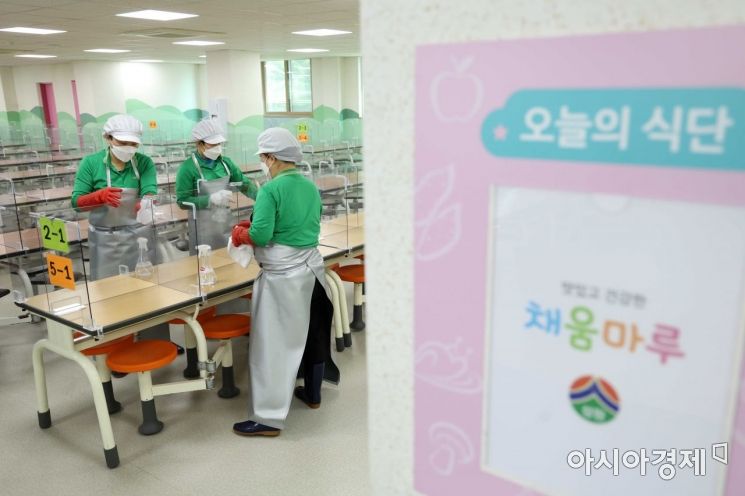 On the 22nd, at the cafeteria of Seongwon Elementary School in Mapo-gu, Seoul, officials are wiping down the droplet barrier screens ahead of the school reopening. Photo by Moon Honam munonam@
[Asia Economy Reporter Han Jinju] As the number of COVID-19 confirmed cases increases and the number of school meal service cooking staff decreases, the Seoul Metropolitan Office of Education has established standards to allow changes in meal provision methods based on the infection rate among cooks.
On the 10th, the Seoul Metropolitan Office of Education announced that it has prepared and will implement the "Standards for School Meal Provision during Infectious Disease Situations." These standards were created by the School Meal Advisory Committee, composed of parents, nutritionists, and other meal-related personnel.
According to these standards, if the infection rate among cooks and kitchen assistants is below 20%, simple meals such as fried rice and rice bowl dishes can be provided. Meals will be served to all students attending school.
If the infection rate is between 20% and less than 50%, simple meals, some ready-made products, semi-processed foods such as seaweed or frozen foods can be used, and outsourced lunchbox provision is also possible.
If the infection rate is 50% or higher, substitute meals such as bread, rice cakes, milk, fruits, or outsourced lunchbox provision are allowed.
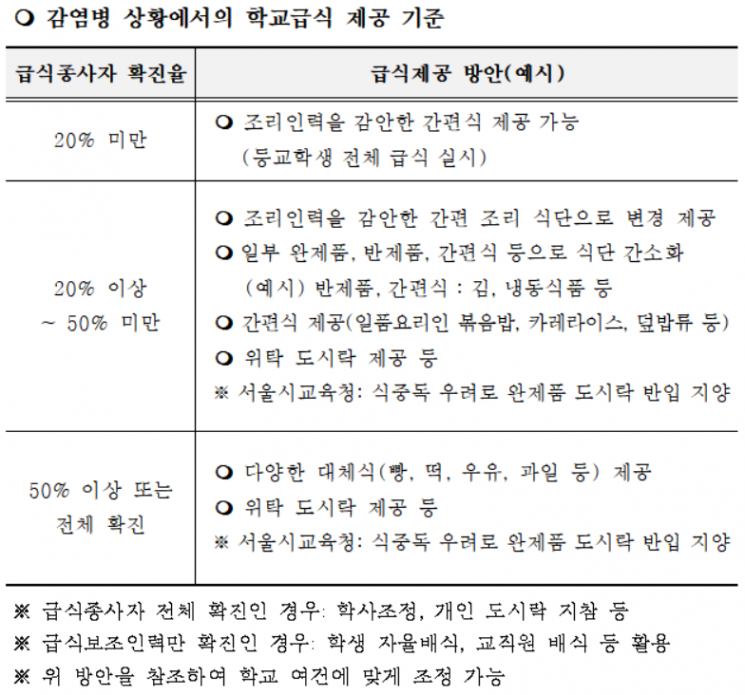
Depending on the school's circumstances, a mix of simple meals and substitute meals can be provided, and if students attend school, meals must be provided without fail.
If all meal service workers are quarantined, in the short term, academic schedules such as shortened classes should be adjusted, and students should bring lunchboxes or be provided substitute meals; in the mid to long term, external outsourcing and other meal provision plans should be considered.
According to the Seoul Metropolitan Office of Education, as of the 30th of last month, 96% of the 1,353 schools operating meal services were running normal meal services.
© The Asia Business Daily(www.asiae.co.kr). All rights reserved.
![User Who Sold Erroneously Deposited Bitcoins to Repay Debt and Fund Entertainment... What Did the Supreme Court Decide in 2021? [Legal Issue Check]](https://cwcontent.asiae.co.kr/asiaresize/183/2026020910431234020_1770601391.png)
















