No Risk of Losing Paper Documents, No Shipping Costs... Creating a Clean Tap Water Usage Environment
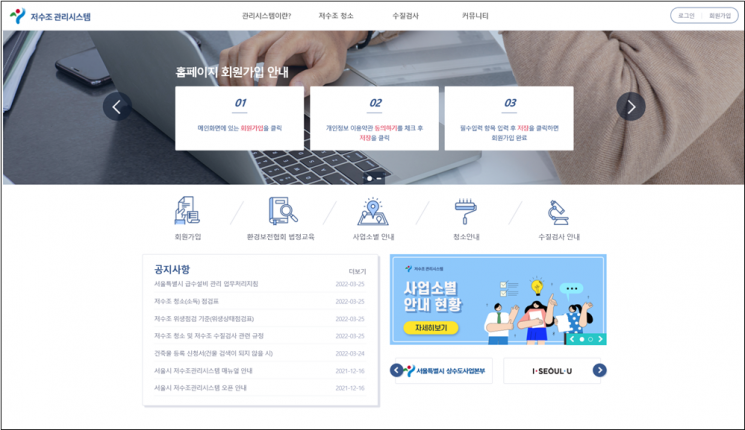
[Asia Economy Reporter Lim Cheol-young] The Seoul Metropolitan Government announced on the 11th that it has established a water tank management system that allows building owners or managers to conveniently input and submit the results of hygiene measures for water supply facilities, such as cleaning and water quality inspection of water tanks, online, and has been officially operating it since April this year.
Results of hygiene measures for water tanks, which were mostly managed manually via mail, fax, etc., will now be submitted and managed 100% electronically, eliminating paper documents. This is to improve inefficient work processes and to encourage owners (managers) of individual water supply facilities to implement hygiene measures so that clean water can be supplied all the way to the faucet.
The Seoul Metropolitan Government aims to systematically manage the hygiene status of 27,973 water tanks installed in 15,142 buildings (including apartment complexes) and further analyze the individual water supply conditions registered electronically to create an environment for using clean tap water. Apartments, buildings with a total floor area of 5,000㎡ or more, and office facilities with a total floor area of 3,000㎡ or more are classified as large buildings, while others are classified as small buildings, and the installed water tanks are managed accordingly.
Water tanks are a type of “tap water storage” installed by individuals in large water supply places such as apartments to prepare for sudden power outages or water outages. According to related laws, hygiene measures such as cleaning must be conducted at least once every six months, and the results must be submitted to the relevant waterworks office. Hygiene measures for water supply facilities within buildings necessary for water use must be carried out directly by the building owner, and the city manages whether these hygiene measures are implemented.
Until now, whether water tank cleaning was conducted could be registered on the website if desired, but most water quality inspection results in paper documents were sent to the relevant waterworks office via registered mail, fax, email, etc., causing concerns about loss and difficulties in management. To solve these problems, the city established a separate page for the water tank management system on the Waterworks Headquarters website, improving it so that building managers can directly register all hygiene measure results for water supply facilities via the internet.
The city plans to utilize the system to analyze individual water supply conditions such as types and aging of water pipes within buildings and water quality changes based on the electronically entered data, and to prepare customized support measures necessary for using clean tap water once the system is stably established. Gu Ami, head of the Waterworks Headquarters, said, “Seoul meticulously manages the tap water supply process through various methods such as real-time water quality monitoring and periodic replacement and cleaning of water pipes,” and added, “Through these processes, we ask for active participation in hygiene management activities for water supply facilities such as water tanks within demand sites so that the water supplied to individual water supply points can be delivered cleanly and safely to each household.”
© The Asia Business Daily(www.asiae.co.kr). All rights reserved.

















