Democratic Party Rep. Lee Haesik Leads Bill to Display Official Quotas for Civil Servants on the 7th
[Asia Economy Reporter Park Jong-il] Will the disadvantage of public officials being treated as fractional employees due to the time-selective system be eliminated?
On the 7th, Lee Hae-sik, a member of the Democratic Party of Korea (Gangdong-gu Eul, Seoul), took the lead in proposing partial amendments to the Local Public Officials Act and the Government Organization Act to improve laws that had been repeatedly raised during the National Assembly’s Public Administration and Security Committee audit. These amendments address issues where time-selective public officials are calculated as fractions based on weekly working hours and face discrimination or lack individual support in tasks, personnel, and equipment based on the quota.
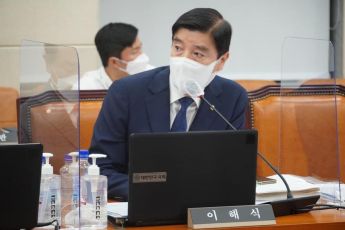
This is a follow-up bill to the partial amendment to the National Public Officials Act, which Lee Hae-sik had led in proposing on December 16 last year, aimed at improving the treatment and rights protection of time-selective public officials.
Since the weekly working hours for time-selective recruited public officials were expanded to 35 hours in 2019, problems have been continuously pointed out during the Public Administration and Security Committee audits regarding the operation of the fractional quota system. For example, in the field, office supplies such as desks or PCs are provided at a rate of one per two people, causing discrimination.
Lee Hae-sik stated, “Following last year, I have proposed a follow-up bill to abolish the fractional quota system for time-selective public officials. No public official should ever be disadvantaged by being treated as a fraction simply because they are time-selective. To improve the unreasonable treatment of time-selective public officials, this bill clearly defines the quota for time-selective public officials as ‘the number of public officials by type and rank belonging to each institution, expressed as an integer at the institutional level.’”
Additionally, since the working hours of time-selective recruited public officials can be changed by the appointing authority when necessary for personnel management, there have been cases where changes to working hours are notified just one day in advance. This greatly affects work assignments and living conditions. Therefore, Lee urged the Ministry of Personnel Management to improve the current manual so that changes in working hours are notified to the concerned parties at least one month in advance, enabling time-selective public officials to work stably.
Jung Sung-hye, Chairperson of the National Time-Selective Public Officials Labor Union, said, “The current quota system, which counts one person working 40 hours per week as one full quota, causes many problems in the field, and time-selective officials often hear various insulting terms such as ‘half-head’ and ‘dot-five human.’ If this bill passes the plenary session and is implemented, it will create an environment where one public official can work stably, contributing to the improvement of service quality to the public.” She expressed her welcome for the bill’s proposal.
© The Asia Business Daily(www.asiae.co.kr). All rights reserved.

















