GIST Research Team Develops Rapid Diagnostic Kit with Applied New Technology
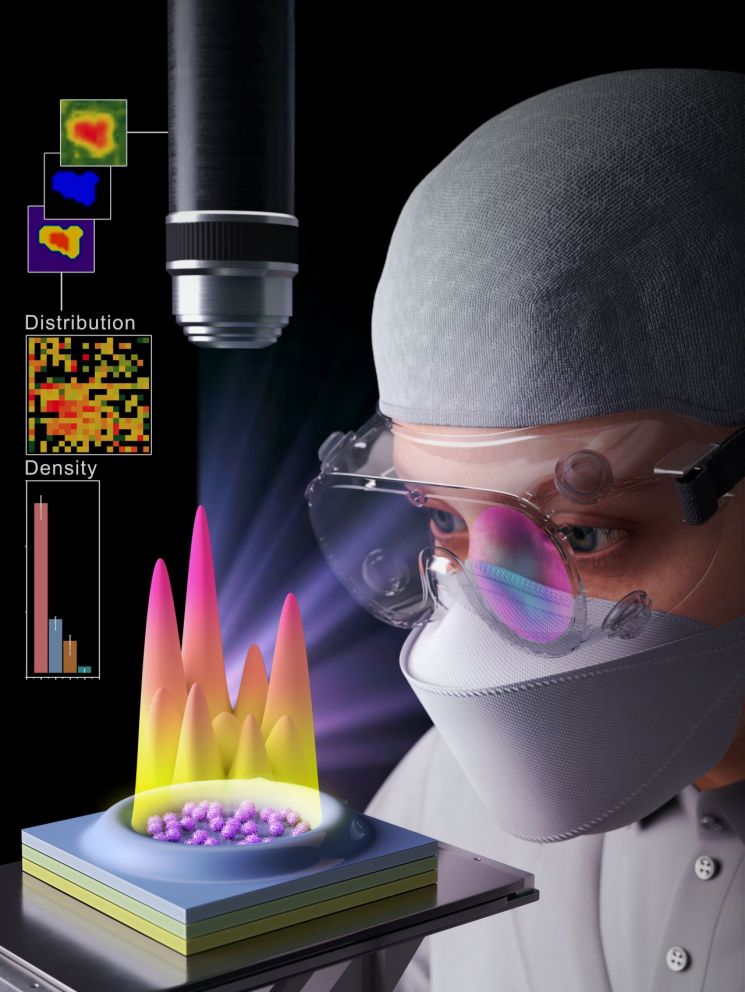
[Asia Economy Reporter Kim Bong-su] Domestic researchers have developed a rapid diagnostic kit that not only detects the presence of the COVID-19 virus but also shows its concentration in different colors. This allows patients infected with the COVID-19 virus to self-monitor their recovery progress, reducing anxiety. It is also expected to serve as a next-generation virus detection and analysis platform that can complement the complexity of genetic amplification (PCR) tests and the low accuracy of existing rapid diagnostic kits.
The research team led by Professor Song Young-min from the Department of Electrical, Electronics and Computer Engineering at Gwangju Institute of Science and Technology (GIST) announced on the 7th that they, in collaboration with Professor Kim Dae-hyung’s team at Seoul National University, have developed a bio color sensor platform capable of rapidly and accurately observing and analyzing viruses.
This platform enables medical personnel to determine the degree of infection by analyzing the color of microscopic images according to concentration levels, allowing for more precise assessment of infection status. Additionally, due to its simple structure, it can be produced in kit form, and the color changes can be intuitively identified, enabling general users to easily confirm infection status.
Existing rapid diagnostic kits detect viruses through changes in electrochemical signals when viruses attach, but they have the disadvantage of requiring complex electrode structures and separate analysis equipment. Also, optical methods such as the plasmonic effect, which are relatively intuitive, involve complex nanostructures making them difficult to manufacture, and the subtle optical changes require separate optical analysis equipment for accurate detection. Recently, to overcome these manufacturing methods and complexities, simple film-type optical structures have been developed, but since most use materials with high refractive indices, it has been difficult to detect bio-particles like viruses that have low refractive indices.
The 'Gires-Tournois' resonant structure developed by the research team for virus detection freely modulates optical properties by inserting a porous complex refractive index layer between a low refractive index layer and a metal reflective layer. As a result, it realized single absorption with a slow light effect in the low refractive index layer.
Through simple surface treatment for antibody fixation, the platform intuitively detected viruses at very low concentrations (100 pg/ml) via antigen-antibody reactions without genetic amplification or labeling. Furthermore, by analyzing chromaticity through microscopic scanning, the distribution and density of virus particles within the detection area were successfully derived, realizing a biosensor platform capable of quantitative analysis.
Professor Song stated, "This is the first case of observing viruses through color changes, allowing medical personnel to quickly determine the exact concentration of viruses through microscopic observation and chromaticity analysis, making it possible to simultaneously detect various viruses and harmful agents," adding, "Soon, the general public will be able to identify viruses with the naked eye."
The research results were published online on the 26th of last month in the international journal Advanced Materials (IF: 30.849).
© The Asia Business Daily(www.asiae.co.kr). All rights reserved.
![Clutching a Stolen Dior Bag, Saying "I Hate Being Poor but Real"... The Grotesque Con of a "Human Knockoff" [Slate]](https://cwcontent.asiae.co.kr/asiaresize/183/2026021902243444107_1771435474.jpg)
















