[Asia Economy Reporter Lee Chunhee] Recently, the number of tennis players has surged, especially among people in their 20s and 30s. Since tennis uses a wide court with relatively little physical contact despite high physical activity, the risk of COVID-19 transmission is low. It is also praised for helping create an active image favored by the MZ generation.
Tennis involves running and hitting the ball coming from unpredictable directions, which helps develop the body's sense of balance. The running and jumping involved improve endurance and agility. However, overexertion to hit balls beyond one's capability can lead to injuries or damage. Beginners are particularly prone to injuries caused by intense movements. Special caution is needed to avoid injuries such as 'Tennis Elbow' and 'Tennis Leg,' which are named after the sport.
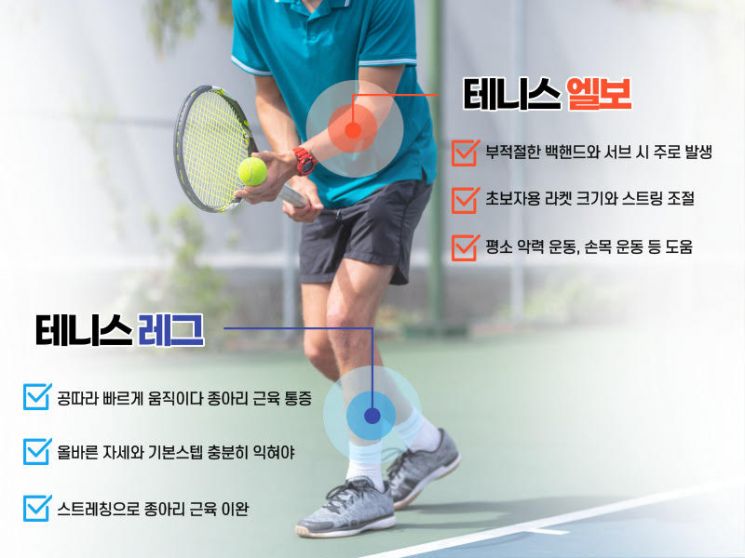
'Tennis Elbow': Prevent It with Proper Racket Selection and Grip Strength Exercises
If you feel pain on the outside of your elbow when gripping or exerting force, you should suspect tennis elbow. Medically, tennis elbow is called 'lateral epicondylitis,' which refers to inflammation where the muscles extending from the elbow to the back of the hand attach to the bone.
Improper backhand strokes or serving can cause pain in the tendons where the outer elbow bone and muscles meet. The backhand involves twisting the wrist backward while facing it upward, applying strong force in a short moment. Serving can also cause pain when the forearm muscles and tendons cannot withstand the impact of the ball on the racket. Beginners often experience pain just from the hitting motion because controlling the racket swing is difficult.
To prevent tennis elbow, use a racket suitable for yourself and adjust the tension of the tennis strings to avoid injury. Beginners should choose rackets with a wide face, light weight, and good rebound to easily control or swing the racket with less force.
Choi Kyungwon, an orthopedic specialist at Mokdong Himchan Hospital, explained, “If tennis elbow is suspected, rest until the pain disappears. In the early stages of pain, apply ice packs, and when using the wrist, it is advisable to wear taping or a brace.”
Preventing tennis elbow requires strengthening the muscles between the wrist and elbow and improving grip strength. Regular grip exercises using a rubber ball and wrist flexion (bending the wrist inward) and extension (lifting the wrist toward the back of the hand) exercises are helpful.

'Tennis Leg': Preventable with Proper Steps and Stretching
There is a saying, “Tennis is played with the feet,” as players constantly step in all directions according to the ball’s trajectory. This can place sudden heavy loads on the calf muscles, causing injuries. If you suddenly feel a sharp pain as if hit by a ball, it could be tennis leg, where the calf muscle tears and causes pain. Along with calf pain, internal bleeding may cause bruising, muscle stiffness, and reduced flexibility.
Beginners are especially at risk because they are not accustomed to quickly changing steps. Instead of recklessly challenging rallies, it is important to first master basic steps such as the split step, where both legs jump and land, and the walking step, which involves moving forward when the opponent’s ball lands near the service line.
Dr. Choi advised, “When calf pain occurs, relax the muscles to prevent cramps and reduce internal bleeding with ice packs. Stretching by repeatedly raising and lowering the heels before exercise sufficiently relaxes the calf muscles and reduces injury risk.” If it is difficult to lift the heel or walk due to pain, using elastic bandages and taping can stabilize the injured area without worsening the injury.
© The Asia Business Daily(www.asiae.co.kr). All rights reserved.
!["The Woman Who Threw Herself into the Water Clutching a Stolen Dior Bag"...A Grotesque Success Story That Shakes the Korean Psyche [Slate]](https://cwcontent.asiae.co.kr/asiaresize/183/2026021902243444107_1771435474.jpg)

















