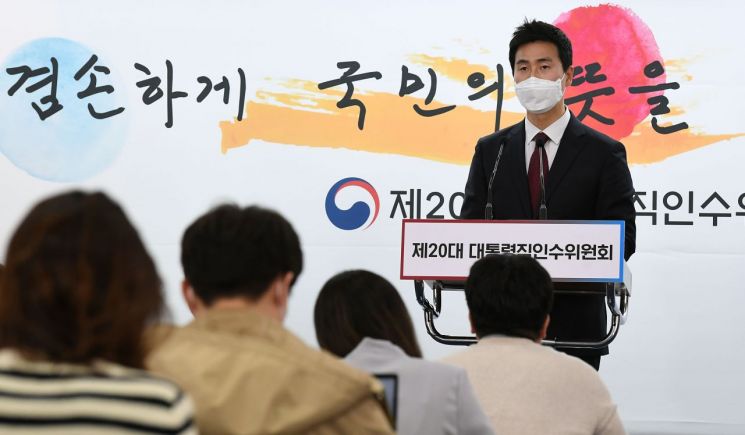
[Asia Economy Reporter Ki-min Lee] On the 6th, the Presidential Transition Committee announced plans to support private companies seeking to secure overseas resources in order to respond to supply chain instability in materials, parts, energy, and resources, and to strengthen resource security.
Kim Ki-heung, deputy spokesperson of the Transition Committee, stated at a briefing held at the committee's office in Tongui-dong, Seoul, that "The Economic Subcommittee 2 of the Transition Committee is currently reviewing a 'private sector-led overseas resource acquisition plan,' where private companies' efforts to stabilize supply chains for overseas resources are supported separately from the government's efforts, and the public sector acts as an assistant to reinforce resource security."
He added, "According to the Transition Committee, all four tax incentives for overseas resource development were gradually sunset and abolished by 2019, and related R&D budgets have been reduced from 28.2 billion KRW in 2014 to 18.9 billion KRW in 2018, and 11.3 billion KRW in 2022," emphasizing, "The committee will first strengthen tax support such as tax reductions to activate private companies' investments, expand financial support including loans and guarantees, and enhance manpower and research and development (R&D) support for private companies."
He continued, "We will establish a new resource security system and legal framework, including a national resource security control tower and early warning and crisis response systems. Resource public enterprises will strive for management normalization through strong restructuring, avoid quantitative expansion relying on past borrowings, and focus on resource cooperation with state-owned enterprises of resource-holding countries."
The Transition Committee cited the background for reviewing support for private-sector-led overseas resource acquisition as the increased demand for critical minerals due to the spread and expansion of electric vehicles and renewable energy in response to climate and environmental changes, geopolitical risks such as the Russia-Ukraine situation, and the weaponization of resources, which have intensified energy supply instability.
In fact, the projected mineral demand in 2040 compared to 2020 is expected to increase by 42 times for lithium, 21 times for cobalt, and 19 times for nickel. Natural gas and coal prices have also reached record highs. Additionally, last month, international oil prices reached $127.86 per barrel, the highest since 2008.
Although the government has implemented measures such as expanding strategic resource stockpiles, supporting diversification of import sources, and increasing tariff quotas, these efforts have been insufficient to respond to supply chain instability and secure resources.
Deputy Spokesperson Kim pointed out, "Due to a passive policy stance toward overseas resources, South Korea's overseas resource acquisition and related investments have significantly decreased. In particular, reductions in government loans and tax support for private companies, as well as weakened overseas resource manpower development and R&D support, have led to a contraction of the related ecosystem."
In addition to overseas resource acquisition plans, he mentioned, "With the prolonged Russian invasion of Ukraine and concerns over refugees and crop conditions in major exporting countries, there is a growing need to discuss and respond to international grain prices and supply-demand trends. The Economic Subcommittee 2 of the Transition Committee is holding meetings with the Ministry of Agriculture and related companies."
© The Asia Business Daily(www.asiae.co.kr). All rights reserved.
!["The Woman Who Threw Herself into the Water Clutching a Stolen Dior Bag"...A Grotesque Success Story That Shakes the Korean Psyche [Slate]](https://cwcontent.asiae.co.kr/asiaresize/183/2026021902243444107_1771435474.jpg)
















