Despite Record High Q1 Earnings Forecast, Stock Price Rise Curve Remains 'Uncertain'
'Foreign Investors' Return Depends on Combined Effect of Global Macro Environment Changes and Dollar Stability'
[Asia Economy Reporter Lee Seon-ae] Will foreigners return to Samsung Electronics' 'Q1 earnings celebration'? The securities industry's outlook is somewhat negative. It is difficult to expect foreigners' return, so despite record-high earnings, it is predicted that the stock price will struggle to break out of the '60,000 won electronics' range and climb the price trajectory.
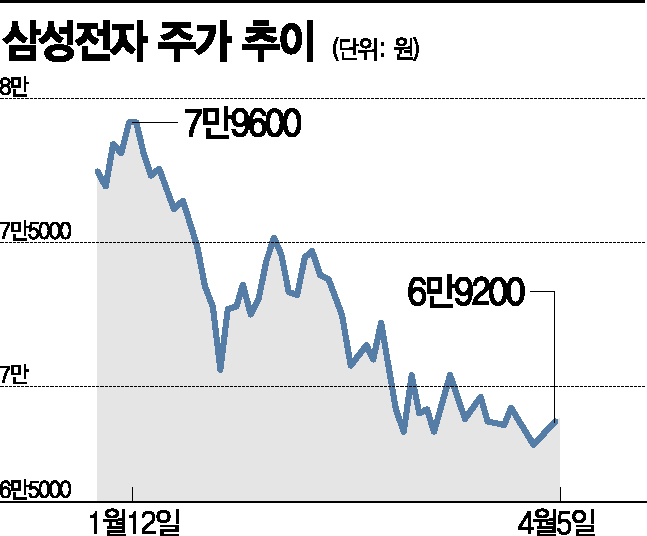
According to the Korea Exchange on the 6th, Samsung Electronics' foreign ownership ratio was 51.61% the previous day, marking the lowest this year. It had maintained an average of about 53-54% over the past two years, but has been continuously selling and reducing its stake this year. Ultimately, foreigners' continuous 'selling' has held back the stock price. Samsung Electronics closed at 69,200 won on the 5th. The stock price, which started the year in the 78,000 won range, continued to decline and broke below 70,000 won on the 8th of last month, becoming trapped in the '60,000 won electronics' range. On the 4th, it fell intraday to 68,600 won, setting a new low for the year. This is close to the 52-week low (68,300 won). The last time Samsung Electronics' stock price closed in the 68,000 won range was on October 13 last year (68,800 won).
Foreigners sold Samsung Electronics shares worth 1.0168 trillion won in the first quarter alone. The problem is that despite Samsung Electronics' strong earnings, foreigners are not expected to return. This is due to the reasons for selling. Since Samsung Electronics' fundamentals are not the reason for selling, even if earnings reach their peak and fundamentals strengthen, it is judged that foreigners will not switch to buying.
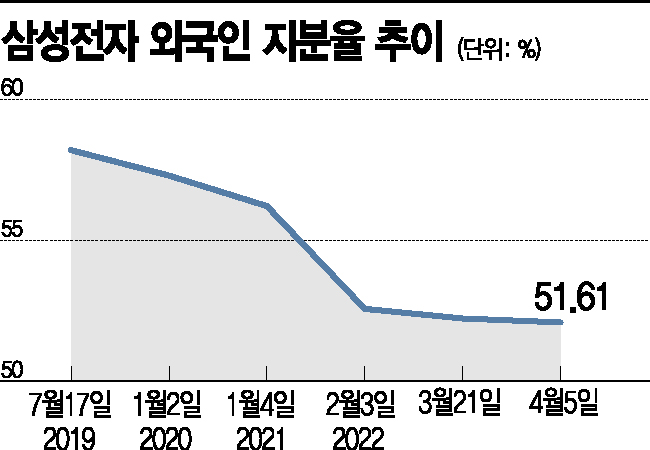
Foreigners are aggressively selling Samsung Electronics, the leading stock with a large stake, as they reduce their exposure to emerging market assets amid overlapping geopolitical risks and inflation. As a result, the foreign ownership ratio in the Korean market is also at its lowest level in the past six years. The biggest reason for foreigners leaving the Korean market is the exchange rate. Since the beginning of the year, the Federal Reserve's tightening policy has intensified, and with the outbreak of the Russia-Ukraine war, the strong dollar trend has continued. The psychological threshold of 1,200 won per dollar, considered a turning point for foreign demand in the domestic stock market, has also been broken. Ultimately, foreigners' return to Samsung Electronics depends not on 'earnings' but on a combination of 'global macro environment changes and dollar stabilization.' Kim Young-hwan, a researcher at NH Investment & Securities, pointed out, "Samsung Electronics' stock price is mainly influenced by the global semiconductor market conditions and the attractiveness of emerging markets centered on manufacturing from a global asset allocation perspective, rather than earnings."
After Samsung Electronics' Q1 earnings announcement on the 7th, the stock price may even undergo further correction. Historically, when Samsung Electronics' earnings exceeded expectations, the stock price on the announcement day tended to move in the opposite direction. Kim Jang-yeol, a researcher at Sangsangin Securities, said, "The consensus operating profit figure of around 13 trillion won for Q1 will hardly affect the stock price," adding, "If macro issues show no signs of resolution and internal issues make no concrete progress, the stock price could fall below the mid-60,000 won range in the short term." Jung Myung-ji, head of the investment information team at Samsung Securities, explained, "From the perspective of foreign investors, since Korea is an export-driven economy, when corporate value approaches its peak, foreigners tend to sell stocks first, so paradoxically, the stock price may be corrected when earnings reach their maximum."
Lee Kyung-min, head of the investment strategy team at Daishin Securities, said, "Foreigners are the main players who will lead the revaluation of the KOSPI valuation," and predicted, "If global macro environment changes and dollar stabilization coincide after the second quarter of this year, foreign investors' stance will change."
© The Asia Business Daily(www.asiae.co.kr). All rights reserved.
![Clutching a Stolen Dior Bag, Saying "I Hate Being Poor but Real"... The Grotesque Con of a "Human Knockoff" [Slate]](https://cwcontent.asiae.co.kr/asiaresize/183/2026021902243444107_1771435474.jpg)











