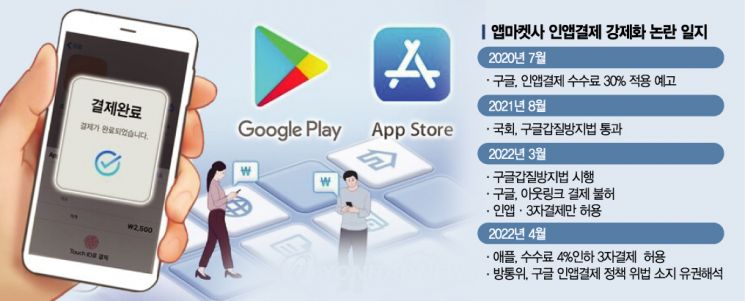
[Asia Economy Reporter Kang Nahum] As the Korea Communications Commission (KCC) issued a legal interpretation suggesting that Google's ban on in-app outlinking may violate the law, Apple has also introduced a third-party payment method that does not allow outlink payments, effectively joining the enforcement of mandatory in-app payments, raising expectations of continued controversy.
◆ Apple avoids the law using Google's method = According to industry sources on the 6th, Apple submitted detailed implementation plans of the amended Telecommunications Business Act (the Google Fair Trade Act) to the KCC at the end of last month. The plan allows app developers to choose either the existing Apple in-app payment system or a third-party in-app payment method to provide to users.
The commission fee for third-party payments is set at 26%, which is 4 percentage points lower than before and the same as the third-party payment commission fee allowed by Google. Considering card payment fees, it is more advantageous for businesses to use Apple's in-app payment system. Like Google, Apple is also attempting to circumvent domestic law.
Meanwhile, the KCC has announced plans for full-scale regulation of these global app market operators. The day before, the KCC issued a legal interpretation stating that although Google allowed third-party in-app payment methods, there is a possibility of legal violation. In particular, the ban on in-app outlinks that induce external payments was judged to fall under Article 50, Paragraph 1, Subparagraph 9 of the Google Fair Trade Act, which prohibits “acts that force a specific payment method.”
◆ KCC’s strong stance raises concerns over trade friction = The KCC plans to verify violations through on-site inspections if Google and Apple force specific payment methods, and if violations are confirmed, it will proceed to fact-finding investigations. If illegalities by Google and Apple are confirmed, these companies will have to pay fines amounting to 2% of their sales.
Concerns have also been raised that if the KCC proceeds with full-scale regulation, trade friction with the United States may occur. The U.S. Trade Representative (USTR) recently expressed concerns about the movement to legislate mandatory network usage fees by the Korean National Assembly in its “2022 National Trade Barriers Report.”
Although it appears to be involved in the lawsuit between Netflix and SK Broadband, the USTR’s stance is based on the purpose of protecting domestic companies, increasing the likelihood of its involvement in the in-app payment regulation issue, which targets domestic companies. When the Korean National Assembly proposed the Google Fair Trade Act last year, the USTR also conveyed concerns about trade friction through the U.S. Embassy, calling it “regulations targeting specific companies.”
© The Asia Business Daily(www.asiae.co.kr). All rights reserved.
![Clutching a Stolen Dior Bag, Saying "I Hate Being Poor but Real"... The Grotesque Con of a "Human Knockoff" [Slate]](https://cwcontent.asiae.co.kr/asiaresize/183/2026021902243444107_1771435474.jpg)
















