[Seoul District News] Seocho-gu Implements One-Stop Handling from Incident Response to Investigation with Police Investigator Participation in Public-Private-Police Joint Cooperation Meetings; Launches '2022 Comprehensive Child Protection Response Plan' Covering 3 Major Areas and 13 Projects Including Joint Public-Private-Police Response, Child Abuse Prevention, and Child-Centered Aftercare... Seongbuk-gu Partners with Seongbuk and Jongam Police Stations to Build Safe Living Environment... Seongdong-gu Launches ‘Children’s Experience Group’ to Learn and Enjoy in Seongsu-dong... Gangdong-gu Fully Implements 2022 Public-Private Governance Projects... Guro-gu’s ‘Challenge Makes You Youth!’
[Asia Economy Reporter Park Jong-il] Seocho-gu has launched a strong drive to create a "happy city without child abuse."
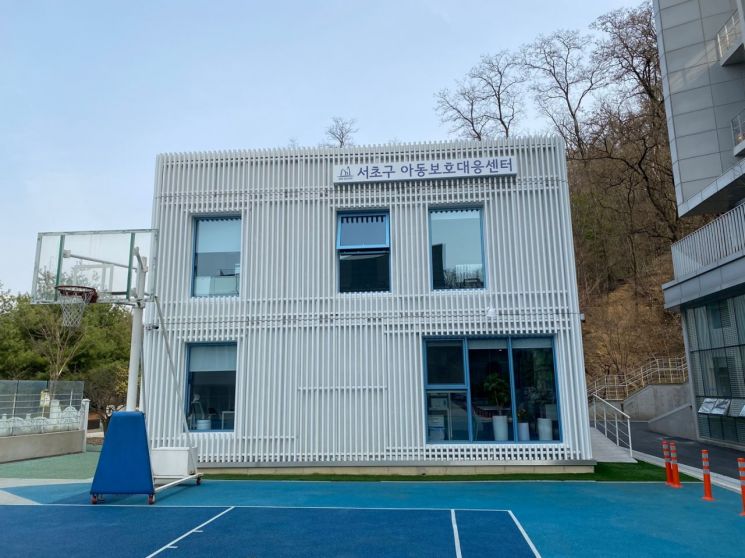
Last year, Seocho-gu established the Seocho Child Protection Response Center, the first of its kind nationwide, for joint civil-government-police response to child abuse cases. At this center, police officers with investigative authority cooperate from the early stages of cases to provide a one-stop child abuse protection response system that handles investigation and follow-up management.
Previously, child abuse cases were handled by child abuse-dedicated public officials and Abuse Prevention Officers (APO) without investigative authority, who would inspect the scene and then hold a joint civil-government-police cooperation meeting to decide whether to investigate. If investigation was deemed necessary, the APO would summarize the meeting's content and refer the case to an investigator at the police station. The investigator who received the case would then decide whether to investigate and conduct the inquiry. However, there were limitations in the investigator's ability to make accurate and prompt decisions, leading to overlapping investigations and highlighting the need to improve the existing system. During this period, the victimized child often had to remain in the home until temporary protective measures were decided.
In response, the district has arranged for investigators to be dispatched to the scene from the initial report of child abuse. To comprehensively discuss child abuse cases, investigators from the Women and Youth Violent Crime Investigation Teams of Seocho Police Station and Bangbae Police Station have been added to the joint civil-government-police cooperation meetings, which previously consisted of private counselors, child abuse-dedicated public officials, and APOs.
Specifically, in the new child abuse protection response system, when a child abuse report is received, an investigator, a child protection-dedicated public official, and an APO are dispatched to the scene to verify the facts. Subsequently, in the joint cooperation meeting involving the investigator, comprehensive discussions are held on ▲whether child abuse occurred ▲whether to initiate an investigation ▲case investigation and handling direction ▲follow-up management plans, enabling immediate investigation or case handling.
An actual example of the revamped system involved a child protection-dedicated public official and an investigator dispatched to the scene upon receiving an abuse report. They confirmed that the household had multiple prior reports of domestic violence through the investigator's authority. Based on the investigator's judgment, in-depth investigations were conducted on the child, guardian, and surrounding individuals. The victimized child was promptly separated and moved to the Seocho-gu Shelter for Abused Children. This was a case of swift response through cooperation with police officers holding investigative authority.
A district official said, "This one-stop child protection response system with active investigator participation significantly shortens the time from report to handling, enabling prompt child protection," and added, "We expect this system to become a new model for local governments."
Seocho-gu has prepared and started implementing this month the "2022 Seocho-gu Comprehensive Child Protection Response Plan," which includes three themes and 13 detailed projects: ▲strengthening joint civil-government-police response ▲enhancing child-centered follow-up management ▲strengthening preventive measures to achieve zero child abuse.
Among the new projects in this comprehensive plan, the district will organize the Child Abuse Case Review Panel more objectively and professionally. To analyze and intervene in child abuse caused by various factors from multiple perspectives, the panel will expand from seven members?including police officers, lawyers, psychological counselors, and youth counselors?to include specialists such as pediatricians and psychiatrists. This will create a pool of experts by field to strengthen case judgment and protective measures for abused children.
Seocho-gu will also incorporate 4th industrial technologies to support psychological treatment for abused children and provide child abuse prevention education. In July, it plans to introduce the nation's first "Metaverse Psychological Counseling Center" using 4th industrial technologies. This aims to encourage non-face-to-face psychological counseling via the metaverse for victimized children who are reluctant to visit or be exposed at the Child Protection Response Center, improving accessibility and convenience.
Additionally, in cooperation with the Seocho Smart Youth Center, the district will offer "Mind Kiosk" psychological tests using brainwave measurements and healing VR experiences, and conduct "Visiting Metaverse Child Abuse Prevention Education" in collaboration with educational institutions.
The comprehensive plan also includes strengthening existing child abuse prevention projects such as discovering "700 Good Stores and 1,000 Good Neighbors" for child abuse prevention, activating the mobile child abuse reporting channel "Seocho-gu Good Report Talk" using KakaoTalk, and "Visiting Daycare Center Child Abuse Prevention Puppet Shows."
Seocho-gu has been proactive in laying the foundation for child abuse prevention and response. In January last year, the district established a Child Protection Team within the district office, assigning five dedicated public officials?more than the Ministry of Health and Welfare's recommended standard of one per 50 cases. In May 2021, two medical institutions specializing in abused children, including Seoul St. Mary's Hospital, were designated. In October 2021, the Seocho Child Protection Response Center and the Seocho Shelter for Abused Children?the first in the Seoul southeastern region?were opened. In the same month, an MOU was signed between Seocho and Bangbae Police Stations to establish a rapid response system for child abuse, creating a tightly knit response system in advance.
Cheon Jeong-wook, Acting Mayor of Seocho-gu, said, "We will continue to use the Child Protection Response Center as a control tower to build a detailed child protection safety net and strive to create 'Seocho, a happy city without child abuse.'"
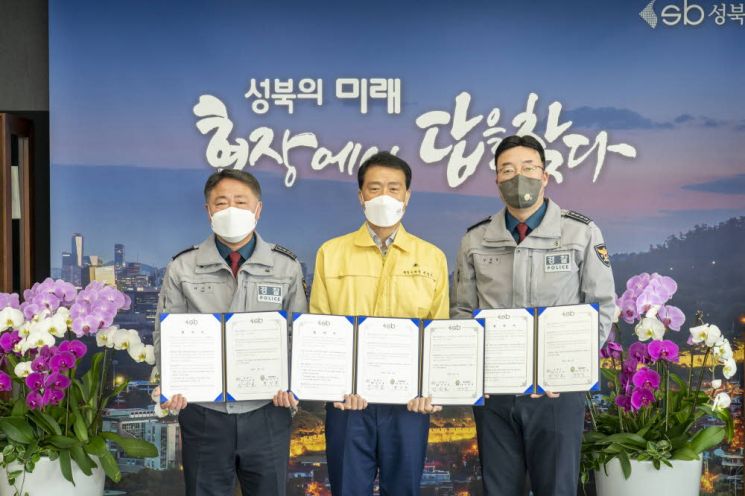
Seongbuk-gu (Mayor Lee Seung-ro) signed a business agreement on the 5th with Seoul Seongbuk Police Station (Chief Tak Ki-ju) and Seoul Jongam Police Station (Chief Kim Moon-young) to promote the "2022 Seoul City Safety Equipment Support Project" for stalking crime prevention.
This agreement concerns the "Emergency Support for Stalking Crime Victim Prevention" under the Seoul City Safety Equipment Support Project. Through this, individuals at risk of gender-based violence will be selected, and a gender violence crime prevention campaign will be conducted, establishing a close cooperation system between the district office and police stations.
The Seoul City "Safety Equipment Support Project" provides safety home sets (▲double locks ▲portable emergency bells, etc.) and stalking crime victim prevention items (▲smart doorbells ▲home CCTV, etc.) to enable the increasing number of single-person households to live in a safe environment and proactively respond to new types of gender violence such as stalking and dating violence.
Applications start in early May, and detailed information and application methods can be found later on the Seongbuk-gu website.
Lee Seung-ro, Mayor of Seongbuk-gu, said, "Seongbuk-gu will promote the Safety Equipment Support Project through close cooperation with the jurisdictional police stations (Seongbuk and Jongam Police Stations), proactively responding to crimes targeting vulnerable single-person households and stalking crimes, thereby alleviating residents' anxiety and creating a safe environment for all."
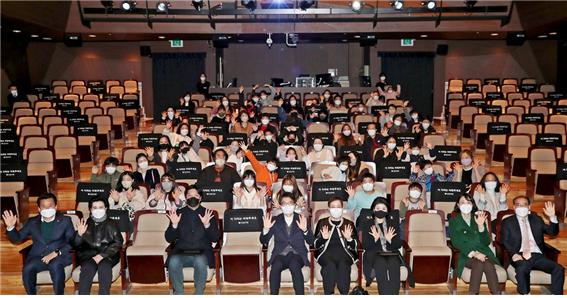
Seongdong-gu (Mayor Jung Won-oh) held the "Seongsu Urban Regeneration Children's Dream Tree Leader Group Launch Ceremony" (photo) on the 27th of last month, providing children with various content experience activities to revitalize urban regeneration.
The "Seongsu Urban Regeneration Children's Dream Tree Leader Group" (hereafter "Leader Group"), composed of 205 elementary students from Kyungdong Elementary, Kyungil Elementary, Kyungsu Elementary, and Seongsu Elementary in the Seongsu-dong area, is a group of elementary students learning and experiencing Seongsu-dong, which has been revitalized through urban regeneration projects.
The district has prepared experience-oriented programs so that children can feel the unique resources and environment of the area and grow into future talents who can engage with the local community. Activities will begin in earnest this month.
Programs include nine sequentially operated activities starting this month, such as creating works using 3D printing and 3D pens, coding programs using AI robots, and eco-friendly cooking classes using beer and food ingredient byproducts. Each program allows parents and students to participate together, and visits to the "Seongsu Urban Regeneration Industrial Innovation Space" and "Seongsu Sharing Center" will raise participation and interest in urban regeneration.
Seongsu-dong was selected as an urban regeneration pilot area in 2015, and after the successful completion of the project in 2020, a unique atmosphere blending old and new emerged, centered on policies such as "preservation and support of red brick buildings." Known as the "Brooklyn of Korea," it features a handmade shoe street, unique cafes converted from old factories, and a red brick village, all contributing to its distinctive charm.
At the launch ceremony, a donation ceremony was also held, delivering 5 million won to the World Fashion Group Korea Association. This donation includes membership fees from the Leader Group and profits from the Seongsu Urban Regeneration Cooperative, Seongsu Jiang, and will be used for social contribution projects for socially disadvantaged children through the World Fashion Group Korea Association.
Following this, a business agreement was signed among four organizations and companies?Seongdong-gu, Seongsu Jiang Cooperative, World Fashion Group Korea Association, and Reharvest?to revitalize urban regeneration in the Seongsu area. According to the agreement, Seongsu Jiang Cooperative will oversee the operation of the Leader Group, and Reharvest will cooperate in children's environmental education. They will also collaborate on the Seongsu Urban Regeneration Festival and the Yeonmujang-gil pop-up store.
Jung Won-oh, Mayor of Seongdong-gu, said, "Seongsu area is a place where the past and present coexist with the concept of red bricks and is recognized as an excellent urban regeneration case nationwide. Last month, executives from the Brooklyn Chamber of Commerce in New York visited Seongsu-dong directly. We will continue to support and strive so that Seongsu-dong, which has achieved remarkable development comparable to Brooklyn's progress, can sustain continuous growth."
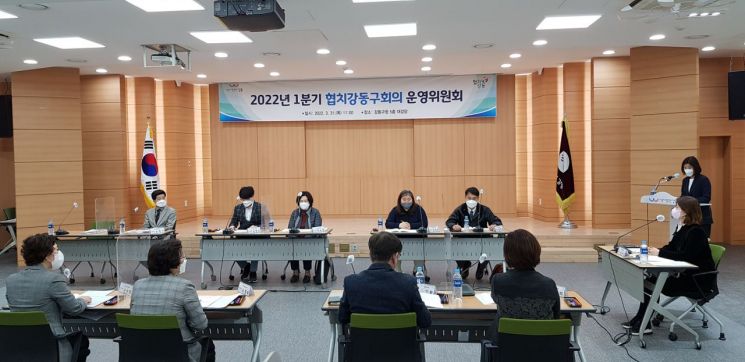
Gangdong-gu (Mayor Lee Jung-hoon) will fully implement eight projects of the "2022 Local Community Innovation Plan" through public-private cooperation starting in April.
The public-private cooperation project is an open policy operation method in which residents and administration participate together in the entire process of discovering agendas to solve local community problems, establishing policies, executing, and evaluating them to improve residents' quality of life.
Gangdong-gu enacted the "Basic Ordinance for Activating Public-Private Cooperation" in 2018, formed the "Cooperation Gangdong-gu Council," and annually establishes and implements the Local Community Innovation Plan as a public-private cooperation project.
This year's Local Community Innovation Plan was established through agenda solicitation from residents last year, visiting agenda discovery, and a deliberative public discussion process involving both public and private sectors.
Through public-private cooperation projects, the district will promote eight projects, including ▲"Workplaces that Create Happiness," which enhances self-reliance capabilities of women in vulnerable employment groups; ▲"10 Years of Observation, 10 Years of Support, 10 Years of Care," where youth companions support at-risk youth; ▲activation of culture and arts in daily life through "EAST WAVE"; ▲citizen practice for carbon neutrality 2050; ▲our neighborhood labor counseling caf?; ▲Gangdong Culture and Arts Forum; ▲an eco-friendly project "Suspicious Partner" created by generations 1 and 3 together; and ▲Resident Talk! Talk! Plaza.
Lee Jung-hoon, Mayor of Gangdong-gu, said, "This year, public-private cooperation fields have expanded further to include women's jobs, labor counseling, youth, culture and arts, intergenerational empathy, and resource circulation. We will strengthen the institutional foundation so that the value of cooperation, which revitalizes the local community while increasing residents' authority and trust in administration, can continue."
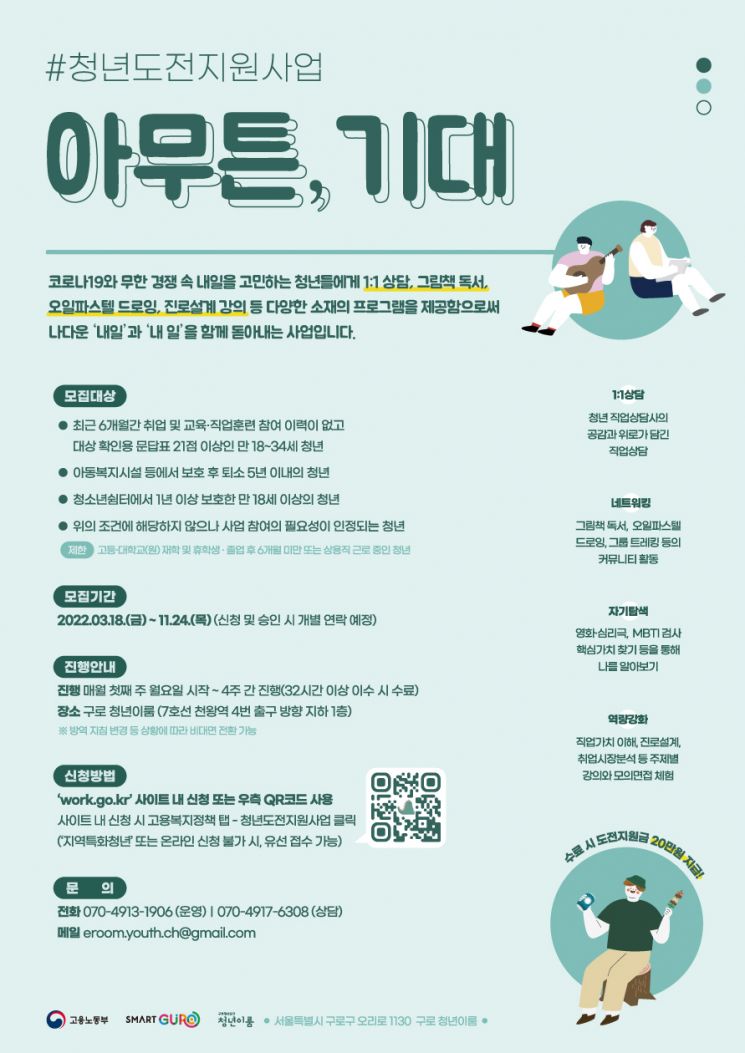
Guro-gu (Mayor Lee Sung) is implementing the "Youth Challenge Support Project" to boost the job-seeking motivation of unemployed youth and encourage employment.
Guro-gu announced on the 6th, "We have been selected for the 2022 Youth Challenge Support Project contest hosted by the Ministry of Employment and Labor, and will conduct the project for 250 youths from this month through December."
The Youth Challenge Support Project is designed to help young people who suffer anxiety due to vague job preparation by providing counseling, self-exploration, and employment competency programs to support their entry into society.
Eligible participants are ▲youth aged 18 to 34 who have no employment or education/training participation history in the past six months ▲youth who have left child welfare facilities within the last five years ▲youth aged 18 or older who have been protected in youth shelters for more than one year ▲and other youth recognized as needing support.
Participants receive individual counseling and psychological analysis. Then, they engage in self-exploration through MBTI tests, movies and psychodrama, picture book reading, oil pastel drawing, and community activities through group trekking.
Additionally, various programs are conducted over 40 hours in four weeks, including resume consulting, AI and VR mock interviews, lectures on job values, career planning, and employment market analysis.
Guro-gu will provide a challenge support fund of 200,000 won to youths who complete the program and offer follow-up support such as linking to the National Employment Support System, establishing individual employment activity plans, and connecting to the center's own employment competency enhancement programs.
The program will be held eight times at "Youth Irum," with 32 participants per session.
Applications can be made on the Worknet website, and if online application is difficult, phone applications are also possible. For offline applications, activity details, schedules, and other information, contact the Youth Irum operation team.
Youth Irum, located on the basement first floor of Cheonwang Station, is a youth job culture space offering various programs such as job counseling and youth community support.
Programs include "Sodam Sodam," a one-time counseling session with a career counselor for job-seeking youth; "Zero Base," a five-session program for self-understanding and exploration with in-depth counseling; "Customizing," which offers AI resume and interview experiences and helps draw employment roadmaps; and "Irujap," which provides VR interview training.
A Guro-gu official said, "We hope this project will be an opportunity to give strength and courage to youth whose spirits have been dampened by COVID-19," and added, "We ask related organizations to participate in recruiting candidates so that youth can understand themselves, enhance employment competencies, and enter society healthily."
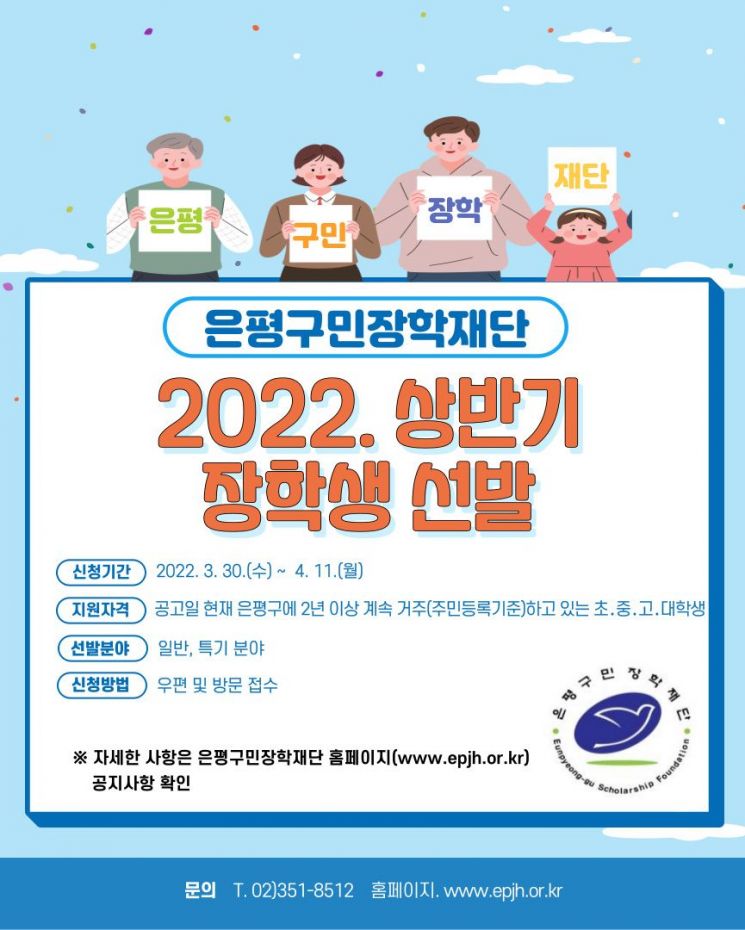
Eunpyeong-gu (Mayor Kim Mi-kyung) will select Eunpyeong-gu residents' scholarship recipients for the first half of this year targeting elementary, middle, high school, and university students to foster local talent.
The "Eunpyeong-gu Residents' Scholarship" is a scholarship program hosted by the Eunpyeong-gu Residents' Scholarship Foundation, and applications for the first half of this year will be accepted until the 11th of this month.
Applicants must be elementary, middle, high school, or university students who have continuously resided in Eunpyeong-gu for more than two years. There are two selection categories: general scholarship and special talent scholarship. The general scholarship is for university students meeting income and academic criteria, and the special talent scholarship is for elementary, middle, and high school students with award-winning achievements.
Scholarship recipients will be selected in May after evaluation based on academic performance, household income, and other criteria for each category. Results will be individually notified and posted on the foundation's website.
The total scholarship fund is 100 million won, with differentiated support of 300,000 won for elementary students, 400,000 won for middle school students, 500,000 won for high school students, and up to 2 million won for university students. If university students receive scholarships from national, school, or private sources, only the difference will be paid, and if the difference is less than 500,000 won, support will be excluded.
Applications can be submitted by mail or in person to the 3rd floor Citizen Education Division (Eunpyeong-gu Residents' Scholarship Foundation) at Eunpyeong-gu Office. Required documents include an application form with the seal of the recommending authority such as the school principal, personal information consent form, resident registration certificate or abstract, enrollment and academic transcripts, etc.
Detailed information about scholarship applications, including required documents, can be found in the notices on the Eunpyeong-gu Residents' Scholarship Foundation website.
The Eunpyeong-gu Residents' Scholarship Foundation is a public interest corporation established in September 2007. It operates scholarship projects using interest income generated from funds donated by Eunpyeong-gu and contributions from residents. Last year, it provided scholarships totaling about 245 million won to 210 students.
A district official said, "We will take the lead in creating conditions so that youth can demonstrate excellence and creativity in a stable environment and freely pursue their dreams for the future through their studies."
© The Asia Business Daily(www.asiae.co.kr). All rights reserved.



















