Professor Jo In-seon of Ajou University and Dr. Han Hyun-soo of Stanford University Joint Research
[Asia Economy Reporter Kim Bong-su] A technology that can increase the efficiency of producing hydrogen by splitting water using solar power by more than four times has been developed.
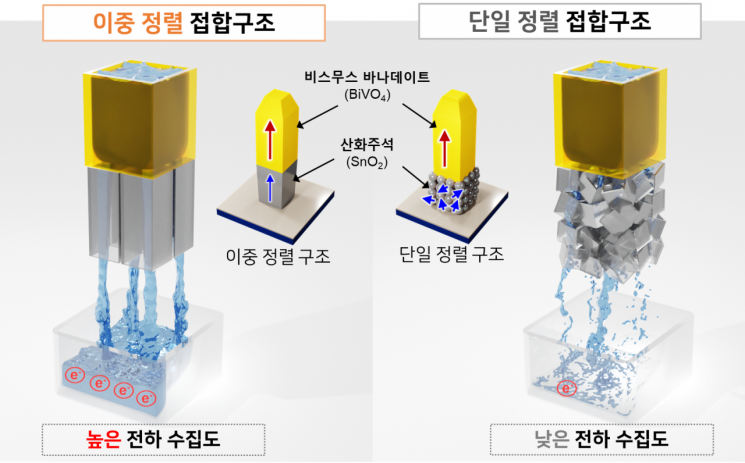
According to the Korea Research Foundation on the 5th, Professor Jo In-seon’s research team at Ajou University, together with Dr. Han Hyun-soo’s research team at Stanford University, proposed a dual-textured heterojunction photoelectrode structure and developed a photoelectrode structure with more than four times higher solar-to-hydrogen conversion efficiency compared to a single-textured photoelectrode.
The dual-textured structure refers to a structure where different materials are joined so that they have similar crystallographic orientations.
Hydrogen energy, considered the most promising energy source among next-generation renewable energies, can be obtained by splitting water using solar power with photoelectrodes. A new nanostructure that can further improve the efficiency of these photoelectrodes has been developed. Solar-to-hydrogen production technology is an eco-friendly energy technology that can produce green hydrogen from infinite and clean solar energy and water.
However, when using conventional single photoelectrode materials, the improvement of solar-to-hydrogen conversion efficiency is limited due to the absorption rate limit of light and low electrical conductivity. To overcome this, research on heterojunction technology stacking different photoelectrode materials has also been actively conducted. However, most studies have focused on stacking with random orientations without considering the crystallographic orientation of the materials or stacking in a core-shell form on nanostructures such as rods, resulting in high electron-hole recombination at the junction interface and surface, lowering charge collection characteristics and limiting performance improvement.
The research team focused on anisotropy, where material properties vary depending on the crystallographic orientation of the material. Based on this principle, they conducted research on a new dual-textured heterojunction model combining surface crystal plane control and heterojunction technology, that is, a heterojunction structure where both the upper and lower layers are aligned in specific orientations. As a result, electron-hole recombination at the junction interface was greatly reduced, charge collection was efficiently enhanced, and hydrogen evolution characteristics were dramatically improved by exposing crystal planes favorable for hydrogen evolution on the surface.
Professor Jo said, "The significance lies in proposing a new idea for heterojunction structure design that can be widely applied to energy production and storage technology devices," adding, "However, for commercialization, additional research will continue as optimization of doping concentration, heat treatment conditions, and improvement of electrode stability are necessary."
The research results were published online on February 10 in the international journal in the field of chemical engineering, the Chemical Engineering Journal.
© The Asia Business Daily(www.asiae.co.kr). All rights reserved.











