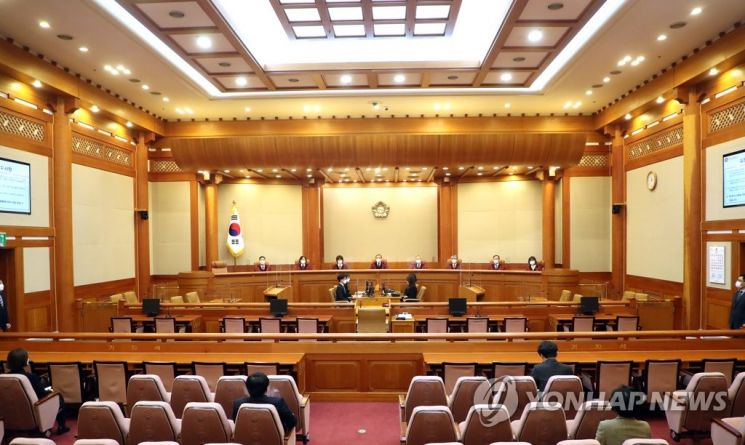
[Asia Economy Reporter Choi Seok-jin, Legal Affairs Specialist] The Constitutional Court has ruled that the provision in the Local Tax Act treating those who have effectively acquired real estate, even without registration, as acquirers subject to acquisition tax and other taxes does not violate the Constitution.
On the 5th, the Constitutional Court announced a unanimous decision by all justices in a constitutional complaint filed by Mr. A, who argued that Article 7, Paragraph 2 of the former Local Tax Act?which considers the owner or transferee of the acquired property as the acquirer even if registration is not made under the Civil Act?violates property rights.
The Court stated in its ruling, "The part of Article 7, Paragraph 2 of the former Local Tax Act concerning 'effective acquisition of real estate' does not violate the Constitution."
In March 2014, Mr. A signed a contract to purchase a 733.7㎡ (approximately 222 pyeong) plot of land in Yuseong-gu, Daejeon Metropolitan City, from Korea Land and Housing Corporation (LH) for 1,465,550,000 KRW. By May 2016, he had paid 1,464,078,500 KRW of the purchase price and installment interest, leaving only 4,484,150 KRW unpaid, which is about 0.3% of the total price.
Since Mr. A had not completed the payment balance, he did not register the land ownership. In March 2018, he entered into a contract to transfer his land purchase rights to Mr. B for 1,450,000,000 KRW.
The Yuseong District Office of Daejeon City determined that Mr. A had effectively acquired the land and imposed taxes totaling approximately 91 million KRW on April 13, 2018, including acquisition tax of about 81 million KRW, local education tax of about 6.9 million KRW, and special rural tax of about 3.4 million KRW.
Mr. A filed a lawsuit in May 2018 requesting cancellation of the tax imposition, arguing that since he had not registered the land ownership and only transferred the purchase rights, under the formalistic system of Korean Civil Law?which requires registration or other public notice methods for changes in real estate rights?he could not be considered the land owner or transferee.
During the lawsuit, he requested a constitutional review of the Local Tax Act provision that formed the basis of the tax imposition. When the court rejected this request, he filed a constitutional complaint with the Constitutional Court in 2019.
The disputed Article 7, Paragraph 2 of the former Local Tax Act (Taxpayer, etc.) states: "Even if registration or other registration under relevant laws such as the Civil Act, Automobile Management Act, Construction Machinery Management Act, Aviation Safety Act, Ship Act, Tree Law, Mining Act, or Fisheries Act is not made, acquisition of real estate, etc., shall be deemed to have been acquired if effectively acquired, and the owner or transferee of the acquired property shall be regarded as the acquirer. However, this applies only to succession acquisition in the case of vehicles, machinery equipment, aircraft, and ships built to order."
Mr. A filed a constitutional complaint against the entire Article 7, Paragraph 2 of the former Local Tax Act, but the Constitutional Court limited the scope of review to the part concerning effective acquisition of real estate, judging that the constitutional issue was about the provision deeming one as an acquirer by law even without registration if effective acquisition occurred.
Mr. A claimed that the provision violated the constitutional principle of clarity and infringed on his property rights.
Specifically, he argued that since the provision determines the obligation to pay acquisition tax?a burdensome regulation?stricter clarity is required. However, the provision imposes tax on effective acquisition of real estate without clear standards on what constitutes effective acquisition or how much payment must be made to be recognized as effective acquisition despite unpaid balances.
However, the Constitutional Court's judgment differed.
First, the Court ruled that the provision does not violate the principle of clarity in tax requirements.
The Court cited past rulings, stating, "Although provisions related to changes in real rights under tax law basically borrow concepts from the Civil Act, the principle of substantive taxation means they do not have to coincide exactly with Civil Act provisions. The timing of transfer or acquisition of goods under tax law can be separately stipulated from the timing of changes in real rights under the Civil Act." While ownership under the Civil Act requires registration, tax law may apply different standards for taxation purposes.
The Court also referenced Supreme Court rulings, noting, "Acquisition tax is a type of turnover tax that captures the fact of transfer of goods itself and imposes tax based on the taxable capacity therein. It is not imposed based on whether the acquirer obtains full ownership rights in substance, but rather on the effective acquisition act itself."
The Court explained, "Article 6, Item 1 of the Local Tax Act does not define acquisition but merely lists acquisition methods illustratively, assuming all acquisitions?original, succession, or gratuitous or onerous?as acquisitions under the Local Tax Act. Lexically, 'acquisition' means making something one's own, and 'effective' means the actual or current state."
It further clarified, "Therefore, 'effective acquisition' of real estate in the disputed provision means that even without registration under the Civil Act, in the case of a sale, the buyer has completed payment and is in a state where they can acquire ownership at any time and use and benefit from the real estate."
Finally, the Court concluded, "It is not difficult for a reasonable person with common sense and ordinary legal awareness to predict what 'effective acquisition of real estate' means in the disputed provision. It is also not an unclear concept subject to arbitrary interpretation or application by law enforcement agencies. Therefore, the provision does not violate the principle of clarity in tax requirements."
The Court also found that the provision does not violate the principle of proportionality or infringe on Mr. A's property rights.
The Court pointed out, "If acquisition tax is not imposed simply because formal requirements such as registration are not met, despite having met substantive requirements such as payment, there is a high possibility that taxpayers may indefinitely delay tax payment or evade tax by reselling to others without completing formal requirements, thus evading tax obligations."
It added, "Imposing acquisition tax on transferees who have effectively acquired ownership under the disputed provision is to realize tax fairness and justice. Even if acquisition tax is paid before formal ownership acquisition requirements are met, the restriction on property rights is not significant compared to the public interest. Therefore, the provision does not violate the principle of proportionality or infringe on the complainant's property rights."
This decision marks the Constitutional Court's first ruling on the constitutionality of the former Local Tax Act provision that treats those who have effectively acquired real estate without registration under the Civil Act as acquirers of the property.
© The Asia Business Daily(www.asiae.co.kr). All rights reserved.

















