[Seoul District News] Dobong-gu to Open Shared Office Space (12 Seats) for Startup Teams, Social Economy Enterprise Offices (8 Rooms), and Photo Studio for Live Commerce on April 1; Recruitment for Startup Teams and Social Economy Enterprises Starts March 31... Gwanak-gu Aims to Complete Gwanak Senior Center with 19,59.66㎡ Floor Area and 3 Floors by 2023 with Total Budget of 9.428 Billion Won... Gangbuk-gu to Establish Campus Towns at Sungshin Women’s University and Hanshin University... Dongjak-gu to Greatly Expand Government Office Area with ▲Small Library ▲Multipurpose Room ▲Large...
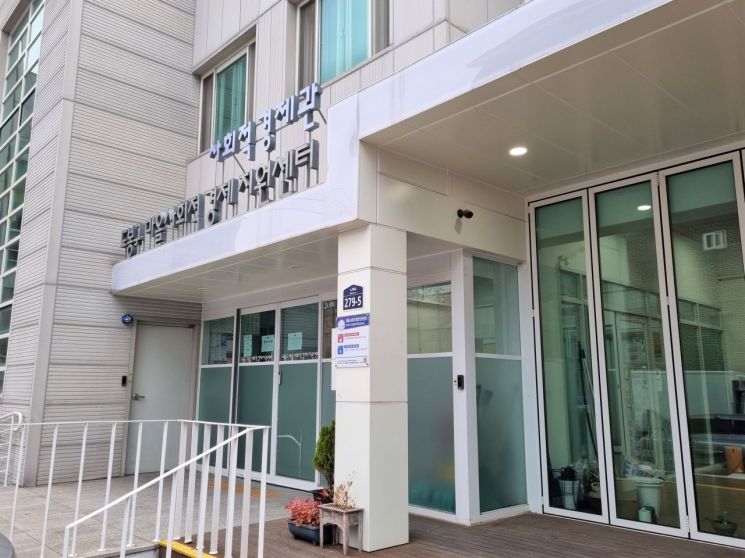
[Asia Economy Reporter Park Jong-il] Dobong-gu (Mayor Lee Dong-jin) Village Social Economy Support Center (279-5 Nohae-ro, Chang-dong) has completed its renovation as a specialized space for social economy and opened its doors on the 1st under the new name 'Dobong-gu Village Social Economy Support Center Social Economy Hall.'
The existing Dobong-gu Village Social Economy Support Center served as an intermediary support organization in the fields of village, autonomy, and social economy, providing integrated support for projects such as 'village creation,' 'social economy establishment,' and 'resident autonomy council support.'
Dobong-gu transformed this space into a dedicated area for social economy support called the 'Social Economy Hall,' newly equipped with 12 seats of 'shared office space' for startup preparation teams interested in social economy entrepreneurship, and 8 'resident offices' (five rooms of 11㎡ and three rooms of 20㎡) for companies that have completed startup as social economy enterprises.
Additionally, a 'photo studio' capable of promotional photo shoots and live commerce was established to support social economy companies in securing online sales channels.
Recruitment for tenants of the 'shared office space' and 'resident offices' within the Social Economy Hall will be announced from the 31st of last month on the Dobong-gu Village Social Economy Support Center blog and the Dobong-gu Office website.
Mayor Lee Dong-jin of Dobong-gu stated, "We hope that the newly introduced Social Economy Hall will become a cradle of Dobong social economy, which pursues 'people-centered consumption, warm consumption,' and a stepping stone for enterprises."
The village and autonomy sectors of Dobong-gu Village Social Economy Support Center will be specially operated at the 'Dobong-gu Village Social Economy Support Center Village Autonomy Hall,' known as 'Everyone's Village Vitality Center' (227 Nohae-ro). 'Everyone's Village Vitality Center' also opened on April 1st, the same day.
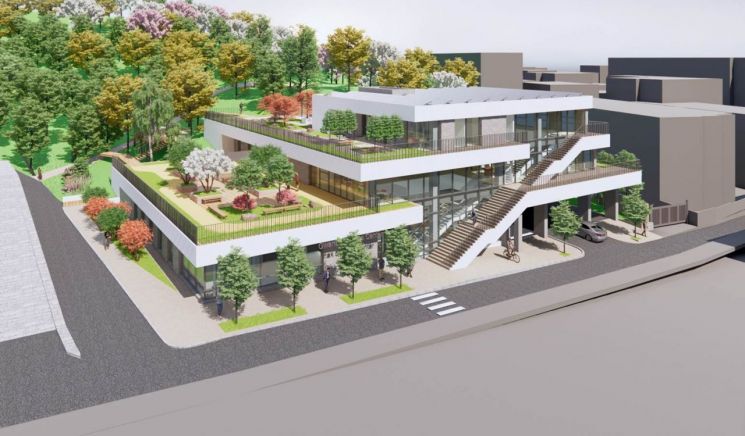
Gwanak-gu (Mayor Park Jun-hee) is making smooth progress in constructing the 'Gwanak Senior Citizens' Hall and 50 Plus Center' (95 Gwanak-ro 5-gil) in preparation for a super-aged society.
Gwanak-gu ranks fifth among Seoul's autonomous districts in terms of population aged 65 and over, and the need for senior welfare facilities has been raised to ensure that elderly residents can enjoy welfare services without inconvenience as the district approaches a super-aged society.
Accordingly, since May last year, the district has been promoting the '(tentative name) Gwanak Senior Citizens' Hall and 50 Plus Center Construction' to support seniors' hobbies and leisure activities and to activate social participation activities for middle-aged people before and after retirement.
After passing the Seoul City Urban Park Committee review in October last year and obtaining building permits and demolition reviews in January this year, related approval procedures have proceeded smoothly, accelerating the project with a goal of completion in 2023.
As of April, demolition of the existing Gwanak-gu Community Center building, which has aged over 35 years since completion, has begun. The new building will be constructed with a total project cost of 9.428 billion KRW, consisting of three above-ground floors and a total floor area of 1,959.66㎡.
Based on the winning design proposal expressing 'connection between park and building,' the center will improve the space previously separated by fences and retaining walls by utilizing the characteristics of the park site.
Main facilities include a first floor with a senior citizens' tailored counseling and program room, a large auditorium, and a village caf? as a meeting place for residents. The 50 Plus Center on the second and third floors will have a media education room, open shared spaces, club rooms, counseling rooms, offices, and an auditorium.
In particular, a 20-pyeong (approx. 66㎡) fitness room will be installed on the first floor senior center, equipped with table tennis tables and exercise equipment to promote seniors' health. The large auditorium will have approximately 150 to 180 seats, and the media education room will have 30 seats, available for both 50 Plus Center trainees and local residents.
A district official said, "Considering the district's characteristics, which is expected to soon enter a super-aged society, we are doing our best to build the 'Senior Citizens' Hall and 50 Plus Center' complex. We will successfully establish and actively operate the center to provide broad, customized welfare services that encompass various generations."
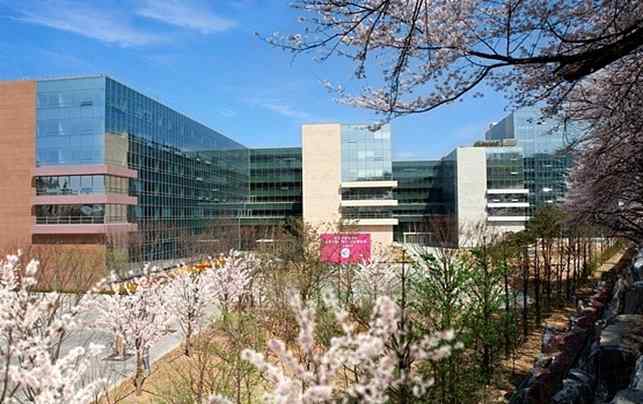
Gangbuk-gu (Mayor Park Kyum-soo) is collaborating with Sungshin Women's University and Hanshin University to create a 'Campus Town.'
A 'Campus Town' is a project aimed at ▲promoting youth activities ▲activating youth entrepreneurship ▲enhancing commercial district and regional cooperation, where universities, youth, and local residents coexist and build a regional community.
Sungshin Women's University and Hanshin University were selected as participants in the 4th phase of the Campus Town public contest last August, and each university is expected to receive 400 million KRW in project funds this year.
First, Sungshin Women's University will promote the 'Sungshin-Suyu Cultural Arts Campus Town Project' by linking human and material resources between the university and local community.
Main project contents include ▲cultural arts community creation 'Ojakgyo Project' ▲traditional market revitalization 'Suyu Hyangyu' ▲cultural arts startup support 'Suyu Arts Startup Village.'
Hanshin University aims to revitalize the local economy through the project 'Gangbuk-type Regional Revitalization Created by Local Youth: Creation (Startup) + Coexistence.'
Main goals are ▲enhancing learning capacity and marketing for small business owners and self-employed ▲strengthening civic power through establishing an open local university ▲building on- and offline infrastructure for regional revitalization ▲activating governance through public-private-academic cooperation.
The total project period is three years, with Seoul City, Gangbuk-gu, and the universities (Sungshin Women's University and Hanshin University) planning to establish annual project plans and sign agreements.
Mayor Park Kyum-soo of Gangbuk-gu said, "With the creation of this Campus Town, outstanding talents from each university will build a regional community together with residents. The district will work with Sungshin Women's University and Hanshin University to develop substantial programs and strive for regional revitalization."
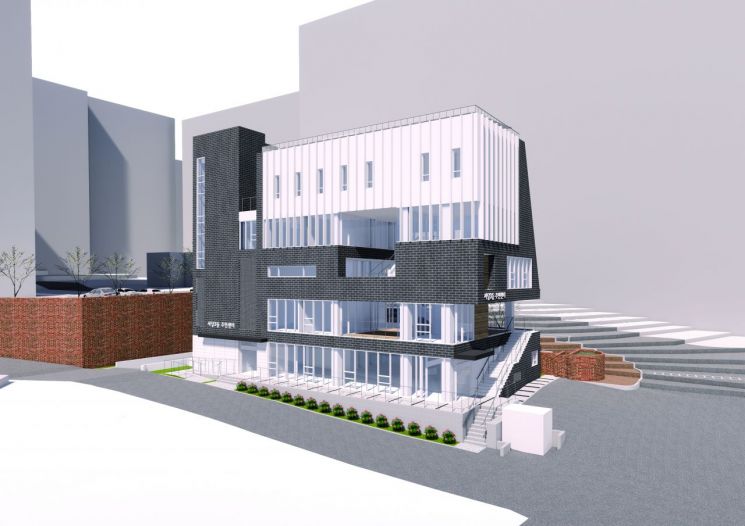
Dongjak-gu (Mayor Lee Chang-woo) began construction of new resident centers in Sadang 3-dong and Sangdo 2-dong, which were built 30 years ago, on March 29 and 30 respectively, expanding convenience facilities for residents.
The district has been implementing the 'Dong Resident Center Reconstruction Project' through annual plans to improve the aging environment of the resident centers, which are the closest administrative institutions to residents' daily lives.
In particular, the Sangdo 2-dong Resident Center, built in 1987, had a total floor area of 636㎡, making it the second smallest among local resident centers. However, due to continuous population inflow, administrative demand has greatly increased, making expansion inevitable.
Therefore, it was decided to create a complex facility combining the Sangdo 2-dong Resident Center and a cultural center as a public contribution facility provided by the Sangdo Hyundai Metro Center Park regional housing project, and reconstruction has been underway since 2020.
The Sangdo 2-dong Resident Center will be constructed at 373-1 Sangdo-dong with a total floor area of 4,183㎡, aiming for completion in January 2023. As a complex building, the resident center will occupy floors 1 to 4, the cultural center floors 6 to 9, and shared spaces such as an underground parking lot and a large auditorium on the 5th floor will be used by both.
Also, the Sadang 3-dong Resident Center, built in 1991, will be newly constructed on the existing site at 169-12 Sadang-dong with a total floor area of 1,810㎡ and 5 floors above ground plus one basement floor, scheduled for completion in November 2023.
The new building will be over 1,000㎡ larger than the existing center and will significantly expand resident spaces such as a resident autonomy program room, a small library, a multipurpose room, a large auditorium, and an underground parking lot.
Meanwhile, the district emphasized reflecting residents' needs by conducting a 'Resident Hope Facility Survey' from the planning stage of both buildings and including local residents in advisory meetings.
They also plan to thoroughly manage construction site safety until the new buildings are completed to ensure smooth progress. For detailed information about the project, inquiries can be made to the Autonomous Administration Division.
Mayor Lee Chang-woo of Dongjak-gu said, "During the 6th and 7th elected terms, we expanded four resident centers, and plans are underway for new buildings in Sadang 2-dong and Sadang 4-dong. We are preparing to build these not just as administrative offices but as open spaces for residents to enjoy, raising the quality of administrative services."
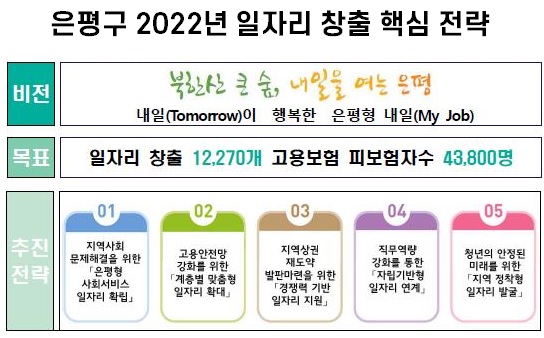
Eunpyeong-gu (Mayor Kim Mi-kyung) is set to actively implement the 2022 job creation plan with a target of creating 12,270 local jobs this year.
Under the vision 'Eunpyeong-type Tomorrow Happy Tomorrow,' the district will discover and promote Eunpyeong-type jobs to revitalize the local economy. The total project budget for this year is 104.4 billion KRW, covering 162 projects.
The district has established the '2022 Job Creation Detailed Plan' in accordance with the Local Job Target Disclosure System and posted it on the district website and the Ministry of Employment and Labor's regional employment information network.
The 'Local Job Target Disclosure System' is a system under Article 9-2 of the Framework Act on Employment Policy, where local government heads announce job creation targets and measures during their term. It helps verify and evaluate performance to enhance local job policy capabilities and contribute to job creation.
Eunpyeong-gu's main strategies for this year are fivefold: ▲Establishing 'Eunpyeong-type social service jobs' to solve local social issues ▲Expanding customized jobs by class to strengthen employment safety nets ▲Supporting competitive jobs to lay the foundation for local commercial district revival ▲Linking self-reliant jobs through job competency enhancement ▲Discovering local settlement-type jobs for youth's stable future.
Last year, the district focused on job creation and succeeded in creating 14,487 jobs, achieving 127% of the initial target of 11,400 jobs.
As of December last year, Eunpyeong-gu's population was 473,307 across 214,711 households. The economically active population aged 15 and over totaled 428,027, with the 15-34 age group comprising 25%, the highest proportion.
A district official stated, "In preparation for the post-COVID-19 era, we will continuously promote policies to revitalize the local economy, such as supporting small business owners for commercial district revival and providing employment support through vocational training."
© The Asia Business Daily(www.asiae.co.kr). All rights reserved.



















