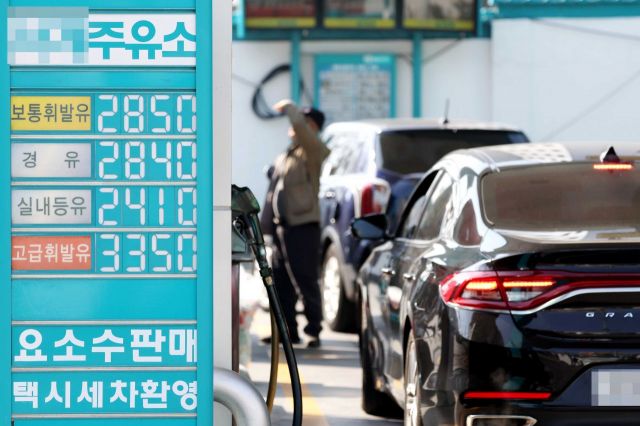
 On the 3rd, fuel price information is displayed at a gas station in Seoul, where domestic gasoline and diesel prices continue to soar due to the sharp rise in international oil prices. Photo by Mun Honam munonam@
[Asia Economy Reporter Oh Hyung-gil] "Control the Oil Prices"
Although domestic oil prices, which surged last month, have recently shown signs of stabilization, attempts to control oil prices are expected to continue. Attention is focused on whether oil prices will drop further in April.
According to Opinet on the 3rd, the nationwide average gasoline price is currently recorded at 1,994 KRW per liter. Over the past week, oil prices have fallen below 2,000 KRW. Since dropping from 2,000 KRW per liter on the 29th of last month to 1,999 KRW on the 30th, prices have shown a continuous decline for a week.
This decline is understood to be due to the fall in international oil prices influenced by the U.S. announcement of additional strategic petroleum reserve releases and the strengthening of lockdown measures in Shanghai, China, which pulled down domestic prices.
In addition, measures to control oil prices, such as reducing the fuel tax, are also expected. The government is strongly considering expanding the fuel tax reduction rate from the existing 20% to 30% at the price-related ministers' meeting scheduled for the 5th.
Deputy Prime Minister and Minister of Strategy and Finance Hong Nam-ki stated at the Emergency Economic Central Countermeasures Headquarters meeting on the 31st of last month, "We are in the final stages of reviewing whether to expand the fuel tax reduction rate," adding, "We will finalize and announce additional measures, including expanding the scope of items subject to the allocation tariff, at next week's price-related ministers' meeting."
Since the Presidential Transition Committee (Insoo-wi) has also requested an expansion of the fuel tax reduction rate, it is highly likely that the rate will be lowered to the legal limit. Choi Sang-mok, the economic division chief of the Insoo-wi, said on the 31st of last month, "Due to the recent rise in oil prices, gasoline exceeds 2,000 KRW per liter," and requested, "Please further reduce the fuel tax reduction rate from 20% to 30% to alleviate the price burden even slightly."
If the fuel tax reduction rate is expanded from 20% to 30%, gasoline taxes will decrease by 82 KRW compared to now. If the reduction rate is expanded to 30%, the tax on gasoline per liter will drop to 574 KRW. This means a reduction of 246 KRW compared to before the fuel tax cut and 82 KRW more than when the 20% reduction rate was applied.
There are also claims that the elastic tax rate applied to the transportation tax portion of the fuel tax (529 KRW) should be reverted to the statutory tax rate (475 KRW), resulting in an additional reduction of about 7 percentage points.
In particular, an increase in fuel subsidies paid to freight truck drivers, who have been burdened by the recent sharp rise in diesel prices, is also under consideration. The fuel subsidy system, introduced in June 2001, partially or fully compensates for the amount corresponding to the fuel tax increase for commercial freight trucks. However, since the subsidy amount is linked to the fuel tax, subsidies decrease when the fuel tax is reduced, potentially causing losses for freight truck drivers.
Insoo-wi Vice Chairman Kwon Young-se said on the 29th of last month, "The sharp rise in diesel prices threatens the livelihoods of the entire logistics industry, especially freight truck drivers and small business owners," adding, "The government is reviewing measures to stabilize prices for ordinary citizens, including extending and expanding the fuel tax reduction. However, since the diesel price surge is likely to continue, it is necessary to consider additional support measures for ordinary citizens and small business owners beyond the uniform fuel tax reduction."
© The Asia Business Daily(www.asiae.co.kr). All rights reserved.

















