Kyunghyong Distributes 2022 Collective Bargaining Checkpoints
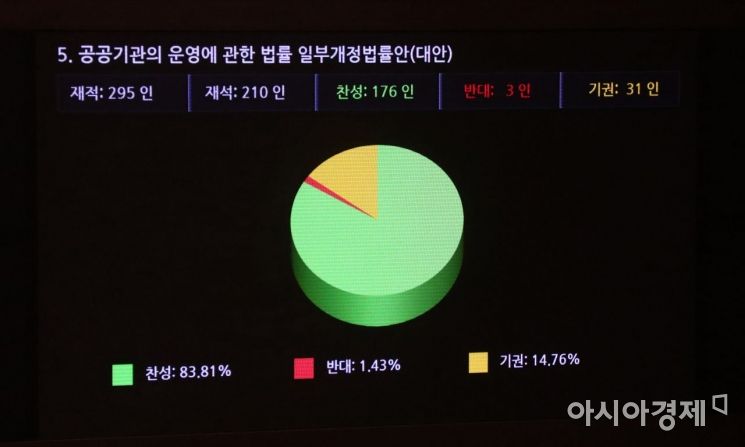 The voting results when the partial amendment bill (alternative) to the Act on the Operation of Public Institutions, which includes the introduction of the 'Public Institution Labor Director System' in December 2020, passed the plenary session of the National Assembly / Photo by Yoon Dong-joo doso7@
[Asia Economy Reporter Choi Dae-yeol] The Korea Employers Federation (KEF) announced on the 3rd that it has compiled key issues likely to become major points of contention in this year's collective bargaining between labor and management and informed its member companies and other major firms. KEF predicted that wage increases, management performance bonuses, expansion of welfare benefits, wage system reform, employment stability, union activities such as working hour exemptions (time-off), the status of the primary contractor as a party to collective bargaining, and the labor director system will be important topics in this year's collective agreements.
Regarding the wage system, KEF advised reducing excessive seniority-based pay while establishing measures that reflect corporate performance and individual achievements. It also recommended reforming wage and personnel systems to focus on job roles and performance. KEF emphasized that matters related to employment adjustments and total employment guarantees fall under the exclusive authority of employers and are therefore not subject to mandatory bargaining. It also added that when promoting voluntary retirement, cooperation measures with employees are necessary.
Union activities should, in principle, be conducted outside working hours without pay, and exemptions from working hours should be limited to tasks stipulated by the Labor Union Act, with exempted personnel primarily performing those tasks. The distribution also included that operating expenses that would undermine union autonomy should be borne by the union, and that non-company personnel must obtain prior approval before entering the workplace. KEF explained that even if a union composed of subcontractor employees demands collective bargaining with the primary contractor, there is no legal obligation to comply. The union activities of subcontractor employees are restricted by facility management rights.
Guidelines related to the labor director system, introduced mainly in some local public enterprises, were also provided. KEF stated, "Matters related to the election of executives, participation in board composition, and corporate social responsibility should, in principle, not be discussed in collective bargaining." It further explained, "Even when labor directors are appointed in public enterprises and quasi-governmental agencies, matters concerning labor directors should, in principle, not be discussed in collective bargaining."
From the 4th to the 22nd, KEF will hold briefing sessions with 15 local KEF branches to share strategies for responding to this year's collective bargaining agreements. The organization expressed hope that "by establishing a rational foundation for collective bargaining, it will contribute to establishing basic order in industrial sites and fostering a cooperative labor-management culture."
© The Asia Business Daily(www.asiae.co.kr). All rights reserved.
![Clutching a Stolen Dior Bag, Saying "I Hate Being Poor but Real"... The Grotesque Con of a "Human Knockoff" [Slate]](https://cwcontent.asiae.co.kr/asiaresize/183/2026021902243444107_1771435474.jpg)
















