Court: "Statute of limitations starts from the time the disciplinary cause occurs... Not subject to discipline"
[Asia Economy Reporter Heo Kyung-jun] The Supreme Court has ruled that it is unfair to impose disciplinary action on cases where the three-year statute of limitations for disciplinary action under the Military Personnel Act has passed.
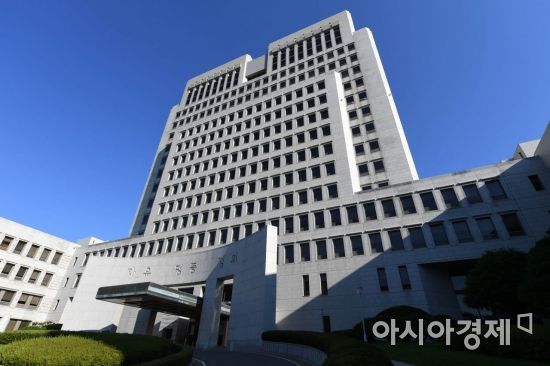
The Supreme Court's First Division (Presiding Justice Kim Seon-su) announced on the 3rd that it overturned the lower court's ruling, which dismissed the appeal in the case where Sergeant A, an administrative supply officer of an Army unit, filed a lawsuit against his division commander to confirm the invalidity of disciplinary action, and sent the case back to the Seoul High Court.
In June 2015, Sergeant A drove about 2 km in a state of severe intoxication with a blood alcohol concentration of 0.139% and collided with another vehicle. In October of the same year, the court finalized a summary order imposing a fine of 4 million won.
The issue was that Sergeant A did not disclose his status as an active-duty soldier from the time of the incident until the disposition was finalized, nor did he report this fact to his unit commander. Sergeant A violated the "Army Regulation Reporting Clause," which stipulates that if a criminal disposition is made by civilian prosecutors and courts, it must be immediately reported to the direct commanding officer who has disciplinary authority.
Upon learning of this, the Board of Audit and Inspection notified the division commander of Sergeant A's unit about his criminal record, and the division commander, following the recommendation of the disciplinary committee in December 2019, imposed a three-month suspension for violation of the duty of obedience (failure to follow orders) due to the failure to report. Ultimately, Sergeant A filed a lawsuit claiming that there was no ground for disciplinary action since the three-year statute of limitations for disciplinary action under the Military Personnel Act had passed.
The first and second trials rejected Sergeant A's claim. The courts ruled that "the disciplinary reason for violating the Army Regulation Reporting Clause is recognized, and the statute of limitations for disciplinary action does not start until Sergeant A reports the confirmation of the summary order to the disciplinary authority, so the statute of limitations has not passed." Since Sergeant A did not report initially, the starting point for the statute of limitations should be from 2019 when the criminal disposition was reported.
However, the Supreme Court's judgment was different. It stated that since the disciplinary reason occurred at the time of the failure to report, the statute of limitations should also be calculated from that point.
The court said, "In principle, the statute of limitations for disciplinary action starts from the time the disciplinary reason occurs, and it cannot be considered to start from when the disciplinary authority becomes aware of the disciplinary reason," and sent the case back for retrial by the second trial court.
© The Asia Business Daily(www.asiae.co.kr). All rights reserved.

















